
- Ptolemy’s ‘Geocentric Concept’ states that “The Earth is at the center of the universe and the Sun and other planets revolve around it.”
- ‘Copernicus’ refused Ptolemy’s concept and propounded the ‘Heliocentric Concept’, which means that the “The Sun is at the center of the universe and the Earth and other planets revolve around the sun.” so by this way Copernicus was called the ‘Father of Modern Astronomy’.
- In 16th century, Kepler discovered the laws of planetary motion and consider that the Sun is in the center of the planetary orbit.
- ‘Herschel’ in 1805 said that the Earth, Sun and other planets are only a part of the galaxy.
- , Edwin Hubble in 1920 gave evidence that the expansion of the universe is still continuing, on the basis of the increasing distance between the galaxies.
Galaxy and Nebula
- The formation of a galaxy begins with the accumulation of huge clouds made of hydrogen gas. This is called a ‘nebula’.
- When the nebula grow, clusters of gas developed, the clusters grew and became dense gaseous bodies from which stars get formed.
- The stars, dust particles and gases bound under the force of gravity is called a ‘galaxy’.
- Various types of radiation comes out from the galaxy, these include infrared rays, gamma rays, radio waves, X-rays, visible light and ultraviolet waves etc.
- ‘Milky Way’ galaxy in which our solar system is located. Milky Way’ galaxy look spiral in shape, and a member of a large group of many galaxies, which is called the local group.
Origin and Evolution of Star
- The lifespan of stars is very long which passes through various stages. Which are are as follows:
- When the gravity of the gases and dust particles/clouds present in the universe, nuclear fusion starts in the center of the galaxy and new stars are formed due to the conversion of hydrogen into helium. These clouds are called ‘stellar nurseries’.
- Due to the hydrogen cloud in the galaxy grows large, the gaseous body starts shrinking due to the effect of gravity, which is the initial form of the birth of a star. This is called a ‘protostar’.
- When the protostar shrinks, the process of conversion of hydrogen into helium begins due to the increase in the number of collisions of atoms in the gas clouds. In this state, the protostar becomes a ‘full star’.
- Due to the conversion of hydrogen in the outer shell of the star into helium, the intensity of energy radiation decreases and its colour changes to red. The star in this stage is called ‘Red Giant Star’.
- If the mass of a star is less than or equal to the mass of the Sun (Chandrasekhar Limit), then it transforms from a red giant into a ‘White Dwarf’ and ultimately into a ‘Black Dwarf’.
- If the mass of the star is more than or many times more than the mass of the Sun, then the intermediate layer of the star collapses at the centre of the star due to gravity. The energy released from this destroys the upper layer of the star and a terrible explosion occurs which is called ‘Supernova Explosion’.
- After the supernova explosion, that star turns into a ‘neutron star’ and then into a ‘black hole’.
Chandrashekhar Limit
- S. Chandrasekhar was an American astrophysicist of Indian origin, formulated a theory about the life stages of white dwarf stars.
- 1.44 solar masses is the upper limit of the mass of a white dwarf. This is called the’Chandrasekhar limit’.
- S. Chandrasekhar and ‘W.A. Fowler’ jointly awarded for the Nobel Prize in Nuclear Astrophysics in 1983 .
Neutron Star
- Neutron stars are formed from the central part left after the supernova explosion, which is of very high density.
- Stars made of neutrons revolving at high speed are called ‘neutron stars’.
- All the parts of a neutron star are organized in the form of neutrons. They emit intense radio waves.
- Neutron stars are also called ‘pulsars’.
Black Hole
- A black hole is a place in space where the gravity is so high that light cannot reflect or any object cannot escape from there. It cannot be seen even with a telescope.
- The existence of a black hole is confirmed by the deviation of the path of light.
- A black hole can be formed when the mass in a neutron star gets concentrated at one place or it is dying.
- A black hole can be big or small in size. Small black holes can be as small as an atom but their mass is very high.
- Stars whose mass is more than three times the mass of the Sun disintegrate and ultimately turn into a black hole.
Asterism
- A group of stars arranged in a definite shape is called a ‘Nakshatra’. Their number is believed to be 27. (Indian sages have also imagined a 28th Nakshatra ‘Abhijit’.)
- Some important Nakshatras are Hasta, Visakha, Shravan, Dhanishtha, Megha, Ardra, Anuradha, Rohini etc.
- Nakshatra day- The time between two successive passes of a particular Nakshatra above the meridian is called Nakshatra day. It is of 23 hours, 56 minutes.
Pole Star
- The star located on the North Pole is called the ‘Pole Star’. It always remains at the same place in the sky. It is a member of the ‘Little Bear Star Group’.
Meteorites and meteoroids
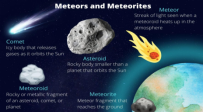
- These are extremely tiny cosmic bodies moving at high speed in space. When these bodies made of dust and gas enter the atmosphere, they come towards the earth rapidly due to the gravity of the earth and start shining due to burning due to atmospheric friction. These are also called shooting stars. Usually these burn and get destroyed before reaching the earth and are called meteors. But some bodies donot burn completely due to the friction of the atmosphere and fall on the earth in the form of rocks which are called meteorites.
Comets
- These are bodies of celestial dust, ice and icy gases, which reside in cold and dark areas away from the Sun. They revolve around the Sun in a long but irregular or eccentric orbit.
- After many years of revolving in their orbit, when they pass near the Sun, they heat up and spray gases that appear like a long bright tail. Sometimes this tail is millions of kilometers long. In normal conditions, Comets are without tails. The top of the Comet is called Coma. Long period Comets appear at an interval of 70 to 90 years. Halley Comet is also one of them. It appears after an interval of 76 years. It was last seen in 1986. It is worth mentioning that Halley will be visible again in the year 2062. According to astronomers, there are about 1 lakh comets roaming in the solar system.
Theories about origin of the universe :-
1. Big Bang theory
- It was propounded by Belgian astronomer and priest George Lamaitre.
- It states that 13.7 billion years ago, the present universe was in the form of a highly dense and extremely high temperature single body (or point) which was called Singularity.
- A Big Bang occurred in this body due to which the dispersion of the substances contained in it started and in time, cosmic bodies and galaxies were formed by the agglomeration of these substances.
- In these, the innumerable bodies formed by the agglomeration of the substances released from the explosion were again called stars. Through this same process, planets and satellites were also formed over time.
Solar System
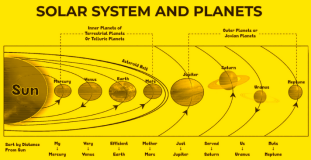
- The Sun and the 8 planets revolving around it, 219 satellites, 227 moons, comets, meteors and asteroids ,huge quantities of dustgrains and gases are collectively called the Solar System. It was formed about 4.6 billion years ago.
- The Sun is the central star of our solar system.
- Mercury is the smallest and the nearest planet to the Sun.
- Venus is considered as Earth’s-twin (similar shape and size).
- It is probably the hottest planet (the atmosphere contains 90-95% of carbon dioxide with clouds of Sulphuric acid).
- Jupiter is the largest planet in the solar system. Its atmosphere contains hydrogen, helium, methane and ammonia.
- The tilt of the rotational axis of Venus and Uranusis so great that these planets actually rotate in a direction that is opposite to the other planets.
| Planet | |
| Inner Planet / Terrestrial Planets | Jovian/outer planet |
| Higher densities and smaller in size.These planets were formed near the Sun.There is extreme temperature here.Due to being close to the Sun, the dust particles and gases were blown away from the terrestrial planets under the influence of solar wind.Its gravitational force is low.It has iron and nickel in high quantity.Mercury, Venus, Earth and Mars. | Lower densities and bigger in sizeThese planets were formed far away from the Sun.The temperature is low here.At greater distance from the Sun, the solar wind force is less effective. Hence, there is abundance of dust particles and gas on these planets.Their gravitational force is very high.Jupiter, Saturn, Uranus and Neptune. |
Sun
- The Sun is a star that provides energy and light. The source of the Sun’s energy is the nuclear fusion of hydrogen atoms at its core to convert them into helium atoms. 99.8% of the solar system’s mass is contained in the Sun. Due to its enormous gravitational force, other planets revolve around it.
- Sometimes a storm of atoms emerges from the photosphere with such a high velocity that it crosses the gravitational force of the Sun and goes into space; this is called Solar Flares. When it enters the Earth’s atmosphere, it collides with air particles and produces coloured light (Aurora Light), which can be seen on the North and South Pole. It is called Aurora Boreolis on the North Pole and Aurora Australis on the South Pole.
- Wherever the solar flare emerges, black spots are visible. These are called Sun Spots. These are relatively cold parts of the Sun, whose temperature is 1500°C. The darkest central part of the sunspot is called Umbra, which is surrounded by a lighter black part, Penumbra.
THE MOON
- The Moon is the only natural satellite of the Earth.
- Its diameter is only one-quarter that of the Earth and it is about 3,84,400 km away from us.
- The moon is tidally locked to the earth, meaning that the moon revolves around the earth in about 27 days, 7 hours and 43 minutes which is the same time it takes to complete one rotation.
- As a result of tidal locking, only one side of the moon is visible to us on the earth.
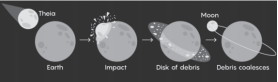
- Generally it is believed that the formation of the Moon, as a satellite of the earth, is an outcome of giant impact or what is described as the big splat.
Planet
- The lightless celestial bodies revolving around the stars are called planets. These are the bodies that have emerged from the Sun and revolve around the Sun. They do not have their own light, hence they are illuminated and receive heat only by the sunlight.
1. Mercury
- Mercury is the closest planet to the Sun and the smallest planet in the solar system. It completes its orbit around the Sun in 88 days.
- Being between the Sun and Earth, Mercury and Venus are also called interior planets.
- Its temperature difference is the highest among all planets (560°C). One day on Mercury is equal to 90 days on Earth.
2. Venus
- It is the second closest planet to the Sun and completes its revolution around the Sun in 225 days.
- It revolves on its axis from east to west (clockwise) opposite to the general direction of the planets. It is closest to the Earth and appears the brightest after the Sun and the Moon. It is also called the evening star and the morning star. Because it appears in the west in the evening and in the east in the morning.
- Being slightly smaller than the Earth in size and mass, it is called the twin sister of the Earth.
- Carbon dioxide (CO2) is up to 90-95% in the atmosphere of Venus. Due to this, a pressure cooker like condition is created here.
- It is the hottest planet in the solar system.
3. (Earth)
- It is the third planet in order of distance from the Sun and ranks fifth among all the planets in terms of size.
- It is tilted 23½o on its axis. It completes one revolution in about 365 days. Its average distance from the Sun is about 15 crore km. Due to moderate temperature, oxygen and abundant water all around, it is the only planet in the solar system where life exists. Hence, it is also called the blue planet.
| Earth facts | |
| Shape | Geoid |
| Axipolar diameter | 12,714 km. |
| Equatorial diameter | 12,756 km. |
| Polar circumference (girth) | 40,008 km. |
| Equatorial circumference | 40,075 km. |
| Mass | 5.97×10²¹ tons |
| Volume | 1.083×1027 cubic cm |
| Average density | 5.52 (relative to the density of water) |
| Estimated age of the Earth | 4.6 billion years |
| Revolution time | 365 days 5 hours 48 minutes 46 seconds |
| Minimum distance from the Sun | 147 million km. |
| Revolution time | 23 hours 56 minutes 4 seconds |
| Maximum distance from the Sun | 152.1 million km. |
| Time taken for light to reach the Earth from the Sun | 8 minutes, 20 seconds |
| Distance from the Moon | 384,000 km. |
4. Mars
- It is the fourth planet after Earth in order of distance from the Sun. It completes its orbit around the Sun in 687 days.
- Mars is also called the Red Planet because its surface is red.
- The reason for Mars appearing red is the oxidation of iron in its rocks, rusting and the presence of dust particles.
- Phobos and Deimos are the two satellites of Mars. Deimos is the smallest satellite in the solar system. The highest mountain on this planet is Nix Olympia, which is three times higher than Everest.
| Mars facts | |
| Distance from the Sun | 22.79 crore km. |
| Diameter | 6,794 km. |
| Orbit around the Sun | 686.98 days |
| Rotation speed | 24 hours, 37 minutes, 23 seconds |
| Satellite 2 | (Phobos and Deimos) |
| Atmosphere | Carbon dioxide, nitrogen, argon |
5. Jupiter
- It is the largest planet in the solar system, which revolves around the Sun in 11.9 years.
- It has 92 satellites in the solar system, of which Ganymede is the largest. It is the largest satellite in the solar system.
- Jupiter’s four largest satellites Ganymede, Io, Europa, and Callisto are called Galilean satellites after the Italian astronomer Galileo Galilei, who first saw these planets in the year 1610.
- Jupiter is also called a small solar system. Gases like hydrogen, helium, methane and ammonia are found in its atmosphere.
- It has the properties of both as star & planet, because of its own radio energy. Jupiter’s famous Great Red Spot is a giant storm larger than the Earth.
6. Saturn
- second largest planet in size. completes its orbit around the Sun in 29.5 years.
- Its biggest feature or mystery is the presence of fully developed rings around its equator, which are 7 in number.
- This planet appears like a yellow star in the sky. Its atmosphere also contains hydrogen, helium, methane and ammonia gases like Jupiter.
- Titan is the largest satellite of Saturn.
7. Uranus
- It was discovered in 1781 by Sir William Herschel. It is the seventh planet in the solar system and the third largest planet in size.
- Due to high axial tilt, it is also called the lying planet. It completes its revolution around the Sun in 84 years. Like Venus, it also revolves on its axis from east to west (clockwise) direction, opposite to the general direction of the planets.
- It has 27 satellites.
- On Uranus, sunrise takes place in the west and sunset in the east.
8. Neptune
- It was discovered by German astronomer Johann Galle in 1846.
- The coldest planet in the solar system is Neptune.
- Hydrogen, helium, methane and ammonia are present in it.
- This planet appears light yellow. It has 14 satellites. Among these, Triton and Merid are prominent.
- Goldilocks Zone :- The Goldilocks zone, also known as the habitable zone, is a region around a star where the surface of an Earth-like planet is neither too cold nor too hot, meaning that there is a possibility of life on that planet. The planet located in the Goldilocks zone of our solar system is Earth.