
| On The Basis of Raw Materials | Agro based Industries: Raw material sourced from the agriculture sector.E.g : Cotton, sugar etc.Mineral based Industries: Raw material sources from mining, E.g : Iron & steel, cement etc.Forest based Industries: Raw material sourced from forest. E.g : Paper industry, Timber etc |
| On The Basis Of Input | Basic or key industries: Supply their goods to other industries. E.g : Iron & steelConsumer Industries: Produce goods for direct consumption.E.g : Toothpaste, Television etc |
| On The Basis Of Ownership | Public sector: Owned & operated by the government. E.g : BHEL, SAIL etc.Private sector: Owned & operated by private individuals.E.g : TISCO, RIL.Joint sector: Jointly run by state & private players. E.g. OILCooperative sector: Owned & operated by the producers and suppliers of raw materials, workers or both. E.g : Sugar industry in Maharashtra |
| On Basis Of Size | Small scale industries: Use a lesser amount of capital investment and technology, and produce a small volume of products.E.g : handicrafts, cottage industries etc.Large scale industries: Investment of capital is higher and the technology used is superior in large scale industries. E.g : automobile industry, heavy machinery industry etc. |
| On The Basis of Mode Of Operation | Labour Intensive Industry: Large no. of skilled unskilled or semi-skilled labour is employed. E.g. Textile, leather & footwear.Capital goods Industry: Manufactures machine tools, heavy electrical equipment, heavy transport vehicles, mining & earth moving tools etc.Industries with strategic significance: Industries which are critical for the purpose of earning foreign exchange, research & defence. E.g : Aerospace, shipping, electronics & telecommunication, defence equipment etc. |
FACTORS AFFECTING LOCATION OF INDUSTRIES
- Raw material
- Transport
- Power and energy
- Capital
- Market
- Labour
MAJOR INDUSTRIES IN INDIA
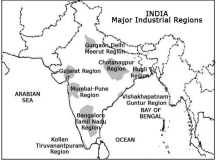
Iron and Steel
- Location in india:
- Bokaro steel plant -1964
- TISCO- Jamshedpur
- Visvesvaraya plant : Karnataka
- Raw material:
- Bulk inputs of the iron & steel industry are iron ore (gross/ weight-loss raw material), fuel (coal; weight-loss), limestone (flux) & water (required for cooling & worker safety).
- Mostly large integrated steel plants are located close to the source of raw materials, as they use large quantities of heavy and weight losing raw materials.
- Concentration of Iron and steel industry in Chota Nagpur region – Presence of Iron ore & coal in this region. TISCO at Jamshedpur.
- Purvodaya Initiative (2020): Set up steel plants in Eastern india.
| Largest steel producer1. China (54%)2. India (6%)3. Japan | Largest steel consumer1. China (49%)2. USA3. India (6%) |
Cotton Textile Industry
- Tropical climate abundant yield of cotton.
- 1854: first cotton mill in Mumbai.
- Uninterrupted supply of raw cotton from large cotton growing areas of west India benefited the industry in centres like Ahmedabad (Manchester of India), Nagpur, Surat, Indore and Coimbatore.
- E-cocoon App: mobile application for quality certification in silkworm seed sector.
- At 23% of the global total, India is the world’s largest producer of cotton. It also has the largest area under cotton cultivation in the world, representing about 25% of the world’s area under cultivation.
- The States of Gujarat, Maharashtra, Andhra Pradesh, Haryana, Punjab, Madhya Pradesh, Rajasthan, Karnataka and Tamil Nadu are the major cotton producing areas in India.
Cement Industry:
- most advanced industries in the country.
- It is a depreciating industry.
- The first modern cement factory in the country was established in Chennai in 1904.
- This industry is basically based on non-metallic minerals.
- Limestone and coal are its main raw materials. 2.02 tonnes of raw material is required to produce one tonne of cement, of which 1.6 tonnes is the maximum contribution of limestone alone. At present, seashells, slag, etc. are also being used as alternative raw materials.
- Cement industries have been established in Dwarka (Gujarat), Thiruvananthapuram (Kerala), Chennai (Tamil Nadu) on the basis of availability of seashells.
- On this basis, this industry has developed in Sindri (Jharkhand) and Talcher (Odisha). On this basis, this industry has developed in centers like Durgapur, Chandil, Bhilai, Rourkela, Bhadravati etc. Most of the factories of cement industry are located in Andhra Pradesh. Later it spread in Rajasthan, Gujarat, Tamil Nadu, Madhya Pradesh respectively.
- India second position in the world after China in cement production and produces cement of world class quality.
Woolen Textile Industry
- Rural based
- Export oriented
- Not enough production
- Main area: Punjab, Maharashtra, Uttar Pradesh.
Jute Industry
- The British setup the first jute industry in India in 1855 in the Hooghly valley near Kolkata.
- There is the availability of local fibres like Mesta (important commercial fibre crop after cotton and Jute. Jute and Mesta fibre together is known as raw jute).
- Producer of jute :- West Bengal alone accounts for 72% of India’s jute production.
- Jute Packaging Material Act 1987 :- 100% of food grains and 20% of sugar must be packed in jute bags.
Fertiliser Industry
- One of eight core industries.
- About 70% of units producing nitrogenous fertilisers use naphtha as basic raw material. That’s why they are located near oil refineries.
- Hajira – Vijaipur – Jagdishpur gas pipeline has given birth to plants at Vijaipur, Jagdishpur, Babrala etc.
- Phosphatic fertiliser plants are dependent on mineral phosphate which is largely imported but reserves are also found in Rajasthan, Madhya Pradesh and Jharkhand.
- Current developments: DBT of fertiliser -2018, urea subsidy, neem coated urea.
- Along with the availability of raw material, the lack of nitrogen in Indian alluvial soils has also been the main reason for the development of nitrogen based industry in India. Mainly five types of raw materials are used in nitrogen based fertilizer industry:
1. Naphtha: It is a by-product of petroleum, hence this industry has developed at all the oil refineries of the country.
2. Coal: The main factories based on this are located in Talcher, Korba, Sindri, Bhilai and Durgapur.
3. Natural Gas: With the development of pipeline transportation, natural gas based nitrogenous fertilizer industries have also been established. Six factories (Bijapur, Sawaimadhopur, Anola, Jagdishpur, Dabrala and Shahjahanpur) have developed on the basis of Hazira-Bijapur-Jagdishpur (HBJ) pipeline. The Amla factory has developed under the cooperative sector.
4. Sulphuric Acid: Factories based on sulphuric acid have developed in Kochi, Khetri and Alwar.
5. Phosphorous: The main reason for the lack of phosphorus based industry is the insufficient availability of rock phosphate in India. At present, raw material is being imported for this industry from Nauru and Morocco. These industries have developed in Visakhapatnam, Udagamandalam (Ooty), Chennai, Udaipur, Ramagundam and Kochi.
Oil refining industry
- this industry is largely dependent on imports.
- their main concentration has been in the coastal areas. This industry has also developed near the gas pipelines. At present, the annual oil refining capacity in the country has now increased to about 250 million tonnes, which was only 0.25 million tonnes at the time of independence.
- The first mineral oil refinery in the country was established in Digboi (Assam) in 1901. At present, their total number is 23. Outof these, 18 are in the public sector, 2 in the joint sector and 3 in the private sector.
- Public sector oil refineries have been established at Digboi, Noonmati, Bongaigaon, Numaligarh (Assam), Barauni (Bihar), Haldia (West Bengal), Visakhapatnam (Andhra Pradesh), Chennai, Nariman (Tamil Nadu), Kochi (Kerala), Trombay (Maharashtra), Koyali (Gujarat), Mathura (Uttar Pradesh), Karnal and Panipat (Haryana), Bhatinda (Punjab), Manali (Himachal Pradesh), Bina (Madhya Pradesh), Paradip (Odisha). Bina, Bhatinda and Paradip refinery projects are in the process of construction.
- The private sector (Reliance Petroleum Limited) has two oil refineries at Jamnagar (Gujarat) and Vadnagar. The Jamnagar refinery has an oil refining capacity of about 65 million metric tonnes per annum. This is the country’s largest oil refinery.
- The joint sector oil refinery is located in Mangalore (Karnataka).
- The state-owned Maharatna company Oil and Natural Gas Corporation (ONGC) has planned to set up three new refineries. These will be set up in Mangalore (Karnataka), Kakinada (Andhra Pradesh) and Barmer (Rajasthan). There are petrochemical complexes in Haldia (West Bengal), Ankleshwar (Gujarat) and Mangalore (Karnataka).
Sugar Industry
- Indialargest consumer of sugar in the world and the second largest producer after Brazil.
- first sugar industry established in Bettiah (Bihar) in 1840 AD, but its actual development was patronized from 1931 AD.
- Till 1960 AD, Uttar Pradesh and Bihar were the main sugar producing states, later due to the development of tube well irrigation in South India, the trend of decentralization emerged in this industry. Due to the high productivity of sugarcane and the quantity of juice per ton in South India, it has now become an important center of sugar production.
Cottage Industry
| Major cottage industries of the country | |
| Industry | Centre |
| (i) Handloom(a) Muslin(b) Carpet(c) Khadi | Meerut, Mathura, Madurai, Varanasi, Ambala, Machilipatnam, Agra, Jhansi, Aligarh, Ambala, Amrah, Calicut, Pune |
| (ii) Silk cloth | Mysore, Kanjivaram, Varanasi, Srinagar, Murshidabad, Amritsar, Nathnagar (Bhagalpur) |
| (iii) Woollen cloth | (Mostly in Punjab) Amritsar, Dhariwal, Ludhiana, Machilipatnam, Srinagar, Warangal |
| (iv) Leather | Kanpur (Uttar Pradesh) |
| (v) Jaggery and Khandsari | Meerut (Uttar Pradesh) |
Aluminium Industry
- a depreciating industry.
- 5 tons of bauxite, 0.5 tons of limestone, 0.3 tons of caustic soda and 20-24 thousand kilowatts of electricity are required to produce 1 ton of aluminium.
- India’s first aluminium plant was established in 1937 at Muri in Jharkhand in the bauxite mining area. The third aluminium plant was set up by Hindustan Aluminium Corporation (Hindalco) at a place called Renukoot in Uttar Pradesh. The fourth plant was set up by Madras Aluminium Company at a place called Mettur in Tamil Nadu.
Automobile Industry
- There is a huge increase in automobile production with a catalyst effect by indirectly increasing the demand for a number of raw materials like steel, rubber, plastics, glass, paint, electronics and services.
- India has emerged as Asia’s fourth largest exporter of automobiles, behind Japan, South Korea and Thailand.
- The country is expected to top the world in car volumes with approximately 611 million vehicles on the nation’s roads by 2050.
METALLIC MINERALS
Ferrous Minerals
- Iron Ore
- Basic mineral and the backbone of industrial development.
- India is endowed with fairly abundant resources of iron ore.
- Magnetite is the finest iron ore with a very high content of iron up to 70 per cent. It has excellent magnetic qualities, especially valuable in the electrical industry.
- Hematite ore is the most important industrial iron ore in terms of the quantity used, but has a slightly lower iron content than magnetite (50-60 per cent)
- Major iron ore belts:-
- Odisha-Jharkhand belt.
- Durg-Bastar-belt.
- Bellary-Chitradurga-Chikmagalur-Tumkur belt.
- Maharashtra-Goa belt.
| Ore Iron | Content | Use |
| Magnetite | 72% | Electronic Industries |
| Hematite | 60-70% | Iron and Steel Industries |
| Limonite | 40-60% | Pigment for paints |
| Siderite | 40-50% | Source of Manganese |
Manganese
- Mainly used in the manufacturing of steel and ferromanganese alloy.
- Nearly 10 kg of manganese is required to manufacture one ton of steel.
- It is also used in manufacturing bleaching powder, insecticides and paints.
| Non-Ferrous Minerals | |
| Copper | India is critically deficient in the reserve and production of copper.Being malleable, ductile and a good conductor, copper is mainly used in electrical cables, electronics and chemical industries.The Balaghat mines in Madhya Pradesh, Khetri mines in Rajasthan and Singhbhum district of Jharkhand are leading producers of copper. |
| Bauxite | Bauxite, a clay-like substance that produces aluminaand later aluminium is obtained. Bauxite deposits are formed by the decompositionof a wide variety of rocks rich in aluminium silicates.It combines the strength of metals such as iron, with extreme lightness and also with good conductivityand great malleability.Mainly found in the Amarkantak plateau, Maikal hills and the plateau region of Bilaspur-Katni. |
NON-METALLIC MINERALS
- Mica
- Mica is a mineral made up of a series of plates or leaves. It splits easily into thin sheets.
- Mica can be clear, black, green, red, yellow or brown.
- Due to its excellent di-electric strength, low power loss factor, insulating properties and resistance to high voltage, it is used in electric and electronic industries.
- Mica deposits are found in the northern edge of the Chota Nagpur plateau, Ajmer (Rajasthan), Nellore (Andhra Pradesh).
- Koderma Gaya – Hazaribagh belt of Jharkhand is the leading producer.
ENERGY RESOURCES
- Coal
- Coal that has been buried deep and subjected to increased temperatures is bituminous coal.
- It is the most popular coal in commercial use and most abundantly available fossil fuel.
- Gondwana coal: a little over 200 million years in age major resources of Gondwana coal, which are metallurgical coal, are located in Damodar valley (West Bengal-Jharkhand). Jharia, Raniganj, Bokaro are important coalfields. The Godavari, Mahanadi, Son and Wardha valleys also contain coal deposits.
- Tertiary coal: occur in the north eastern states of Meghalaya, Assam, Arunachal Pradesh and Nagaland.
- Lignite is a low-grade brown coal, which is soft with high moisture content. The principal lignite reserves are in Neyveli in Tamil Nadu.
- Metallurgical coal is high grade bituminous coal which has a special value for smelting iron in blast furnaces. Anthracite is the highest quality hard coal.
- Petroleum
- Associated with anticlines and fault traps in the rock formations of the tertiary age.
- Petroleum refineries act as a “nodal industry” for synthetic textile, fertiliser and numerous chemical industries.
- 63 per cent of India’s petroleum production is from Mumbai High, 18 per cent from Gujarat and 16 per cent from Assam.
- Ankaleshwar is the most important field of Gujarat.
- Assam is the oldest oil producing state of India. Digboi, Naharkatiya and Moran-Hugrijan are the important oil fields in the state.
- Petroleum or mineral oil is the next major energy source in India after coal. It provides fuel for heat and lighting, lubricants for machinery and raw materials for a number of manufacturing industries.
- Natural Gas
- Since it has low carbon dioxide emissions it is called the fuel for the present century.
- Resources found in association with or without petroleum. It is used as a source of energy as well as an industrial raw material in the petrochemical industry.
- The 1700 km long Hazira-Vijaipur-Jagdishpur Cross country gas pipeline links Mumbai High and Bassein with the fertiliser, power and industrial complexes in western and northern India.
- This artery has provided an impetus to India’s gas production. The power and fertiliser industries are the key users of natural gas. Use of Compressed Natural Gas (CNG) for vehicles to replace liquid fuels is gaining wide popularity in the country.
| conditions for Maharatna, Navratna and Miniratna | ||||
| Standard | Maharatna | Navaratna | Miniratna-1 | Miniratna-2 |
| Term | 1. Average annual profit of more than Rs 2500 crore for last 3 years2. Average annual asset of Rs 15,000 crore for last 3 years. | 1. Have secured 60% marks in 6 performance parameters2. Have received Miniratna-1 status. | Consistent profit for the last 3 years or average profit for the last 3 years is Rs. 30 Crores | Consistent and positive profits for the last 3 years |
| Investment Benefits | Allowance to invest up to Rs 1000-5000 crore or 15% of its assets in a Project | Investment exemption up to Rs.1,000 crore or 15% of the asset size in a single Project | Exemption of investment up to Rs 500 crore or equal to the value of one’s assets, whichever is lower. | Investment exemption up to Rs 300 crore or 50% of your assets |
- Eight core industries are :- Coal, Crude oil, Natural gas , Refinery products, fertilizers, steel, cement , electricity.