
Constituent Assembly
- It was formed to draft the constitution for Independent India.
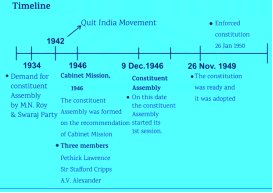
- The demand for a Constituent Assembly was earlier made by M.N. Roy & Swaraj Party in the year, 1934.
- However, the constituent Assembly of India was formed on the guidance of Cabinet Mission.
- Initially the Constituent Assembly had 389 members. British Province – 292 , Chief Commissioners Province – 4 , Members from Princely State – 93
- But after the partition of India the members from the Pakistan region vacated the constituent Assembly.
- After partition the Assembly became 299 members body.
Constituent Assembly Members
- Nominated :- The ruler of the princely state will nominate members to the Constituent Assembly.
- Member from Chief Commissioner Province were nominated by the Viceroy.
- Indirect Election :- The legislative councils of the British provinces will elect members to the Constituent Assembly.
Session Starts on
- 9th December, 1946 :- Dr. Sachhidanand Sinha will became the temporary Chairman/President of Constituent Assembly.
- 11th December, 1946 :- Dr. Rajendra Prasad will be elected as the permanent chairman of Constituent Assembly.
- 13th December, 1946 :- Objective resolution will be presented by J.L. Nehru.
- Total session Duration – 2 years 11 month 18 days from 9 Dec, 1946 to 26 Nov, 1949.
- Number of session – 11
- Number of days on which the Assembly met – 166 days
- The constitution was enforced on 26th Jan, 1950 to mark the historical importance of 26 Jan 1930.
Objective Resolutions
- Preamble of the constitution is based on the objective resolution.
- It provides the vision & idea of the Constitution which was to be made.
- Independent Country
- Sovereignty
- Equality, Justice, Rights of the Citizens
- International peace
- Democratic Setup
Imortant facts related to the Constituent Assembly –
- Symbol (Seal) of the Constituent Assembly – Elephant
- Prem Behari Narain Raizada (Calligrapher) – who drafted the constitution in a flowing italic sytle.
- Nand Lal Bose and Beohar Rammanohar Sinha decorated the origional constitution.
- Constituent Assembly ratified India’s membership of the commonwealth in May 1949.
- National Flag was adopted on 22 July, 1947.
- Adoption of National Anthem and National Song.
- Total Session : 11 (From Dec 1946 to November 1949)
- Total expenditure on making Contitution was Rs. 64 lakh.
FAQs
1. How many members were there in the Constituent Assembly initially?
(A) 296 (B) 300
(C) 389 (D) 299
Ans :- (C) 389
- The total strength of the Constituent Assembly was 389 members 296 from British India and 93 from princely states. After partition, the strength was reduced to 299.
2. Which amendment added the word socialist and secular to the preamble?
(A) 44th Amendment (B) 42nd Amendment
(C) 1st Amendment (D) 24th Amendment
Ans :- (B) 42nd Amendment
- The 42nd Amendment (1976) added the words Socialist and seculer to the premble.
3. The Indian constitution is the lengthiest in the world because—
(A) It accomodates the diversity of India
(B) It contains both fundamental rights and directive principles.
(C) It is handwritten.
(D) It includes detailed administrativeprovisions.
Ans :- (A) It accomodates the diversity of India
- Due to India’s vast diversity, the constitution includes provisions for governance at different levels, special provisions for states, and detailed administrative procedures.
4. Which of the following features is NOT borrowed from the Govt. of India Act, 1935?
(A) Federal Structure
(B) Office of the Governor
(C) Emergency provisions
(D) Fundamental Rights
Ans :- (D) Fundamental Rights
- The Govt. of India Act, 1935 did not provide fundamental Rights. They were taken from the USA.
5. Which of the following is not a feature of the Indian Constitution?
(A) Fundamental Duties
(B) Presidential form of government
(C) Single citizenship
(D) Separation of Powers
Ans :- (B) Presidential form of government
- India follows a parliamentary system unlike the USA, which has presidential system.
6. Which of the following words are mentioned in the Preamble?
I. Democratic II. Federal III. Unity IV. Secular
(A) I, II, III, IV (B) I, II, IV (C) I, II, III (D) I, III, IV
Ans :- (D) I, III, IV
- Democratic, Unity and Secular words are mentioned in the preamble except Federal Art-1 says, India shall be Union of States.
7. Which of the following Act introduced Dyarchy at Centre?
(A) Morley-Minto reforms (1909) (B) Montegue-Chelmsford reforms (1919)
(C) G.O.I. – 1935 (D) Regulating Act, 1773
Ans :- (C) G.O.I. – 1935
- Montegue-Chelmsford reforms, 1919 introduced Dyarchy in provinces, but Government of India Act, 1935, introduced Dyarchy at Centre.
8. Which of the following is federal features of Indian Constitution?
(A) Single Citizenship (B) Single Constitution (C) Written Constitution (D) Integrated Judiciary
Ans :- (C) Written Constitution
- Written Constitution is the federal feature of the Indian Constitution but, Single Citizenship, Single Constitution and Integrated Judiciary are the Unitary features of the Indian Constitution.