
1. Lengthiest Written Constitution
- Initially (26 Jan, 1950) – It had 395 Articles, 22 parts and 8 schedules.
- In due course, amendment of the constitution has taken place and various parts, articles & schedules have been added in the constitution.
- At present – The constitution has more than 450 articles, 25 parts and 12 schedules.
The constitution became lengthy mainly due to the following factors –
- Indian Diversity : India is a country of great diversity. It is a country of several minorities. It has many languages, castes, races and interests of these different groups have found place in the constitution.
- Colonial History
- Government of India Act, 1935 : The Government of India Act, 1935 was in operation when India got independence our leaders were familiar with this act. They borrowed heavily from this lengthy Act while framing our constitution.
- Focus on rights of all the citizens
- Single Constitution for both the Centre and the State except Jammu and Kashmir.
- Many members of the constituent assembly were lawyer politicians. They have made the constitution not only long, but also extremely complicated. Ivor Jennings has described our constitution as a lawyers’s pradise.
2. Drawn from various sources :
- Indian constitution has taken inspiration from different constitution of the world
- Parliamentary system – U.K., Britain Constitution
- Fundamental Rights – USA
- Office of governor – Canada
- Federalism – Govt. Of India Act, 1935 (Canadian Model of Federalism : Federalism with a strong centre)
- Directive Principles of state policy (DPSP) – Irish Constitution
- Suspension of Fundamental Rights during emergency – German Constitution
- Principles of Liberty, equality and fraternity – French Constitution, French Revolution
- Principles of Justice (Social Justice, Economic Justice, Political Justice) – Russian Revolution
- Procedure of amendment of the Constitution – South African Constitution
- Govt. of India Act, 1935 – It provided the structural part of the Indian Constitution, therefore it is called as Blue print of the Constitution.
- Federal System
- Division of legislative subjects
- Public Service Commission
- Federal Court – Supreme Court of India
- Fundamental Duties – USSR (Russian Constitution)
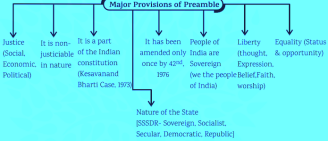
3. Preamble of the Indian Constitution
- It is the introduction of the Indian constitution.
- It is also reffered as the ID Card of the Indian Constitution.
- It is also reffered as the Soul of the Indian Constitution.
- It is based on the objective resolution.
- Presented by the J.L. Nehru in the Constituent Assembly on 13th Dec, 1946.
4. Parliamentary System of Governance
- The parliamentary system of Governance means the executive is responsible towards the legislature.
- Article 75 (3) of the Indian Constitution States that the Council of Ministers Shall be collectively responsible to the house of people (Lok Sabha).
| Parliamentary System | Presidental System |
| • Executive is a part of legislature. There is inter-connection between these two. • The main powers are enjoyed by Prime Ministers. • Collective responsibility. • Ex – Britain (U.K), India• Executive : Prime Minister + Council of Ministers • Legislature – Parliament (Art.-79) • (Lok Sabha & Rajya Sabha) • The Executive will hold office only if it has the majority in Lok Sabha. | • There is a complete separation of powers between the executive and the legislature.• The real powers are enjoyed by the president. Executive does not have responsibility towards the legislature. • Ex. – U.S.A• Executive – President is elected by the citizens and he appoints his ministers. • There is no relation between Executive & Legislature. • Executive does not have to prove majority in legislature. |
Collective Responsible –
- Swim together & Sink together
- P.M and his Council of Ministers will hold office till they have majority in Lok Sabha.
- Incase, No confidence motion is passed in Lok Sabha then PM will resign.
5. Federalism with a bias towards centre
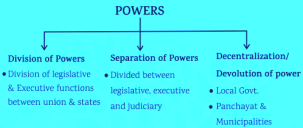
- There is a division of powers between Union & States in India.
- But the Union has been given more powers with respect to the states in India.
- We have more unitary features in the Constitution.
| Federal Features | Unitary Features |
| • When the Union & States have shared powers • Written Constitution • Dual Polity (Division of Powers) ▪ Central Government ▪ State Government • Independent Judiciary • Bicameralism (Lok Sabha & Rajya Sabha) • Rigidity of the Constitution | • When the powers of Union Prevails • Single Constitution • Single Citizenship • Integrated Judiciary • Appointment of Governors • Emergeny provisions• Residuary Powers |
Integrated Judiciary
- There is a hiearchy of courts in India
Supreme Court
↓
High Court
↓
District Courts
- They all enforce the laws made by the Union legislature as well as state legislature.
- Judges of the Supreme Courts and High Courts are appointed by the president of India.
- Supreme Court is the Court of record.
- Therefore its judgments are binding on the courts which are subordinate to it.
Appointment of Governors
- Governor is the Constitutional head of the state
- Governor is the nominal head of the State Executive.
- All the executive action of the States are taken in the name of governor.
- Governor are appointed by the president and they hold office during the pleasure of the president.
Residuary Powers
- There is a division of legislative subjects in the constitution.
- Art-246 & 7th Schedule is related with the division of legislative subjects.
7th Schedule
- Union list (100 subjects, defence, Currency-Railway, Citizenship)
- State list (61) Police, health, Agriculture, Local Government
- Concurrent list (52) Education, Marriage Divorce, Adoption
- Those subjects which are not mentioned in any list of the 7th schedule. In such cases parliament can make laws. Ex- Security
1. Fundamental Rights
- Part-III, Article:- 12-35
- Taken from American Constitution
Six fundamental rights
- Right to Equality :- Art (14-18)
- Right to Freedom :- Art (19-22)
- Right against exploitation :- Art (23-24)
- Right to freedom of religion :- Art [25-28] (Freedom of conscience to practice, propagate & profess any religion).
- Cultural and Educational Rights [Art-29-30] (Protection to religious and linguistic minorities)
- Right to Constitutional Remedies [Art-32] (It means any aggrieved person whose fundamental right has been violated will directly approach the Supreme Court).
- It is also called as the Heart & Soul of the Constitution.
General Features of the Fundamental Rights
- Justiciable in natur
- It puts a limit on the state [(Art-13) – It declared those laws to be void which infringes on the fundamental rights and it also gives the judiciary the power of judicial review.]
- It promotes political democracy
- Six in numbers
[Note :- Right to property has been repealed by 44th Constitutional Amendment Act –1978]
- These can be amended also.
2. Directive Principle of State Policy (D.P.S.P)
- Part-IV, Art → (36-51)
- Taken from Irish Constitution
- DPSPs are not justiciable or Enforceable in nature
- Fundamental to the Governance of the Country
- It creates welfare state in India
- It promotes social & economic democracy
Classification of DPSPs
- Gandhian Principles
- Socialist Principles
- Liberal and Intellectual Principles
3. Fundamental Duties
- Part-IV (A), Art. – 51 (A)
- It has been added in the Indian Constitution by 42nd Constitutional Amendment Act-1976 (The Prime Minister during the enactment of the 42nd Constitutional Amendment Act in 1976 was Indira Gandhi).
- It has been added on the recommendation of Swaran Singh Committee.
- Taken from U.S.S.R Constitution
4. Secularism
- It is one of the salient feature of the Indian Constitution.
- It means there will not be any official religion of the country. (No State Religion)
- The word secular was added in the preamble by 42nd C.A.A. -1976.
| Secularism | |
| Indian Concept | Western Concept |
| Positive Secularism State treats all religion equally and state does not interfere in religion normally but state can interfere if religious practices violate fundamental rights. Fundamental Right to freedom of religion. | Negative Secularism There is a complete separation of religion and state. State doesn’t interfere into the religious matters. |
Features of indian secularism
- No state religion (State doesn’t have official religion)
- All religion treated equally
- Constitution grants right to freedom of religion.
- Subjected to state intervention when the issue of public order, morality or health is involved.
- Positive & Dynamic Secularism
5. Blend of Rigidity & Flexibility
- Rigidity means the procedure for the amendment is complex. For example the amendment of the USA constitution is a very complex process therefore it is a rigid constitution.
- On the other hand the flexibility of the constitution means that the constitution can be amended easily by simple procedure. For ex.- The British Consitution
- But the Indian Constitution is neither as rigid like the USA Constitution nor as flexible like the British Constitution.
6. Synthesis of Parliamentary Sovereignty & Judicial Supermacy
- Paraliamentary Sovereignty :- It means the parliament is sovereign and there is no limit on the powers of the parliament. For ex.- British Parliament is Sovereign because its powers are not limited by any written constitution also the British Courts cannot review the laws made by British Parliament.
- Judicial Supermacy :- It is the American doctrine it means the judiciary will have the powers to review the constitutionality of the laws made by the legislature. So the laws can be declared Null & Void.
Indian Parliament
- It is not a sovereign body like the British Parliament
- Limits on the powers of Indian Parliament
➢ Written Constitution
➢ Judicial review
➢ Fundamental Rights
➢ Federalism
➢ Written Constitution : Doctrine of Constitutional Supermacy
➢ Judicial Review :
- It ensures Checks & Balances
- Constitutionality of laws are checked
➢ Fundamental Rights : Art-13 → Laws will be void for the Violation of Fundamental Rights.
➢ Federalism : Parliament cann’t legislate on state list in normal circumstances.
Integrated and Independent Judiciary
| Integrated | Independent |
| There is a hierarchy of courts in India. The integrated judiciary enforces union laws as well as state laws Unitary Feature of constitution of India | Federal Feature of the constitution.It ensures that the checks & balances between the three organs of the govt. are maintained.Independence of judiciary is also basic structure of the constitution. |
7. Emergency provisions
- Taken from govt. of India Act-1935
- Suspension of fundamental rights during emergency has been taken from German Constitution.
- Part – XVIII, Art.- 352-360
- Three types of Emergency
- National emergency (War, External aggression, Armed rebellion) : Art.. – 352
- President rule : Art – 356/365 and State Emergency
- Financial Emergency : Art. – 360
- Suspension of Fundamental Rights during emergency as per article – 358 & 359
- Proclaimed by the president subjected to parliamentary approval.
| Part of the Constitution | Related subject areas | Extension of article |
| Part-1 | The Union and its Territory | 1 to 4 |
| Part-2 | Citizenship | 5 to 11 |
| Part-3 | Fundamental Rights | 12 to 35 |
| Part-4 | Directive Principles of State Policy | 36 to 51 |
| Part-4(a) | Fundamental Duties | 51 ‘A’ |
| Part-5 | Governance of the Union | 52 to 151 |
| Part-6 | Governance of the State | 152 to 237 |
| Part-7 | States in Part ‘B’ of the First Schedule | 238 (Repealed) |
| Part-8 | Union Territories | 239 to 242 |
| Part-9 | Panchayats | 243 and 243 (A to O) |
| Part-9(a) | Municipalities | 243 ‘P’ to 243-ZG |
| Part-9(b) | Co-operative Societies | 243 ZH to 243 ZT |
| Part-10 | Scheduled and Tribal Areas | 244 and 244 ‘A |
| Part-11 | Relations between the Union and the States | 245 to 263 |
| Part-12 | Finance, Property, Contracts and Suits | 264 to 300 A |
| Part-13 | Trade, Commerce and Interaction within the Territory of India | 301 to 307 |
| Part-14 | Services under the Union and the States | 308 to 323 |
| Part-14a | Tribunals | 323 ‘A’ and 323 ‘B’ |
| Part-15 | Elections | 324 to 329 |
| Part-16 | Special Provisions in Respect of Certain Classes | 330 to 342 |
| Part-17 | Official Language | 343 to 351 |
| Part-18 | Emergency Provisions | 352 to 360 |
| Part-19 | Miscellaneous | 361 to 367 |
| Part-20 | Amendment of the Constitution | 368 |
| Part-21 | Temporary, Transitional and Special Provisions | 369 to 392 |
| Part 22 | Short title, commencement, authoritative text in Hindi and repeal | 393 to 395 |
| Schedules | |
| Schedule | Subject Area |
| First | 1. Names of States and 2. Union Territories and their boundaries. |
| Second | (a) Provisions regarding President and Governors of States (Salaries and Allowances) (b) Repealed (c) Provisions regarding Speaker and Deputy Speaker of Lok Sabha and Speaker and Deputy Speaker of Rajya Sabha and Speaker and Deputy Speaker of Legislative Assembly of States and Chairman and Deputy Chairman of Legislative Council (Salaries and Allowances) (d) Provisions regarding Judges of Supreme and High Courts (e) Provisions regarding Comptroller and Auditor General of India |
| Third | Forms of Oath and Affirmation of Constitutional Officers |
| Fourth | Allocation of seats in the Rajya Sabha. States and Union Territories |
| Fifth | Provisions as to the administration and control of Scheduled Areas and Scheduled Tribes |
| Sixth | Provisions for the administration of tribal areas in the States of Assam, Meghalaya, Tripura and Mizoram |
| Seventh | Division of subjects (1. Union List, 2. State List 3. Concurrent List) |
| Eighth | Languages |
| Ninth | Validation of certain Acts and Regulations (Land Reforms Act) |
| Tenth | Provisions regarding disqualification on ground of defection |
| Eleventh | Powers, authorities and responsibilities of Panchayats |
| Twelfth | Powers, authorities and responsibilities of Municipalities, etc. |
FAQs
1. Which of the following Articles of the Constitution of India deals with the Right to Equality?
(A) Art. 25-28 (B) Art. 19-22
(C) Art. 14-18 (D) Art. 23-24
Ans :- (C) Art. 14-18
- Article 14:- The State shall not deny to any person equality before the law or the equal protection of the laws within the territory of India, on grounds of religion, race, caste, sex or place of birth.
- Article 15:- The State shall not discriminate against any citizen on grounds only of religion, race, caste, sex, place of birth or any of them.
- Article 16:- There shall be equality of opportunity for all citizens in matters relating to employment or appointment to any office under the State.
- Article 17:- Abolition of untouchability.
- Article 18:- Abolition of all titles except military and academic.
2. Fundamental Duties were added to the Indian Constitution by which constitutional Amendment ?
(A) 73rd Amendment, 1992
(B) 44th Amendment, 1978
(C) 86th Amendment, 2002
(D) 42nd Amendment, 1976
Ans :- (D) 42nd Amendment, 1976
- Later the 86th Amendment (2002) added the 11th Fundamental Duty related to childern’s education.
3. The Fundamental Duties in the Indian Constitution were inspired by which country’s constitution?
(A) USA (B) UK
(C) USSR (D) France
Ans :- (C) USSR
- The Concept of Fundamental Duties was borrowed from the Soviet Constitution (USSR) to instill a sense of national responsibity.
4. Which Amendment removed the Right to property from Fundamental Rights?
(A) 42nd Amendment
(B) 44th Amendment
(C) 52nd Amendment
(D) 61st Amendment
Ans :- (B) 44th Amendment
- The 44th Amendment Act, 1978 removed Right to Property (Art.– 31) from Fundamental Rights and made it a legal right under Article 300 A.
5. Which case established the Basic Structure Doctrine?
- Golaknath Case
(B) Minerva Mills Case
(C) Kesavananda Bharti Case
(D) Maneka Gandhi Case
Ans :- (C) Kesavananda Bharti Case
- The Kesavananda Bharti Case (1973) established that parliament can’t alter the basic structure of the constitution.
6. Select the correct statement with respect to parliament of India
I. Parliament is supreme and the constitution of India derives its authority from the parliament of India.
II. Judicial review is an important tool to limit the powers of legislature.
(A) I only (B) II only
(C) Both I and II (D) N.O.T
Ans. (B) II only