
Preamble
- It is an introduction to the Indian Constitution. It is based on the objectives resolution presented in the constituent assembly by J.L. Nehru.
- Preamble contains the core/foundational values of the Constitution.
What do we know from the Preamble ?
1. Source of Authority :
- The source of authority of the constitution lies with the people of India. The preamble begins with the opening line “We the people of India”.
2. Nature of Indian State
- Preamble mentions that India is a Sovereign, Socialist, Secular, Democratic, Republic (SSSDR) State.
3. Goals/Objectives of the Preamble
(a) Justice – Social, Economic, Political
(b) Liberty – Thought, Expression, Belief, Faith & Worship
(c) Equality – Status & Opportunity
(d) Fraternity – Assuring Dignity of the individual and unity and integrity of the nation.
4. Date of Adoption
- 26 Nov, 1949
- On this date the constitution was adopted by the constituent assembly.
- However the enforcement of the constitution took place on 26 Jan, 1950.
Keywords of the Preamble
1. Sovereign
- The Preamble declares India to be a Sovereign State. It means India is not under any other authority superior to her. India is free to take independent decisions in the internal and external matters.
2. Socialist
- The word socialist was added by the 42nd Amendment Act 1976 in the Preamble.
- India is a socialist state, it means the princples of socialism are implicit in the Indian Constitution.
- Various DPSPs are based on socialist Principles.
- The Indian model of socialism is called as democratic socialism.
- It means the ends of socialism are to be achieved through democratic process and not the revolution as suggested by Karl Marx.
Economic System –
| Socialism | Capitalism |
| The princples of socialism was propounded by Karl Marx (German Philosopher).According to him, there are inherent inequalities in the capitalist mode of production. Marx highlighted that there is a division in the capitalist society. (Haves and Have not’s) The profits are kept by the capitalist and the working class provides the labour therefore there is an element of injustice towards working class. Therefore he calls for a socialist revolution and overthrow of capitalism. Propounds state control of means of production. | It is based on Free Market economy. Government has minimal intervention. The means of production are owned by the Private Owners. Goods & Services & their prices vary according to demand and supply. |
Features of Socialism
- Government control over the means of production.
- Minimising economic inequality
- Fair distribution of resources
- Concentration of wealth is checked/prohibited
- Equal pay for equal work
- In India we have adopted the mixed economy, it means the public sector and the private sector both operate.
Secular
- The word secular was also inserted into the preamble by the 42nd Constitutional Amendment, 1976.
- India does not have any state religion.
- All religions are treated equally by the state
- Citizens get fundamental rights to freedom of religion
- No discrimination on the basis of religion.
- Right to equality under art-14, 15
- No religious discrimination in Right to vote.
Democratic
- The principles of elections, Right to Vote, Universal Adult Franchise reflect the notion of democracy in India.
- India follows parliamentary democracy & representative democracy.
Republic
- It means the head of the state is the elected head and not any Monarch.
- The President of India represents the republican nature of Indian state.
- The President is indirectly elected in India.
- The citizens of the India are eligible to fill constitutional posts & public offices based on the fulfillment of certain criterias.
- In UK there is a Monarchy System.
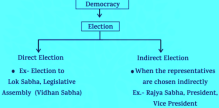
Types of Democracy
1. Direct democracy
- People participate directly in the decision making. For ex.- Garm Sabha in Panchayat
- Types of Direct Democracy
- Referendum
- Recall
- Initiative
- Plebiscite – Border disputes
2. Indirect Democracy
- It is also known as representative democracy.
- Decisions are taken by the elected representatives
- MP/MLA
Goals of the Preamble
• Justice
- The idea of justice embodied in the constitution is of integrated and holistic kind.
- It envisages social justice, economic justice and political justice.
➢ Social Justice :
→ There should not be any social discrinination based on religion, race, caste, sex, place of birth.
→ There is no place for caste discrimination, religious discrimination, gender discrimination, untouchability, social deprivation etc.
➢ Economic Justice
→ It means providing livelihood opportunity for citizens.
→ Equal pay for equal work
→ Minimising economic inequalitites in societies, reducing concentration of wealth in few hands.
➢ Political Justice
→ It means the citizens enjoy equal political rights.
→ Ex.- Right to freedom of Speech & Expression, Right to vote, Universal Adult Franchise, equal Fundamental Rights, Right to form associations.
Note :
Domicile
- Not the criteria of place of Birth
- It shows the residence criteria
- Parliament can make laws making residence as a ceriteria for certain type of employments.
Liberty
- It means absence of restraint
- Five types of Liberty –
1. Liberty of thought
2. Expression
3. Belief
4. Faith and
5. Worship
- Liberty of thought & expression is provided under Artice 19 (1) of the constitution.
- Liberty of Belief, faith and worship is guaranteed by Right to freedom of religion under Article- 25,26, 27, 28.
Equality
Two types –
1. Equality of status
2. Equality of opportunity
| Status | Opportunity |
| Right to Equality (Art-14) Equality before law No discrimination on the basis of caste, religion, race, sex, place of Birth (Art-15)Abolition of untouchability (Art-17)Abolition of titles (Art-18) | Equal protection of laws (Art-14)Affirmative actions for woman, children. SC/ST/ BC/EWS etc. (Art-15, 16) |
Fraternity
- It means a sense of Brotherhood.
- It promotes national integration
- It is essential to secure dignity of the individuals and promote unity and integrity of the country.
- Fraternity is promoted by Fundamental duties
- Threats to Fraternity are :- Hate Speech , Communal /Caste Politics , Regionalism , Linguism
- It assures that the unity, integrity and sovereignty remains intact.
Is preamble part of the constitution or Not ?
- Supreme court gave different interpretations
- In Berubari Union Case (1960) : Supreme court held the view that preamble is not a part of the constitution.
- In Kesavananda Bharati Case (1973) Supreme court held that preamble is a part of the constitution.
- In the LIC of India case (1995) the supreme court reaffirmed that preamble is an integral part of the constitution.
- However it is not justiciable in nature.
- Also it is not a source of authority to the legislature.
| Procedure Established by Law | Due Process of Law |
| British concept Focus is on procedure of Law making.Law is considered fair if the procedure for legislation was correct. | American concept Its focus is on the fairness, reasonablenessand just laws.The Law should be fair, just & resonable.If any law which follows the procedures but if it is unreasonable then it will declared void by judiciary. |
Note :-
- Art-21 (Fundamental Right to life & personal liberty)
- No one shall be deprived of his life & personal liberty except “procedure established by law”.
- In the Maneka Gandhi Case Judgment 1978 Supreme Court applied the principle of Due process of law and said that it is implicit in Article-21 of the constitution.
FAQs
1. The preamble of the Indian Constitution is based on the basis of which historical document?
(A) Objective Resolution, 1946
(B) American Declaration of Independence
(C) Nehru Report, 1928
(D) Government of India Act, 1946
Ans :- (A) Objective Resolution, 1946
- The Preamble of the Indian Constitution is based on the objective resolution drafted and moved by Pandit Nehru and adopted by the constituent assembly.
2. In which of the following cases Supreme Court Of India held that Preamble can be amended?
(A) Golakhnath Case
(B) Kesavananda Bharati Case
(C) Minerva Mills Case
(D) Vishakha Case
Ans :- (B) Kesavananda Bharati Case
- In Kesavananda Bharati case Supreme Court (13 Judges bench) held that Preamble is a part of the Constitution and it can be amended.
- Article 368 deals with the Constitutional Amendment.
- The doctrine of Basic Structure came into effect from the Kesavananda Bharati case.
3. What does ‘Liberty of thought, expression, belief, faith, and worship’ in the preamble signify?
(A) Right to property
(B) Religious freedom only
(C) Freedom of speech and religion
(D) Socialism
Ans :- (C) Freedom of speech and religion
- The term liberty ensures freedom of speech, expression, belief, and religion.
4. Which of the following does not match the preamble?
(A) Republic – Elected head of state
(B) Sovereign – Independent of foreign control
(C) Socialist – Government controls all industries
(D) Secular – No official religion
Ans :- (C) Socialist – Government controls all industries
- Indian socialism is democratic, allowing both public and private industries.
5. Which case ruled that the preamble is a key to interpreting the constitution?
(A) Golaknath case, 1967
(B) Kesavananda Bharti case, 1973
(C) Berubari union case, 1960
(D) Minerva Mills case, 1980
Ans :- (C) Berubari union case, 1960
- The supreme court in the Berubari union case (1960) states that the preamble cannot be considered as a part of the constitution but is a key to its interpretation.
6. Select the correct sequence of goals in the preamble?
(A) Equality, Justice, Fraternity, Liberty
(B) Justice, Liberty, Fraternity, Equality
(C) Justice, Liberty, Equality, Fraternity
(D) Equality, Justice, Liberty, Fraternity
Ans :- (C) Justice, Liberty, Equality, Fraternity