
Citizenship in India
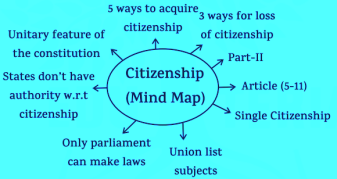
- The provisions of citizenship are mentioned in Part-II of the constitution and Articles 5-11 of the constitution.
- The citizenship is a subject of union list in seventh schedule.
- Only the parliament of India has the authority to make laws with respect to citizenship.
- The provisions of citizenship illustrate the unitary features of the constitution.
- India has the provision of Single Citizenship.
- Single Citizenship means there is no provision for state citizenship in India, also an Indian citizen can not hold citizenship of other country simultaneously.
- Few countries like USA provide for dual citizenship it means a citizen of USA has the state citizenship also and can hold citizenship of other countries also.
| Citizenship in India | Citizenship in USA |
| Single citizenship A person having Indian citizenship cann’t hold the citizenship of other countries simultaneously. | Dual citizenship USA citizens can hold simultaneously the citizenship of other countries provided that such countries also provide dual citizenship. |
Citizenship : Constitutional Provisions
- The Constitution of India provides the legal framework for Indian citizenship under Part II (Articles 5 to 11). It defines who is considered an Indian citizen at the commencement of the Constitution and empowers Parliament to regulate citizenship laws. States in India don’t have any say in the Citizenship provisions therefore Single Citizenship is the Unitary feature of the Constitution.
Article 5 – Citizenship at the commencement of the Constitution
- A person domiciled in India and
- Born in India, or
- Either parent was born in India, or
- Lived in India for at least 5 years before 26th January 1950 → is considered an Indian citizen.
Article 6 – Citizenship for migrants from Pakistan.
- If the Migrant, or either of his/her parents or either of his/her grandparents were born in India as defined in the Government of India Act-1935.
- Persons who migrated from Pakistan to India before 19 July 1948 were given citizenship.
- Those who migrated after this date had to register and stay for at least 6 months in India.
Article 7 – Citizenship for persons who migrated to Pakistan but later returned to India.
- People who migrated to Pakistan after March 1, 1947, but later returned to India with resettlement permits, were granted citizenship.
Article 8- Citizenship for Indians living abroad.
- Persons of Indian origin living outside India could acquire citizenship by registering with Indian diplomatic offices.
Article 9 – No dual citizenship
- If an Indian voluntarily acquires citizenship of another country, they lose Indian citizenship.
Article 10 – Continuation of citizenship
- Any person recognised as a citizen under these provisions continues to be a citizen unless Parliament makes a law to the contrary.
Article 11 – Parliament’s power to regulate citizenship
- Parliament has the authority to make laws regarding the acquisition and termination of Indian citizenship. This led to the enactment of the Citizenship Act, 1955, which governs citizenship rules in India.
Ways to acquire citizenship in India
- The Parliament of India has enacted “Citizenship Act, 1955” and it contains the detailed provisions with regard to acquisition and loss of Indian citizenship.
- The Citizenship Act, 1955 provides 5 ways for the acquisition of citizenship
1. By Birth
2. By Descent
3. By Registration
4. By Naturalisation
5. By incorporation of territory
1. By Birth
- A person born in India on or after January 26, 1950, and before July 1, 1987, is a citizen of India by birth.
- For those born on or after July 1, 1987, at least one parent must be an Indian citizen at the time of their birth.
- For individuals born on or after December 3, 2004, citizenship by birth is granted only if :–
- Both parents are Indian citizens, or
- One parent is an Indian citizen, and the other is not an illegal migrant.
2. By Descent
- A person born outside India on or after January 26, 1950, but before December 10, 1992, is a citizen of India by descent if their father was an Indian citizen at the time of their birth.
- For those born outside India on or after December 10, 1992, either parent must be an Indian citizen, and the child’s birth must be registered with an Indian consulate within one year (or with permission after this period).
3. By Registration
- Certain categories of persons can acquire citizenship through registration, including :-
- Persons of Indian origin residing in India for 7 years before applying.
- Persons married to Indian citizens and residing in India for 7 years.
- Minor children of Indian citizens.
- Persons of Indian origin residing in countries outside undivided India.
4. By Naturalization
- A foreign national who has resided in India for 12 years (continuously for 1 year prior to application and 11 years in aggregate in the preceding 14 years) can apply for Indian citizenship, provided they meet certain qualifications, including a good moral character and renunciation of their original citizenship.
5. By Incorporation of Territory
- If a foreign territory becomes part of India, the Government of India may specify the conditions under which the people of that territory may acquire Indian citizenship. For example, people from Sikkim acquired Indian citizenship when it became a part of India in 1975.
Loss of Indian Citizenship
- Indian citizenship can be lost in three ways as outlined under the Citizenship Act, 1955:
1. By Renunciation :
- If an Indian citizen voluntarily renounces their Indian citizenship by applying to the government, their citizenship is terminated. However during war times of which India is a party the Indian Government shall withhold giving authorisation for renunciation of Citizenship.
- If a person renounces Indian citizenship, their minor children also lose Indian citizenship but can regain it when they turn 18 years old.
2. By Termination :
- If an Indian citizen voluntarily acquires citizenship of another country, their Indian citizenship automatically terminates.
- No formal declaration is required; the moment a person gets foreign citizenship, their Indian citizenship ends.
- This provision reinforces India’s policy of not allowing dual citizenship. However this provision does not apply during war.
3. By Deprivation :
- The Government of India can deprive a person of their Indian citizenship under certain conditions. This applies only to citizens by naturalization or registration, not by birth or descent. A person can lose citizenship if :-
- Citizenship was acquired fraudulently – If someone obtained citizenship through misrepresentation or concealment of facts.
- Disloyalty to the Indian Constitution – If a person shows disloyalty or acts against the sovereignty, security, or integrity of India.
- Assistance to an enemy country – If a person, during war, unlawfully communicated or traded with an enemy country.
- Criminal Conviction – If a person is sentenced to imprisonment for 2 years or more within 5 years of acquiring citizenship.
- Continuous residence outside India – If a citizen lives outside India for 7 years without officially informing the Indian consulate.
Overseas Citizens of India (OCI)
- Persons of Indian Origin (PIO) and Overseas Citizens of India (OCI) are classifications of individuals of Indian ancestry who reside outside India. These categories are part of India’s effort to maintain connections with its diaspora while granting them certain privileges.
- The PIO scheme was merged with the OCI scheme in 2015, creating a unified category under the OCI framework. OCI is a visa-like document provided to individuals of Indian origin who have acquired foreign citizenship but still want to maintain their connection with India.
Eligibility:
- A person who was eligible to become a citizen of India on January 26, 1950.
- Descendants of such persons up to four generations.
- Excludes citizens of countries like Pakistan, Bangladesh, China, and a few others.
Key Rights Granted to OCI Cardholders
- OCI cardholders enjoy several rights in India, though they are not considered Indian citizens.
- Here are the key benefits :
1. Entry and Stay in India :- Lifetime visa-free travel to India for any purpose. Exemption from registration with the Foreigners Regional Registration Office (FRRO) for any length of stay in India.
2. Property Ownership :- Can purchase immovable property in India, except for agricultural land, plantation properties, and farmhouses.
3. Employment and Education :- Eligible for employment in the private sector, except for government jobs or positions requiring security clearance. Can study in Indian institutions under the same conditions as Non-Resident Indians (NRIs).
4. Economic Rights :- Can open and maintain bank accounts in India under NRO (NonResident Ordinary) accounts. Eligible to invest in businesses and mutual funds under certain conditions.
5. Cultural and Social Rights :- Can participate in cultural and religious activities freely.
Restrictions on OCI Cardholders
- No Political Rights :- Cannot vote in Indian elections.
- Cannot contest elections or hold constitutional offices (e.g., President, Vice President, Member of Parliament).
- No Government Jobs :- Ineligible for government jobs or positions requiring security clearance.
- No Purchase of Agricultural Land :- Cannot own agricultural land, plantation properties, or farmhouses.
- No Dual Citizenship :- India does not allow dual citizenship. OCl is not equivalent to Indian citizenship; it is a residency and travel privilege.
CAA & NRC
Citizenship in India
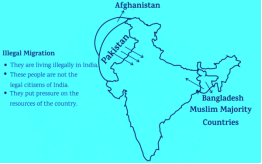
- Parliament of India Amended the citizenship Act, 1955 to allow granting citizenships to the (Non-Muslim religions) migrants from Pakistan, Afghanistan and Bangladesh and belonging to six religions (Hindus, Buddhists, Jains, Parsis, Christians and Sikhs).
- The ground for granting citizenship to these migrants is that they are religious minorities in their countries and they are suffering from religious persecution.
Issues with CAA
- Violates Right to equality :- Excluding Muslims is violating the Right to equality of these people.
- Selective Humanism :- The Tamils in Srilanka, Rohingya Muslims in Mayanmar, Ahmadiya Muslims in Pakistan also face religious persecution. But these groups have been excluded from the ambit of CAA-2019. Therefore it promotes the selective humanism.
- Threatens the Secular credentials of India :- India is a secular country which treats all religions equally but the CAA-2019 excludes Muslims from its purview therefore it undermines the secular credentials of India.
- No legal Clarity :- Idendification of the illegal migrants who would be given citizenship remains a challenge.
- CAA & NRC together may lead to detention of people and may create a pool of stateless people.
- The provisions of the CAA has been enforced & the people are being given citizenship under this Act.
NRC (National Register of Citizens)
- NRC is a register containing details of all legal citizens of India. It aims to identify individuals who are Indian citizens and exclude illegal immigrants.
- The NRC was first created in 1951 following the Census, primarily for Assam, to document citizens and their place of residence.
- An updated NRC for Assam was published on August 31, 2019, following a Supreme Court monitored process. Over 1.9 million people were excluded from this list.
- Assam has a history that is shaped by migration. The Assam Accord, signed by the governments of Assam and India, and the All Assam Students’ Union (AASU) and the All Assam Gana Sangram Parishad in 1985, after a six-year mass movement, essentially declared that a resident of Assam is an Indian citizen if she could prove her presence, or an ancestor’s presence, in Assam before March 25, 1971.
- The main purpose of NRC is to identify the legal citizens of India and to filter out illegal migrants in India.
- Many people in India are residing illegally and they are draining the resources of the country.
- Proposed Nationwide NRC :- The Indian government has expressed intentions to implement a nationwide NRC, but details and timelines remain unclear. A nationwide NRC would require individuals across India to provide documentation to prove their citizenship.
Assam Accord
- The Assam Accord was signed on 15 August 1985 between the Government of India (Rajiv Gandhi Govt) and the leaders of the Assam Movement, which was led by the All Assam Students’ Union (AASU) and the All Assam Gana Sangram Parishad (AAGSP).
- It aimed to resolve the issue of illegal immigration from Bangladesh, which had caused political and demographic unrest in Assam.
- Illegal Immigration Issue : Assam witnessed large-scale illegal immigration from East Pakistan (now Bangladesh) since before India’s independence. After the 1971 Bangladesh Liberation War, the influx increased significantly, creating economic and political tensions.
- Detection and Deportation of Illegal Immigrants : Those who entered Assam before 1 January 1966 were to be considered Indian citizens. Those who entered between 1 January 1966 and 24 March 1971 were to be detected and allowed citizenship after 10 years. Those who entered on or after 25 March 1971 were to be deported.
NRC and Citizenship Issues
- Verification of Citizenship :- The NRC requires individuals to prove their citizenship through documentary evidence, such as birth certificates, voter ID, or land records. Those unable to provide the required documents are at risk of being declared stateless or illegal immigrants.
- Connection with Assam :- In Assam, NRC updating was tied to Section 6A of the Citizenship Act, 1955, which provided a mechanism for identifying Indian citizens and illegal immigrants based on the cut-off date of March 25, 1971. The process has been contentious due to errors, exclusion of genuine citizens, and inclusion of ineligible individuals.
- Link with Citizenship Amendment Act (CAA), 2019 :- The CAA grants citizenship to NonMuslim persecuted minorities from Afghanistan, Bangladesh, and Pakistan who entered India on or before December 31, 2014. Critics argue that the CAA and NRC together may lead to religious discrimination, as the CAA protects certain groups but excludes Muslims.
- In states like Assam, where demographic concerns are significant, the CAA is viewed as undermining the NRC’s objective of protecting native identities.
- Legal and Humanitarian Concerns :- People excluded from the NRC may have to appeal to Foreigners Tribunals to prove their citizenship. There is a risk of creating a large population of stateless individuals who lack citizenship rights but cannot be deported. Critics warn of potential misuse and marginalization, particularly of economically weaker sections and minority communities and they may have to suffer in Detention Centres if declared illegal immigrants.
- Administrative and Practical Challenges :- Ensuring accurate documentation for millions of people across India is logistically complex. The process may disproportionately affect those in rural areas, poor communities, and marginalized groups, who often lack proper records.
Why does India need NRC?
- The idea of a National Register of Citizens (NRC) in India is often justified on various grounds, primarily related to national security, migration management, and preserving the cultural identity of indigenous populations.
1. To Address Illegal Immigration :
- Unregulated Migration :- India shares long and porous borders with countries like Bangladesh, Myanmar, and Nepal. This has historically led to unregulated migration, particularly from Bangladesh.
- Demographic Concerns :- In states like Assam and parts of the northeast, the influx of migrants is perceived to have altered the demographic balance, leading to cultural and linguistic dilution.
- Economic Strain :- Large numbers of illegal immigrants can place pressure on public services, employment opportunities, and resources.
2. National Security
- Terrorism and Border Security :- An NRC is seen as a tool to identify and prevent potential threats, such as individuals who may pose a security risk or engage in antinational activities
- Countering Organized Crime :- Migrants without proper documentation can become vulnerable to exploitation by criminal networks, including trafficking and smuggling.
3. Preservation of Indigenous and Regional Identity
- Assam and the Northeast :- The NRC has been a longstanding demand in Assam to protect the identity and rights of the indigenous population, as enshrined in the Assam Accord (1985).
- Cultural Preservation :- Many local communities fear the loss of their cultural, linguistic, and ethnic identity due to an influx of migrants.
4. Regularization of Citizenship
- Streamlining Citizenship :- The NRC could provide a comprehensive framework to streamline and formalize citizenship, ensuring that only eligible individuals receive the rights and privileges of Indian citizenship.
- Legal Clarity :- It would help differentiate between citizens, legal migrants, and illegal migrants, reducing ambiguity in legal and administrative matters.
5. Facilitating Welfare Distribution
- Targeted Welfare Programs: By identifying citizens, the NRC could ensure that welfare schemes and government benefits reach only legitimate beneficiaries.
- Reducing Leakage: It can minimize leakages in public distribution systems by excluding ineligible individuals.
6. Fulfilling Constitutional Obligations
- Rule of Law :- The Constitution of India and various laws require the government to address issues of illegal immigration and ensure that citizenship laws are upheld.
- Global Precedents : Many countries maintain population registers to regulate migration and citizenship, and proponents argue that India, as a rapidly developing country, should adopt similar measures.
Challenges and Concerns in NRC implementation
While there are reasons to justify the NRC, implementing it is fraught with challenges:
- Documentation Issues : Many citizens, particularly in rural areas, lack formal documents, making it difficult to prove their citizenship.
- Risk of Statelessness : A poorly implemented NRC could create a large population of stateless individuals, leading to humanitarian crises.
- Religious and Ethnic Tensions : Linking the NRC with laws like the Citizenship Amendment Act (CAA) raises fears of religious discrimination and marginalization of minority groups, especially Muslims.
- Cost and Feasibility : Conducting a nationwide NRC would require massive administrative resources and financial investment, with no guarantee of error-free implementation
- Social Unrest : The NRC has the potential to exacerbate existing social tensions, as seen during its implementation in Assam, where protests and controversies arose over exclusions.
Way Forward
- Transparent and Inclusive Process: The government should ensure that the NRC process is transparent, inclusive, and free from discrimination.
- Clear Legal Framework: Establish a clear and consistent legal framework for citizenship verification to avoid ambiguity and reduce public fear.
- Protecting Human Rights: Safeguards must be in place to prevent the creation of stateless individuals human rights violations.
- Focus on Dialogue: Engage stakeholders, including state governments and civil society, to address concerns and find balanced solutions.
- Strengthen Border Management: Improve border security and migration control to reduce reliance retrospective measures like the NRC.
- International Cooperation: Work with neighbouring countries to resolve migration issues diplomatically.
- The NRC remains a contentious issue, reflecting broader challenges related to citizenship, identity, and migration in India. Its implementation will significantly impact the social and political fabric of the country.
FAQs
1. Which article of the Constitution defines who shall be the citizens of India at the commencement of the Constitution?
(A) Article 5 (B) Article 6
(C) Article 7 (D) Article 8
Ans :- (A) Article 5
- Article 5 defines citizenship for people domiciled in India at the commencement of the Constitution (26th January 1950).
2. Which of the following is NOT a mode of acquiring Indian Citizenship?
(A) By Birth (B) By Descent
(C) By Registration (D) By Seizure
Ans :- (D) By Seizure
- Indian citizenship can be acquired by Birth, Descent, Registration, Naturalization, and Incorporation of Territory. “Seizure” is not a mode of acquiring citizenship.
3. Which of the following conditions can lead to the termination of Indian Citizenship?
(A) Renunciation
(B) Acquisition of Citizenship of another country
(C) Fraud in obtaining citizenship
(D) All of the above
Ans :- (D) All of the above
- Citizenship can be renounced, terminated, or revoked if obtained through fraud or acquiring foreign citizenship.
4. Which Act governs the provisions of Indian Citizenship?
(A) The Indian Citizenship Act, 1947
(B) The Indian Citizenship Act, 1950
(C) The Citizenship Act, 1955
(D) The Constitution of India
Ans :- (C) The Citizenship Act, 1955
- The Citizenship Act, 1955 provides detailed provisions on acquiring, terminating, acquiring foreign citizenship.
5. Which article provides the Parliament with the power to make laws regarding citizenship?
(A) Article 5 (B) Article 7
(C) Article 9 (D) Article 11
Ans :- (D) Article 11
- Article 11 empowers Parliament to regulate citizenship by law. Using this power, Parliament enacted the Citizenship Act, 1955.
6. A person who voluntarily acquires the citizenship of another country:
(A) Can hold dual citizenship
(B) Ceases to be an Indian citizen
(C) Can be an Indian citizen only if permitted by the Government
(D) Can regain Indian citizenship automatically
Ans :- (B) Ceases to be an Indian citizen
- Article 9 states that if a person voluntarily acquires another country’s citizenship, they automatically lose Indiancitizenship. India does not allow dual citizenship.
7. The Overseas Citizen of India (OCI) scheme was introduced through which amendment?
(A) Citizenship (Amendment) Act, 1986
(B) Citizenship (Amendment) Act, 1992
(C) Citizenship (Amendment) Act, 2003
(D) Citizenship (Amendment) Act, 2019
Ans :- (C) Citizenship (Amendment) Act, 2003
- The 2003 amendment introduced the OCI (Overseas Citizen of India) card, allowing foreign nationals of Indian origin to reside in India indefinitely. However, it does not grant full citizenship rights.
8. What is the primary difference between an OCI and an NRI?
(A) OCI is a full citizen, while NRl is not
(B) OCI cannot buy agricultural land, while NRI can
(C) NRI cannot vote, while OCI can
(D) Both OCI and NRI can hold an Indian passport
Ans :- (B) OCI cannot buy agricultural land, while NRI can
- NRI (Non-Resident Indian) = Indian citizen living abroad.
- OCI (Overseas Citizen of India) = Foreign national of Indian origin with long-term visa but no voting rights.
- OCI cannot buy agricultural land in India.
9. When was the Citizenship (Amendment) Act passed by the Indian Parliament?
(A) December 9, 2019 (B) December 11, 2019
(C) January 26, 2020 (D) August 15, 2019
Ans :- (B) December 11, 2019
- The Citizenship Amendment Bill (CAB) was passed by Lok Sabha on December 9, 2019 and by Rajya Sabha on December 11, 2019. It became an Act after receiving the President’s assent on December 12, 2019.
10. Which communities are eligible for Indian citizenship under CAA 2019?
(A) Hindus, Sikhs, Buddhists, Jains, Parsis, and Christians
(B) Only Hindus and Sikhs
(C) Only Muslims from neighboring countries
(D) All religious communities from South Asia
Ans :- (A) Hindus, Sikhs, Buddhists, Jains, Parsis, and Christians
- The CAA grants fast-track citizenship to non-Muslim religious minorities from Pakistan, Bangladesh, and Afghanistan who entered India before December 31, 2014, claiming persecution.
11. What is the primary aim of the CAA 2019?
(A) To grant citizenship to all immigrants in India
(B) To provide fast-track citizenship to persecuted minorities from Pakistan, Bangladesh, and Afghanistan
(C) To deport all illegal immigrants from India
(D) To grant citizenship to Indian-origin people worldwide
Ans :- (B) To provide fast-track citizenship to persecuted minorities from Pakistan, Bangladesh, and Afghanistan
- The CAA is designed to help persecuted minorities who fled religious discrimination in these three countries. It does not apply to Indian-origin people worldwide.
12. Which state witnessed the most protests against the CAA?
(A) Uttar Pradesh (B) Assam
(C) Kerala (D) Tamil Nadu
Ans :- (B) Assam
- In Assam, large-scale protests erupted because many feared CAA would grant citizenship to illegal Bengali Hindu immigrants, affecting the state’s demographic balance.
13. Under CAA, how many years of residency in India are required for eligible communities to apply for citizenship?
(A) 5 years (B) 11 years
(C) 7 years (D) 15 years
Ans :- (A) 5 years
- Normally, Indian citizenship by naturalization requires 11 years of residency, but under CAA 2019, it has been reduced to 5 years for eligible communities.
14. Select the correct statements regarding O.C.I. (Overseas Citizens of India).
I. They are similar to N.R.I (Non Resident Indians)
II. They do not have voting rights in Indian election.
(A) I only (B) II only (C) Both I and II (D) Neither 1 nor 2
Ans (B) II only
15. On which of the following grounds the Indian citizenship cann’t be lost?
(A) Acquiring citizenship of other countries. (B) Indulging in anti National activities
(C) Opening a bank account in foreign country (D) Have acquired citizenship by Fraud
Ans (C)Opening a bank account in foreign country
16. Select the incorrect statement regarding citizenship in India.
I. India allows single citizenship.
II. Citizenship is the federal feature of Indian Constitution.
(A) I only (B) II only (C) Both I and II (D) Neither 1 nor 2
Ans(B) II only
17. Who has the authority to make laws with regards to citizenship in India?
(A) President of India (B) State legislature (C) Parliament of India (D) Lok Sabha only
Ans.(C) Parliament of India