
Fundamental Rights
- These are the rights guaranteed by the constitution of India under part-III of the constitution and Articles (12-35).
- The Fundamental Rights have been taken from U.S.A constitution.
- The Fundamental Rights resemble the Bill of Rights mentioned in the U.S.A constitution.
- The Bill of Rights are the first ten amendments of the U.S.A constitution inserted in the year 1791.
- Fundamental Rights are also called as Magna Carta of India.
Note :- Magna Carta is the first written document related to fundamental rights which was signed by King John of England in the year 1215.
Features of the Fundamental Rights
- The Fundamental Rights are Justiciable/Enforceable in nature. It means if the fundamental rights are violated then the aggrieved person can directly go to the Supreme Court or High Court for the enforcement of fundamental rights.
- Few fundamental rights are available to citizens only whereas other fundamental rights are available to citizens as well as non-citizens.
- The Rights under Articles, 15, 16, 19, 29, 30 are available to the citizens only and they are not available for non-citizens.
- Fundamental rights are not absolute in nature it means reasonable restrictions can be put on the fundamental rigths. Due to the reasonable restrictions, the fundamental rights become qualified in nature.
Reasonable restrictions
- Unity, integirity, Sovereignty of India
- Public order
- Morality
- Decency
- Contempt of Court
- Defamation
- Health
- Protection of Scheduled Tribes
- Affirmative actions
- In maintaining friendly relationship with other foreign nations.
| Doctrine of Eclipse | Doctrine of Severability |
| It is applied to pre-constitutional laws. Those pre-constitutional laws will be invalid to the extent that they violate any fundamental rights. If the inconsistency is removed by an amendment to the act then the act will again become valid. | It says that only that part of the law will be declared void which infringes the fundamental rights.The totality of the law will still remain operative. Only the invalid part will be struck off by the court. |
- Fundamental rights promote political democracy.
- Fundamental rights are negative as well as positive in nature.
- Negative nature : It restricts the authority of state as state can not violate fundamental rights of the citizens.
- Positive nature : It promotes state to take affirmative actions for the welfare of women, SCs, STs, OBCs, EWS etc.
- Fundamental Rights can be amended by the Parliament. It was established under Kesavananda Bharati Case-1973. However the basic structures of the constitution cannot be amended. For example :- Right to Property was a Fundamental Right under Article-19 (1) (f) & Article-31 of the constitution, but it was repealed by 44th Constitutional Amendment Act-1978.
| Doctrine of Basic structures |
| It was evolved in Kesavananda Bharati Case-1973. The doctrine of basic structure states that the parliament of India cannot amend the basic structure of the constitution. It is not defined in the constitution. The Supreme Court through Judicial Review decides what constitutes Basic structure or not. |
- Fundamental Rights can be suspended during national emergency. National emergency can be proclaimed by the president of India on the grounds of War, External Aggressionand Armed Rebellion.
- When National emergency is proclaimed the enforcement of fundamental rights can be suspended under Article- 358 & 359 of the constitution.
- The Fundamental rights of the members of Armed Forces can be curtailed by the Parliament of India. (Art.-33)
- The Fundamental rights can also be curtailed in relation to the Martial Laws. (Art.-34)
- For the enforcement of the Fundamental Rights only Parliament is entitled to make laws. State legislatures cannot make laws for the enforcement of Fundamental rights (Art.-35)
Why these rights are called Fundamental Rights ?
- As these rights are guaranteed by the constitution itself which is the fundamental law of the land therefore these Rights are called as Fundamental Rights.
- These rights are essential for the overall development of an Individual so these rights are fundamental.
Fundamental Rights
Six in numbers (Initially 7, but Right to Property repealed) :
1. Right to equality (Art- 14-18)
2. Right to freedom (Art- 19-22)
3. Right against exploitation (Art- 23,24)
4. Right to freedom of Religion (Art- 25, 26, 27, 28)
5. Cultural and Educational Right (Art-29, 30)
6. Right to Constitutional Remedies (Art-32)
Article-12
- It provides the definition of state.
- Since fundamental rights protect the citizens from the tyranny of state therefore it is essential to define the state.
- As per Article-12, the state includes central govt. Parliament of India, State govts, State legislature, Local govts. etc.
Article – 13
- If any law abrogates/violates the Fundamental Rights then such laws will be void.
- In the definition of law it includes by- laws, orders, customs etc.
- However the constitutional amendments are not considered law as per Article-13.
- Article-13 is the basis of judicial Review of the Supreme Courts.
- It means the judiciary can declare a law unconsitutional if it violates fundamental Rights.
- Art-13 is also the source of Consitutional Morality.
Article – 14
- The State shall not deny to any person equality before the law or the equal protection of the laws within the territory of India.
- Equality Before Law & Equal Protection of Laws :- These two Principles are enshrined in Article 14 of the Indian Constitution and form the foundation of the Right to Equality.
- Equality Before Law (British Concept – Negative Aspect) :- This principle means that all individuals are treated the same under the law, regardless of their status, wealth or position. It follows the principle of “Rule of Law” -which means that no one is above the law.
- Equal Protection of Laws (American Concept – Positive Aspect) :- This principle ensures that the state treats equals equally and can make reasonable classifications to address inequalities. It allows the government to create special provisions for disadvantaged groups.
| Equality Before Law | Equal Protection of Laws |
| Negative in nature (restricts privileges).Focuses on equal treatment for all individuals.Prevents special privileges for anyone.Example: A minister and a citizen are punished equally for the same crime. | Positive in nature (allows affirmative action).Allows reasonable classification for social justice.Enables special provisions for disadvantaged groups.Example: Reservations for SCs, STs, OBCs, and EWS to promote equality. |
Exceptions to equality
- While Right to Equality is a fundamental right, certain officials and laws are granted immunity for governance, diplomacy, and legislative functioning. These exceptions are designed to ensure the smooth operation of democracy and international relations.
| Category | Exception | Example | |
| President & Governor(Article 361) | No criminal proceedings while in Office | President cannot be arrested | |
| MPs & MLAs (Articles105 & 194) | Immunity for speeches & votes in Legislature | MP criticizing govt in Parliament is protected | |
| MPS & MLAs (Article361A) | No legal action for publishing legislative proceedings | Reporting parliamentary debates in newspapers is Protected | |
| DPSP-based Laws(Article 31C) | Cannot be challenged under Article 14. | Laws reducing wealth inequality are protected | |
| Foreign Diplomats | Full diplomatic immunity(Vienna Convention, 1961) | U.S. Ambassador in India cannot be sued. | |
Article 361: Immunity to the President & Governors
- No Criminal Proceedings During Term :- The President of India and State Governors cannot be prosecuted or arrested while in office for official or personal acts.
Example : If the President or Governor commits an offense, legal action can be taken only after they leave office.
- No arrest during office :- No process for the arrest or imprisonment of the President, or the Governor of a State, shall issue from any court during his term of office.
- No Civil Proceedings Without Notice :- A civil case (lawsuit) against the President or Governor for their personal acts can be filed only if a two-month advance notice is given.
- Acts Done in Official Capacity Cannot Be Questioned :- The President, or the Governor of a State, shall not be answerable to any court for the exercise and performance of the powers and duties of his office.
Article 31C : Laws Implementing Directive Principles (DPSPs) Overrule Article 14
- Certain laws that implement Directive Principles (DPSPs) cannot be challenged for violating Right to Equality (Article 14). Article 31C was inserted by 25th CAA 1971.
Example : If a law is made to reduce economic inequality (DPSP under Article 39(b) & (c)),it will have immunity from being challenged under Article 14.
- Article 39 (b) : “That the ownership and control of the material resources of the community are so distributed as best to subserve the common good.”
- Article 39 (c) : “That the operation of the economic system does not result in the concentration of wealth and means of production to the common detriment.”
| Fundamental Rights | D.P.S.P (Article 36-51) |
| Justiciable In case of breach of fundamental rights one can approach Supreme Court directly for the enforcement of fundamental rights. | Non-justiciable in nature.These are fundamental to the governance of the country. State shall incorporate these principles while making laws. |
Article 15 : Prohibition of discrimination on grounds of religion, race, caste, sex or place of birth.
1. Prohibition of Discrimination :- The State shall not discriminate against any citizen on grounds only of religion, race, caste, sex, or place of birth.
2. No Restriction on Public Access :- No citizen shall be subjected to any disability, liability, restriction, or condition on grounds only of religion, race, caste, sex, or place of birth concerning:
- Access to shops, public restaurants, hotels, and places of public entertainment.
- Use of wells, tanks, bathing ghats, roads, and places of public resort maintained wholly or partly by State funds or open to the general public.
3. Special Provisions for Women and Children :- The State can make special provisions for women and children. This allows affirmative actions like reservations in education, employment, and protection laws.
4. Special Provision for Socially Disadvantaged Groups :- The State can make special provisions for the advancement of socially and educationally backward classes of citizens, Scheduled Castes (SCs), and Scheduled Tribes (STs). This clause enables reservations in education and employment. This clause 15(4) was added by 1st Constitutional amendment act 1951, after the SC judgement in Champakam Dorairajan (1951) case,which ruled that caste-based reservations violated Article 15(1).
- Champakam Dorairajan Case-1951 :- She was from Madras & she was denied admission in a medical college despite having more marks than those candidates who were getting caste based reservations.
5. Reservations in Educational Institutions :- The State can make special provisions for the advancement of Scheduled Castes (SCs), Scheduled Tribes (STs), and socially and educationally backward classes concerning admission to educational institutions, including private institutions (except minority institutions under Article 30). This provision was added in article 15 as Clause (5) by the 93rd Constitutional Amendment Act, 2005.
6. EWS Reservation :- 103rd Constitutional Amendment Act, 2019, added Clause (6) in Article
15 to introduce 10% reservation for Economically Weaker Sections (EWS) in education.
Supreme Court Judgements on Article 15
(i) State of Madras v. Champakam Dorairajan (1951) : The Madras government had reserved seats in medical and engineering colleges based on caste. The Supreme Court ruled that such caste-based reservations violated Article 15(1). It led to the First Constitutional Amendment (1951), which added Article 15(4) allowing special provisions for backward classes.
(ii) Indra Sawhney v. Union of India (1992) – Mandal Commission Case :- The challenge to 27% reservation for Other Backward Classes (OBCs) in government jobs. SC upheld OВС reservations but introduced the “creamy layer” concept (wealthier OBCs should be excluded). It ruled that reservation cannot exceed 50%, except in exceptional circumstances. It strengthened the affirmative action framework in India.
(iii)The Economic Weaker Section (EWS) Case – Janhit Abhiyan v. Union of India (2022) :- Validity of 10% reservation for Economically Weaker Sections (EWS) under the 103rd Constitutional Amendment (2019) was reviewed. SC upheld EWS reservation, stating it did not violate basic structure of the Constitution.
Article 16 : Equality of opportunity in matters of public employment.
- Clause (1): Equality of Opportunity : “There shall be equality of opportunity for all citizens in matters relating to employment or appointment under the State.” It ensures that every citizen has an equal right to public employment without any discrimination.
- Clause (2): Prohibition of Discrimination : “No citizen shall be discriminated against in public employment on grounds only of religion, race, caste, sex, descent, place of birth, or residence.” It prevents the State from favoring or disadvantaging any individual based on these factors.
- Clause (3): Residence-Based Employment : “Parliament may make laws prescribing residence as a condition for certain government jobs.” It allows Parliament to create statespecific employment rules, especially for backward regions.
- Clause (4): Reservation for Backward Classes : “The State may make provisions for the reservation of appointments or posts in favor of any backward class of citizens who are not adequately represented in public services.” Provides the constitutional basis for reservations for Scheduled Castes (SCs), Scheduled Tribes (STs), and Other Backward Classes (OBCs).
- Clause (4A): Reservation in Promotions : “The State may make provisions for reservation in promotions in favor of Scheduled Castes (SCs) and Scheduled Tribes (STs), if they are not adequately represented in public employment.” Added by 77th Constitutional Amendment Act, 1995 following the Indra Sawhney Case (1992).
- Clause (4B): Carry-Forward Rule for Vacant Reserved Posts : “Unfilled reserved vacancies in promotions can be carried forward to the next year.” Added by 81st Constitutional Amendment Act, 2000. It ensures backlog vacancies in reserved categories are not wasted.
- Clause (5): Exemption of Religious & Minority Institutions : “Nothing in this article shall prevent the State from making special provisions for the reservation in educational institutions, including private institutions, except those run by religious or minority institutions.” Added by 93rd Constitutional Amendment Act, 2005. It ensures autonomy of minority-run institutions under Article 30.
- Clause (6): Reservation for Economically Weaker Sections (EWS) : “The State may provide reservations for EWS in public employment up to 10%.” Added by 103rd Constitutional Amendment Act, 2019. It introduced economic criteria for reservations for the first time.
Article 17: abolition of “Untouchability”
- “Untouchability is abolished and its practice in any form is forbidden. The enforcement of any disability arising out of Untouchability shall be an offense punishable in accordance with law.
- To enforce Article 17, the Indian government has enacted several laws :-
(i) The Protection of Civil Rights Act, 1955 : Enacted to enforce Article 17 by making the practice of Untouchability a punishable offense. It declares untouchability as a criminal offense.
(ii) The Scheduled Castes and Scheduled Tribes (Prevention of Atrocities) Act, 1989 : Passed to strengthen legal protection for Dalits and Adivasis against violence and discrimination.
(iii)The Prohibition of Employment as Manual Scavengers and their Rehabilitation Act, 2013 : It aims to eliminate manual scavenging, a practice deeply rooted in castebased untouchability.
Article 18: abolition of “Titles”
(1) No title, not being a military or academic distinction, shall be conferred by the State.
(2) No citizen of India shall accept any title from any foreign State.
(3) No person who is not a citizen of India shall, while he holds any office of profit or trust under the State, accept without the consent of the President any title from any foreign State.
(4) No person holding any office of profit or trust under the State shall, without the consent of the President, accept any present, emolument, or office of any kind from or under any foreign State.
Note:- It abolished British-era titles like Rai Bahadur, Rai Sahib, and Zamindar. Also the Supreme Court in Balaji Raghavan v. Union of India (1996) held that national awards like Bharat Ratna, Padma Awards, etc are not titles under Article 18 as they do not grant special privileges.
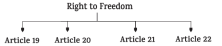
Article 19
- It comes under “right to freedom”.
- Article- 19 (1) provides six freedoms.
- The provisions of Article-19 are available to the Indian citizens only and these are not available to non-citizens.
- These freedoms are not absolute in nature and reasonable restrictions can be put on it.
- Article 19 (1) [Six Freedoms]
- Article 19 (1) (a) – Freedom of speech & expression
- Article 19 (1) (b) – Freedom to Assemble peacefully & without arms
- Article 19 (1) (c) – Freedom to form associations, union & co-operative societies
- Article 19 (1) (d) – Freedom to travel throughout the territory of India
- Article 19 (1) (e) – Freedom to reside & settle in any part of the country
- Article 19 (1) (f) – Related to Right to property (Repealed by 44th amendment of the constitution)
→ Article 31 & Article 19 (1) (f) – related to Right to property and it has been repealed by 44th CAA-1978
- Article 19 (1) (g) – Freedom to practice any profession, or to carry on any occupation, trade or business.
Article 19
- It is not absolute in nature.
- Reasonable restrictions can be put on these freedoms.
- Judiciary is the final interpreter of the constitution & supreme court is the guarantor of fundamental rights.
- Judiciary will decide whether the restrictions are reasonable or not.
Reasonable restictions on these freedoms [Art-19 (2)]
- Freedom of Speech & Expression Restrictions can be imposed on the following grounds :-
- Sovereignty and integrity of India
- Security of State
- Friendly relations with countries
- Public order
- Decency & Morality
- Contempt of court
- Incitement to an offence
- Defamation
- Freedom to Assemble peacefully and without arms :- Restrictions can be imposed on the grounds of Sovereignty and Integrity of India and public order.
- Freedom to form associations, unions or cooperative societies :- Restrictions can be imposed on grounds of Sovereignty & Integrity of India, public order and morality.
- Freedom to move freely throughout India :- Restrictions can be placed in the interests of the general public and protection of the interests of the scheduled tribes to safeguard their culture.
- Freedom to reside and settle in any part of India :- Restrictions can be placed in the interests of the general public and protection of the interests of the scheduled tribes.
- Freedom to practice any profession or business
- Restrictions can be placed in the interest of the general public, can provide necessary professional or technical qualifications and may also reserve few industries or services which may be exclusively carried on by the state.
- The state can have monopoly in few sectors.
Cases related to Article 19
1) LGBT Rights: In Navtej Singh Johar case (2018) SC held that section 377 IPC violated article 19 (1)(a) of the constitution as it curbs the fundamental rights of freedom of expression and choice of the LGBT Community. Seс 377 was declared unconstitutional.
2) Right to Know and Information: Freedom of speech is based on the foundation of freedom of right to know.
3) Liquor trade : There is no fundamental right to carry on business of intoxicants under article 19(1)(g). The state has the exclusive right to impose reasonable restrictions on Liquor manufacturing, sale and trade.
4) Right to Rehabilitation : (Narmada Bachao Andolan v. Union of India (2000)) – The SC held that displacement due to development projects should ensure proper rehabilitation, linking it to freedom of residence and movement.
5) No Fundamental Right to Strike : (T.K. Rangarajan v. Government of Tamil Nadu (2003)) – The SC ruled that government employees do not have a fundamental right to strike, but peaceful protests are permitted.
6) Press Freedom: (Romesh Thapar v. State of Madras (1950)) – The Supreme Court ruled that freedom of speech and expression is the foundation of democracy and includes the freedom of the press.
7) Shreya Singhal v. Union of India (2015) – Section 66A of the IT Act, 2000 was struck down as unconstitutional because it curbed free speech on the internet under vague and arbitrary terms like “offensive” and “annoying.”
8) Striking down Electoral Bonds: Supreme Court observed that electoral bonds because of non transparency violated the right to information under article 19(1)(a) of the constitution.
- The electoral bonds were declared unconstitutional by the supreme court.
Article 20
- It also comes under “Right to Freedom” as a Fundamental Right.
- It is available to citizens as well as non-citizens.
- It protects individuals from arbitrary conviction and punishments.
- It safeguards the individuals from despotism and dictatorship of state.
- It is about protection in respect for conviction of offences.
- Article 20 provides three types of protections
(a) Protection against “Ex-Post Facto Laws” – No retrospective criminal laws.
(b) Protection against “Double Jeopardy” – The same person cannot be punished twice for the same offence.
(c) Protection against “Self incriminination”- A person can not be forced to give evidence against himself.
Article 21
- Rights to life & personal liberty.
- It says that no one shall be deprived of his life and personal liberty except procedure established by law.
- This right is available to citizens as well as non-citizens.
- In the Maneka Gandhi Case-1978, Supreme Court held that the doctrine of Due Process of Law is implicit in Article 21.
Procedure Established by Law Vs Due Process of Law
- Procedure Established by Law: The term “Procedure Established by Law” means that a law must be followed as laid down by the legislature. If the procedure is legally valid, it is considered constitutional, regardless of whether it is just or fair.
- It focuses solely on whether the procedure is lawful, not necessarily if it is just or reasonable.
- Due Process of Law : Due process of law is a broader concept that ensures not just procedural legality but also fairness and justice in legal proceedings.
- It implies that the law must be fair, just, and reasonable and cannot be arbitrary, capricious, or oppressive. The law must follow the principles of natural justice.
- Maneka Gandhi v. Union of India (1978): In this case, the Supreme Court shifted the understanding of Article 21 by reading it as incorporating principles of due process. The Court required the procedure to be not only lawful but also fair, just, and reasonable.
| Procedure Established by Law Vs Due Process of Law | ||
| Aspect | Procedure Established by Law | Due Process of Law |
| Meaning | Lawful procedure as prescribed by the legislature. | Fair, just, and reasonable procedures for protection of rights. |
| Focus | Focuses on whether the procedure is legally followed. | Focuses on fairness, reasonableness, and justice of the procedure and law. |
| Source | Derived from the Indian Constitution (Article 21). | Derived from American legal tradition and international human rights law. |
| Scope | The procedure need only be lawful. | The procedure must also be reasonable and just. |
| Flexibility | No concern for fairness of the law itself. | Concern for both procedural and substantive fairness of the law. |
| Examples | Preventive Detention under National Security Act (NSA). – Tax laws that might be unfair but lawful. | Maneka Gandhi v. Union of India (1978) (right to life is governed by fair procedures). – Unreasonable detentions or arbitrary laws. |
Article 21 : The cornerstone of life and liberty
- Article 21 of the Indian Constitution guarantees the “Right to Life and Personal Liberty”.
- It states :
- “No person shall be deprived of his life or personal liberty except according to procedure established by law.”
- Over time, the Supreme Court of India has greatly expanded the scope of Article 21,interpreting it not just as the protection of mere physcial existence but as an inclusive right that covers various aspects of human dignity, health and freedoms.
- The key judgments where the Supreme Court has significantly enlarged the ambit of Article 21 :-
1. Maneka Gandhi v. Union of India (1978) : Maneka Gandhi’s passport was impounded by the government under the Passport Act, 1967 without providing a reason. She challenged this on the grounds that it violated her Fundamental Rights under Articles 14, 19 and 21.
Judgment:
→ The Supreme Court expanded the scope of Article 21 by ruling that the “procedure established by law” under Article 21 must be “fair, just, and reasonable”, not merely arbitrary or irrational.
→ The court held that the right to personal liberty includes a right to travel abroad, and the procedure for restricting it must be reasonable.
→ The “due process of law” concept, which was earlier not part of Indian law, was read into Article 21 by the Court, making the right more substantive.
Significance:
→ This judgment significantly broadened Article 21, making it more inclusive and extending protection to the rights related to personal liberty beyond mere physical freedom.
2. Francis Coralic Mullin v. Administrator, Union Territory of Delhi (1981) : (Right to live with dignity)
- The case was triggered by the fact that Francis Coralie Mullin, a foreign national, was kept in detention in a Delhi Jail in poor conditions, which she argued violated her basic rights under Article 21. Mullin challenged the conditions of her detention, starting that her right to live with dignity was being violated.
- She argued that the physical conditions in the prison were so poor that they amounted to a denial of her right to life and personal liberty under Article 21.
- The Supreme Court delivered a progressive and far-reaching judgment in this case. The Court ruled that the right to life under Article 21 is not merely confined to the physical act of living but extends to the right to live with dignity. The Court emphasized thatthe conditions in a prison must be such that they do not degrade the dignity of the individuals detained there. The ruling specifically addressed issues such as :
→ Overcrowding in prisons.
→ Lack of adequate ventilation.
→ Unhygienic conditions.
- It stated that the right to live with dignity is inherent in Article 21, and any violation of this would be unconstitutional.
3. Subhash Kumar v. State of Bihar (1991): “right to clean and healthy environment”
- The case dealt with the pollution of the Ganga river and its impact on the public health and the environment. The petitioner, Subhash Kumar, filed a petition seeking the protection of the environment and the right to a clean and healthy environment.
- The Supreme Court held that the “right to clean and healthy environment” is an essential part of the right to life under Article 21 of the Constitution.
- The Court emphasized that the right to life includes the right to live in a healthy environment.
- It directed the state government to take immediate steps to prevent pollution and protect the environment.
- This was one of the earliest cases in which the Supreme Court recognized that environmental protection is fundamental to human life and that pollution is a violation of the right to life guaranteed under Article 21.
4. Vishaka v. State of Rajasthan (1997): (Right to safe workplace)
- The Supreme Court held that sexual harassment at the workplace violates a woman’s right to life and dignity. It laid down Vishaka Guidelines to address workplace sexual harassment, which later became the framework for legal provisions on sexual harassment.
- Significance: This judgment marked an important step in recognizing gender equality and dignity under Article 21. It recognised “Right to safe workplace as a fundamental right under article 21”.
5. Shatrughan Chauhan v. Union of India (2014) : (“Right to a speedy trial”)
- Several death row convicts had their mercy petitions rejected by the President of India after long delays. Shatrughan Chauhan and other prisoners challenged their death sentences, arguing that: The inordinate delay in deciding mercy petitions caused mental agony and violated Article 21 (Right to Life and Peronal Liberty). The poor mental and physical health of prisoners due to prolonged uncertainly justified commutation of their death sentences to life imprisonment.
- In this case, the Supreme Court ruled that Inordinate delay in the disposal of mercy petitions leads to a violation of the right to life under Article 21.
- The Court emphasized that prolonged delays in the execution of the death sentences violate the convict’s right to life and dignity because of the mental agony and uncertainty caused by the delayed process. The Supreme Court highlighted that death row prisoners face extreme mental distress due to the uncerttainly of their fate. This prolonged period of agony can be equated to “living death”.
- The Court emphasized that the “right to a speedy trial” and the “right to be protected from Prolonged mental torture ” are essential elements of Article 21.
6. National Legal Services Authority Vs. Union of India (2014) : (“Right to dignity to transgenders”.)
- The Supreme Court held that transgender persons fall under the definition of “third gender” and are entitled to the same Fundamental Rights under the Constitution, particularly under Article 21 (Right to Life and Personal Liberty).
- It ruled that the right to life and dignity under Article 21 extends to transgender individuals, ensuring that they are recognized as a dístinct category with rights to social, educational, and economic opportunities. This judgment significantly expanded Article- 21, ensuring that the rights of marginalized communities, such as transgender persons, are protected under the Constitution. It pronounced the “Right to dignity to transgenders”.
7. Puttaswamy v. Union of India (2017): (Right to Privacy Case)
- The Supreme Court unanimously declared that privacy is a fundamental right under Article 21 of the Constitution, and the state can only infringe upon this right if the action is reasonable and justifiable in a democratic society.
- The Court held that privacy includes a person’s right to control personal information and maintain autonomy over personal decisions.
Significance:
→ This ruling expanded Article 21 to explicitly include the “right to privacy”,which had previously been an implied right.
→ It is one of the most significant expansions of Article 21, acknowledging the importance of individual autonomy and dignity.
8. Uttarakhand High Court’s Ruling (2017): “Right of Clean Rivers”
- The Uttarakhand High Court in its landmark judgment in March 2017 ruled that the Ganga and Yamuna are entitled to constitutional rights, under Article 21, which protects the right to life and personal liberty. This included the “right to flow freely, and the right to be protected from pollution and degradation”.
- This judgment was significant as it made the rivers beneficiaries of fundamental rights, marking a shift from their historical treatment as mere natural resources to recognizing them as entities with rights.
9. Navtej Singh Johar v. Union of India (2018):
- Struck down Section 377 as unconstitutional, holding it violated Articles 14, 19, and 21.
- Significance: Recognized LGBTQ+ rights and the importance of dignity and privacyunder the Constitution.
10. Parmanand Katara v. Union of India (1989) – “Right to Emergency Medical Aid”
- A motor accident victim died because hospitals refused to treat him, citing legal complications (police formalities and medico-legal cases).
- Pt. Parmanand Katara, a human rights activist, filed a Public Interest Litigation (PIL) in the Supreme Court, seeking a directive that hospitals must provide immediate medical aid to accident victims without waiting for police clearance.
- The Supreme Court ruled in favor of the petitioner and held that “Right to Life” (Article 21) Includes “Emergency Medical Aid”. Every person has the right to receive immediate medical assistance irrespective of legal or procedural formalities. Saving a life is more important than police investigation.
- It is the landmark judgment ensuring that every accident victim has the right to immediate medical care. It removed legal barriers to emergency treatment, making saving lives the top priority
Article 21 (A): Right to Education
- Article 21A was added by the 86th Constitutional Amendment Act, 2002, and it guarantees the right to free and compulsory education for children between the ages of 6 to 14 years as a Fundamental Right.
Key Provisions of Article 21A :
- The State shall provide free and compulsory education to children aged 6 to 14 years – Education must be provided in a manner determined by law.
- This provision ensures that no child is denied education due to economic or social barriers.
Evolution of Right to Education as Fundamental Right in India
- The Mohini Jain case (1992) and the Unni Krishnan case (1993) were landmark judgments that shaped the right to education in India. In the Mohini Jain case, the Supreme Court ruled that the right to education is a fundamental right under Article 21 (Right to Life) and declared that capitation fees charged by private institutions were unconstitutional.
- However, this led to financial difficulties for private colleges, prompting a review in the Unni Krishnan case. The Supreme Court, while upholding the right to education, introduced the “Scheme of Education,” which stated that education up to the age of 14 is a fundamental right, but higher education is dependent on the State’s economic capacity.
- The judgment also allowed private institutions to charge a reasonable fee but prohibited exorbitant capitation fees. These rulings led to the 86th Constitutional Amendment (2002), which added Article 21A, making free and compulsory education for children aged 6-14 years a fundamental right, and later resulted in the Right to Education (RTE) Act, 2009.
- These cases played a crucial role in ensuring universal elementary education and strengthening India’s education system.
Article 22: Protection to individuals against arbitrary arrest and detention
- Article 22 provides protection to individuals against arbitrary arrest and detention. It guarantees certain rights to persons who are arrested and also lays down provisions for preventive detention.
1. Rights of Arrested Persons (Clauses 1-2) (Punitive Detention) :
- Any person arrested under ordinary law has the following rights:
- Right to be informed of the grounds of arrest.
- Right to consult a legal practitioner of their choice.
- Right to be presented before a magistrate within 24 hours of arrest, excluding the travel time.
- Right to be released if not presented before a magistrate within 24 hours, except in cases of preventive detention.
2. Preventive Detention (Clauses 3-7) :
- Preventive detention means detaining a person before a crime is committed, to prevent threats to public order or national security.
- A person can be detained for up to 3 months without trial, but further detention requires the approval of an Advisory Board led by a High Court judge.
- The grounds of detention may not always be disclosed if it affects public interest.
Note: Unlike ordinary arrests, where judicial oversight is mandatory, preventive detention does not require the detainee to be presented before a magistrate. This makes it a powerful but controversial tool, as it can be misused for political or oppressive purposes if not monitored properly.
| DETENTION | |
| Punitive Detention | Preventive Detention |
| It means when a person is detained or arrested after he or she has committed a crime. In cases of punitive detention the detained person has following safeguards.1. The person will be informed of the ground of arrest.2. The person will be presented before magistrate within 24 hours of arrest. It excludes the travel time. 3. He shall be given the legal help. 4. If it is found that his or her arrest was illegal then the person will be let go. | A person is detained on the basis that he or she might commit a crime in future so this detention aims to prevent occurrence of crime in future. The safeguards which are available in the cases of punitive detention are not available in case of preventive detention.But there is a maximum detention period of three months allowed. Advisory board may allow for further extension of Preventive Detention. |
Preventive Detention: A Controversial provision
- Preventive detention is the detention of a person without trial, based on the suspicion that they might commit a crime in the future. Unlike punitive detention, which occurs after a crime is committed, preventive detention aims to prevent potential threats to national security, public order, or state interests.
Controversies Surrounding Preventive Detention
1. Violation of Fundamental Rights : Preventive detention restricts personal liberty guaranteed under Article 21 (Right to Life and Liberty). Detainees may not be informed of the charges against them, violating natural justice.
2. Risk of Misuse by the Government : It has been misused to suppress political dissent, journalists, and activists. Governments have used it to detain people indefinitely without fair trial.
3. Lack of Judicial Oversight : Courts have limited power to intervene in preventive detention cases, as governments may withhold reasons for detention in public interest.
4. Contradiction with Democracy and Human Rights : Democracies promote fair trials and legal representation, but preventive detention allows imprisonimient without trial, raising human rights concerns.
Laws Related to Preventive Detention in India
Several laws in India provide for preventive detention, including :
1. Preventive Detention Act, 1950 (Repealed in 1969) : One of the first laws allowing detention without trial.
2. Maintenance of Internal Security Act (MISA), 1971 (Repealed in 1977) : Used during Emergency (1975-77) to detain political opponents.
3. National Security Act (NSA), 1980 : Allows detention up to 12 months if a person threatens national security or public order.
4. Conservation of Foreign Exchange and Prevention of Smuggling Activities Act (COFEPOSA), 1974 : Prevents smuggling and illegal foreign exchange transactions.
5. Prevention of Terrorism Act (POTA), 2002 (Repealed in 2004) : Used against terrorismrelated activities, but was repealed due to misuse.
6. Unlawful Activities (Prevention) Act (UAPA), 1967 : Allows the government to declare individuals or organizations as terrorists and detain them without trial for up to 180 days.
7. Tamil Nadu Goondas Act, 1982 : Used against habitual offenders like drug traffickers, bootleggers, and cybercriminals.
8. Karnataka Prevention of Dangerous Activities Act, 1985 : Similar to the Goondas Act, covers rowdies, gamblers, and financial fraudsters.
Right Against Exploitation (Articles 23 & 24)
- The Right Against Exploitation is guaranteed under Articles 23 and 24 of the Indian Constitution to protect individuals from forced labor, human trafficking, and child labor.
Article 23: Prohibition of Human Trafficking and Forced Labor:
- Bans human trafficking, begar (forced labor without payment), and similar exploitative practices.
- State can impose compulsory service for public purposes, but without discrimination based on religion, caste, class or race.
- Violation of Article 23 is punishable under the law.
a) The Immoral Traffic (Prevention) Act, 1956 (ITPA): Targets human trafficking, especially for prostitution.
→ Punishes those involved in trafficking and exploiting women and children.
b) The Bonded Labour System (Abolition) Act, 1976: Abolishes the bonded labor system, which forces people to work to pay off debts. Declares bonded labor agreements illegal and unenforceable. Provides for the rehabilitation of freed bonded labourers.
Article 24: Prohibition of Child Labor:
- Prohibits the employment of children below 14 years in any hazardous industry, factory, or mine.
- Ensures child welfare and right to education.
Enabling Laws:
- Child Labour (Prohibition and Regulation) Act, 1986 – Regulates and prohibits child labor in certain sectors.
- Juvenile Justice (Care and Protection) Act, 2015 – Penalises those who employ children in hazardous jobs.
- Right to Education (RTE) Act, 2009 – Ensures free and compulsory education for children aged 6-14 years, reducing child labor.
Right to freedom of Religion : It is available to both the citizens and non-citizens in India.
Article – 25, 26, 27, 28
Article-25
- Freedom of conscience to practice, profess & propagate religion of one’s choice.
- Conscience is the inner voice.
- It is subjected to restrictions of on the basis of public order, morality or health.
- Right to freedom of religion is not an absolute right in India.
- Restrictions can be put on it.
- It promotes secularism in India.
Article-26
- Freedom to manage religious affairs.
- Article 25 lays emphasis on individual freedom of religion but article 26 provides rights to the religious institutions.
- To manage religious affairs and acquire immovable property for the propagation of religion.
| Secular State No official religion of the state. (Article 27) All religions are treated equally. (Article 26)State doesn’t discriminate on the basis of religion. (Article-14, 15, 325, 326)Citizens have right to practice religion of their choice. (Article 25)State doesn’t promote any religion. (Article 28) |
Article 27
- State will not levy any tax for the promotion of any religion.
Article 28
- Religious instructions cann’t be given in the state funded institution.
- It allows religious instruction in institutions, fully funded by private bodies and run by religious groups.
Cultural and Educational Rights (Articles 29 & 30)
- The Constitution of India provides Cultural and Educational Rights under Articles 29 and 30 to protect the rights of minority communities and ensure the preservation of their language, culture, and educational institutions.
Article 29 : Protection of interests of minorities.
1. Any section of the citizens residing in the territory of India or any part thereof having a distinct language, script or culture of its own shall have the right to conserve the same.
2. No citizen shall be denied admission into any educational institution maintained by the State or receiving aid out of State funds on grounds only of religion, race, caste, language or any of them.
Article 30: Right of Minorities to Establish and Administer Educational Institutions:
1. Religious and linguistic minorities have the right to establish and manage educational institutions.
2. The government cannot discriminate against such institutions in granting aid.
- Indian notion of secularism is a positive Secularism.
- It is different than the secularism followed in western countries.
- In the western countries the state & religion are separate & they didn’t intefere with each other.
- In India the state treats all religions equally and the constitution grants every individual the right to freedom of religion.
- Also the minority religions get protection to propagate their religions under Article-28 & 30 of the constitution.
- The State can interfere in the religious affairs if the fundamental rights are violated.
Article 31
- Right to property
- It was repealed as a fundamental right by 44th constitutional amendment act-1978.
- It has been made a constitutional right under article-300A of the constitution under part-XII of the constitution.
Article 31(A), 31(B), 31(C)
- These articles have been added by amendment of the constitution.
- These articles protect laws related to land reforms, Ninth schedule and DPSPs from getting invalidated on the ground of abrogating Article-14 of the constitution.
6. Article 32
- Right to Constitutional Remedies.
- Article 32 is referred as “Heart & Soul” of the constitution by Dr. B.R Ambedkar.
- Right to Constitutional Remedies means that in case of violation of fundamental rights.
- To enforce fundamental rights the Supreme Court can issure writs in the nature of Habeas Corpus, Mandamus, Prohibition and Certiorary.
- Article-32 is the basic structure of the constitution.
- Writ Jurisdiction of the Supreme Court (Article 32)
1. Habeaus Corpus
2. Mandamus
3. Prohibition
4. Certiorari
5. Quo-warranto
1. Habeaus Corpus
- “To have the body”
- It is issued in cases of illegal detention.
- Issued against state and private individual.
2. Mandamus
- “We command”
- It is issued when the public authority fails to do its duty.
- Not issued against Private bodies/President/Governor etc.
3. Prohibition (To forbid)
- It is issued by a higher judiciary against lower judiciary or Quasi Judicial bodies.
- It is issued when the lower court breaches its jurisdiction.
- Not issued against administrative bodies.
4. Certiorari (To be certified)
- Issued by a higher judiciary to the lower judiciary.
- It is issued after the judgement is passed by the lower court.
- It quashes the order of the lower court.
5. Quo-Warranto
- By what authority
- It protects usurpation of public offices by any individual.
| Article 32 | Article 226 |
| Writ jurisdiction of Supreme Court. Supreme Court can issue writs only in cases related to violation of fundamental right. Supreme Court is called as guardian & guarantor of Fundamental Rights. | Write Jurisdiction of High Courts. High Courts can issue writs for the enforcement of Fundamental Rights,Constitutional Rights & Legal Rights also. Therefore the subject matter of writ of High Court is wider than Supreme Courts writ power. |
FAQs
1. Which of the following statements about Fundamental Rights in India is correct?
(A) They are absolute and cannot be restricted.
(B) They can be amended by the Parliament without any restrictions.
(C) They are enforceable by courts but subject to reasonable restrictions.
(D) They are given only to Indian citizens and not to foreigners.
Ans :- (C) They are enforceable by courts but subject to reasonable restrictions.
- Fundamental Rights are not absolute; they can be restricted based on reasonable restrictions in the interest of sovereignty, security, public order, and morality. They are enforceable by courts under Article 32 and Article 226.
2. Which Fundamental Right was removed by the 44th Amendment Act, 1978?
(A) Right to Equality
(B) Right to Property
(C) Right to Freedom of Religion
(D) Right to Protection against SelfIncrimination
Ans :- (B) Right to Property
- The 44th Amendment Act (1978) removed the Right to Property from Part IIl of the Constitution. It is now a legal right under Article 300А.
3. What is the primary objective of Fundamental Rights?
(A) Protect the interests of the Government
(B) Promote economic development
(C) Establish a socialist state
(D) Protect individual liberty and ensure social justice
Ans :- (D) Protect individual liberty and ensure social justice
- Fundamental Rights aim to safeguard individual freedom, dignity, and equality, ensuring social justice.
4. Which of the following is NOT a feature of Fundamental Rights in India?
(A) They are justiciable.
(B) They can be amended by Parliament without any restrictions.
(C) They promote the ideals of liberty and equality.
(D) They are available against state action.
Ans :- (B) They can be amended by Parliament without any restrictions.
- Fundamental Rights can be amended but with restrictions. As per Kesavananda Bharati Case (1973), the basic structure of the Constitution, including Fundamental Rights, cannot be destroyed.
5. Which of the following statements is true about the enforcement of Fundamental Rights?
(A) They are only moral rights and cannot be enforced by courts.
(B) Only the Supreme Court can enforce Fundamental Rights.
(C) Fundamental Rights can be enforced through both Supreme Court and High Courts.
(D) Parliament decides whether a citizen can approach courts for enforcing Fundamental Rights.
Ans :- (C) Fundamental Rights can be enforced through both Supreme Court and High Courts.
- Article 32 allows individuals to approach the Supreme Court, while Article 226 allows them to approach High Courts to enforce Fundamental Rights.
6. Which of the following statements correctly describes the principle of equality under Article 14 of the Indian Constitution?
(A) Equality means treating every individual in the same manner in all circumstances.
(B) Article 14 provides both ‘Equality before law’ and ‘Equal protection of laws.’
(C) It mandates that unequals should be treated equally.
(D) Article 14 prohibits the classification of individuals into different categories.
Ans :- (B) Article 14 provides both ‘Equality before law’ and ‘Equal protection of laws.
- Article 14 ensures both ‘Equality before law’ (from British concept) and ‘Equal protection of laws’ (from the American concept). It does not mean absolute equality, as reasonable classification is permitted based on intelligible differentia and rational nexus with the objective.
7. Which constitutional amendment enabled the state to make special provisions for socially and educationally backward classes?
(A) 42nd Amendment
(B) 93rd Amendment
(C) 103rd Amendment
(D) 1st Amendment
Ans :- (A) 1st Amendment
- The 1st Constitutional Amendment Act, 1951, added Article 15(4), allowing the state to make special provisions for the advancement of socially and educationally backward classes, Scheduled Castes (SCs), and Scheduled Tribes (STs).
8. The 103rd Constitutional Amendment Act, 2019, introduced which new category for reservation under Article 16(6)?
(A) Other Backward Classes
(B) Economically Weaker Sections (EWS)
(C) Women and Transgender Persons
(D) Persons with Disabilities
Ans :- (B) Economically Weaker Sections (EWS)
- The 103rd Amendment Act, 2019, introduced a 10% reservation for Economically Weaker Sections (EWS) in government jobs and educational institutions, based on economic criteria.
9. Which Act was passed by the Parliament to implement Article 17?
(A) Scheduled Castes and Scheduled Tribes (Prevention of Atrocities) Act, 1989
(B) Protection of Civil Rights Act, 1955.
(C) Equal Remuneration Act, 1976
(D) Religious Endowments Act, 1863
Ans :- (B) Protection of Civil Rights Act, 1955
- The Protection of Civil Rights Act, 1955 prescribes punishments for practicing untouchability and enforces the constitutional mandate under Article 17.
10. Article 18(1) abolishes which types of titles?
(A) Military and Academic Titles
(B) Civil and Honorary Titles
(C) Titles like ‘Maharaja’ and ‘Rai Bahadur’
(D) Both B and C
Ans :- (D) Both B and C
- Article 18(1) abolishes all hereditary and honorary titles like ‘Maharaja’ and ‘Rai Bahadur’ but allows military and academic titles like ‘Field Marshal’ and ‘Doctor’.
11. Which of the following is NOT a freedom guaranteed under Article 19(1)?
(A) Freedom to speech and expression
(B) Freedom to assemble peacefully
(C) Freedom to profess and practice religion
(D) Freedom to move freely throughout India
Ans :- (C) Freedom to profess and practice religion
- Article-19(1) provides six fundamental freedoms, but freedom of religion is covered under Articles 25-28. The six freedoms under Article 19(1) are :
1. Freedom of speech and expression [19 (1)(a)]
2. Freedom to assemble peacefully [19 (1)(b)]
3. Freedom to form associations or unions [19 (1) (c)]
4. Freedom to move freely throughout India [19 (1)(d)]
5. Freedom to reside and settle in any part of India [19 (1)(e)]
6. Freedom to practice any profession or occupation [19 (1)(g)]
12. The freedom of speech and expression under Article 19 (1)(a) is subject to which reasonable restrictions?
(A) Sovereignty and integrity of India
(B) Public order
(C) Defamation
(D) All of the above
Ans :- (D) All of the above
- Article-19(2) allows the state to impose reasonable restrictions on free speech based on :
▪ Sovereignty and integrity of India
▪ Security of the state
▪ Friendly relations with foreign states
▪ Public order
▪ Decency or morality
▪ Contempt of court
▪ Defamation
13. Which of the following protections is NOT guaranteed under Article 20?
(A) Protection against ex-post facto laws
(B) Protection against double jeopardy
(C) Protection against self-incrimination
(D) Right to fair compensation
Ans :- (D) Right to fair compensation
- Article 20 provides three protections :
• Ex-post facto law [20(1)] – No person can be punished for an act that was not a crime at the time of its commission.
• Double jeopardy [20(2)] – No person shall be prosecuted and punished twice for the same offense.
• Self-incrimination [20(3)] – No person can be forced to be a witness against themselves.
14. Which case expanded Article 21 to include the ‘right to live with human dignity’?
- A.K. Gopalan v. State of Madras
(B) Maneka Gandhi v. Union of India
(C) Indra Sawhney v. Union of India
(D) R. Rajagopal v. State of Tamil Nadu
Ans :- (B) Maneka Gandhi v. Union of India
- In Maneka Gandhi v. Union of India (1978), the Supreme Court ruled that Article 21 includes the right to live with dignity, personal liberty and due process of law.
15. Consider the following statements about Article 21 :
I. It guarantees the right to life and personal liberty.
II. It applies only to Indian citizens.
III. The right to privacy is a part of Article 21.
Which of the statements are correct?
(A) I and II (B) I and III
(C) II and III (D) All of the above
Ans :- (B) I and III
- Article 21 applies to both citizens and non-citizens. Right to Privacy was declared a fundamental right in Puttaswamy v. Union of India (2017).
16. Consider the following statements regarding Article 21 :
I. It guarantees the right to life and personal liberty to citizens only.
II. It can not be suspended during a National Emergency under Article 359.
III. It has been expanded by the judiciary to include various rights like the right to privacy and the right to education.
Which of the above statements are correct?
(A) I and II (B) II and III
(C) I and III (D) III only
Ans :- (B) II and III
- Article 21 applies to both citizens and non-citizens (Maneka Gandhi v. Union of India, 1978)
- It can not be suspended during a National Emergency (A.D.M. Jabalpur v. Shivkant Shukla, 1976)
- The judiciary has expanded Article 21 to include rights like privacy, health, education and a dignified life.
17. Which of the following statements about the “Right to Live with Dignity” under Article 21 is true?
I. It includes the right to have basic human needs met.
II. It extends to prisoners and detainees.
III. It does not include the right to privacy.
Select the correct answer :
(A) I and II (B) II and III
(C) I and III (D) All of the above
Ans :- (A) I and II
- In Francis Coralie Mullin v. Administrator, Delhi (1981), the Supreme Court ruled that the Right to Life includes a dignified life with basic human needs.
- In Sunil Batra v. Delhi Administration (1978), it was ruled that prisoners also have the right to dignity.
- Right to Privacy is also included under Article 21 (K.S. Puttaswamy v. Union of India, 2017).
18. Consider the following statements about the Right to Privacy under Article 21 :
I. It was first recognized in K.S. Puttaswamy v. Union of India (2017).
II. It includes the right to protection from state surveillance.
III. It does not include the right to sexual orientation.
Which of the statements are correct?
(A) I and II (B) II and III
(C) I and III (D) All of the above
Ans :- (A) I and II
- Right to Privacy was declared a fundamental right in K.S. Puttaswamy v. Union of India (2017).
- It protects individuals from surveillance by the state.
- It includes the right to sexual orientation, as ruled in Navtej Singh Johar v. Union of India (2018).
19. Consider the following statements about the Right to Education under Article 21A :
I. It was inserted through the 86th Consitutional Amendment Act, 2002.
II. It applies to all age groups.
III. It makes education a fundamental right for children aged 6-14 years.
Which of the statements are correct?
(A) I and III (B) II and III
(C) I and II (D) All of the above
Ans :- (A) I and III
- The 86th Amendment (2002) added Article 21A, making education a fundamental right for children aged 6-14 years.
- It does not apply to all age groups but only to children in the specified age range.
20. Which of the following is true regarding the Right to Pollution-Free Environment under Article 21?
I. The Supreme Court has recognized the right to a clean environment as part of the Right to Life.
II. The Polluter Pays Principle applies to environment degradation.
III. Environmental laws have no connection with Article 21.
Select the correct answer :
(A) I and II (B) I and III
(C) I and III (D) All of the above
Ans :- (A) I and II
- The Right to a clean environment is part of Article 21 (M.C. Mehta v. Union of India, 1987).
- Polluter Pays Principle is an important part of environmental jurisprudence.
21. Consider the following statements regarding Article 23 (Prohibition of Human Trafficking and Forced Labor):
I. It applies to both the State and private individuals.
II. It allows the government to impose compulsory services for public purposes.
III. Violation of Article 23 is punishable under the Bonded Labour System (Abolition) Act, 1976.
Which of the statements are correct?
(A) I and II (B) II and III
(C) I and III (D) All of the above
Ans :- (D) All of the above
- Article 23 applies not only to the State but also to private individuals (People’s Union of Democractic Rights v. Union of India, 1982).
- Compulsory service for public purposes is allowed, but without discrimination.
- The Bonded Labour System (Abolition) Act, 1976 was enacted to enforce Article 23.
22. Consider the following statements about Article 25 (Freedom of Religion) :
I. It includes the right to propagate religion.
II. It allows religious practices even if they violate public order.
III. It lays emphasis on individual freedom of religion.
Which statements are correct?
(A) I and III (B) II and III
(C) I and II (D) All of the above
Ans :- (A) I and III
- Article 25 includes freedom to profess, practice and propagate religion (Father Stanislaus v. Madhya Pradesh, 1977).
- Religious practices cannot violate public order, morality and health.
- Article 25 lays emphasis on individual freedom of religion but article 26 provides rights to the religious institutions.
23. Which of the following statements is/are true about Article 24 (Prohibition of Child Labor)?
I. It bans employment of children below 14 years in hazardous industries.
II. It completely prohibits child labor in all sectors.
III. The child labour (Prohibition and Regulation) Act, 1986, enforces this provision.
Select the correct answer :
(A) I and II (B) I and III
(C) II and III (D) All of the above
Ans :- (B) I and III
- Article 24 prohibits child labor below 14 years only in hazardous industries, not in all sectors.
- The Child Labour (Prohibition and Regulation) Act, 1986, regulates child labor in non-hazardous sectors.
24. Consider the following statements:
1. Article 25 of the Indian Constitution guarantees the freedom to hold religious beliefs and also to express them through appropriate outward acts.
2. The Indian Constitution subordinates the freedom of religion to other fundamental rights.
3. The freedom of religion protects practices rooted in superstition in a religion.
How many of the statements given above are correct?
(A) Only one (B) Only two
(C) All three (D) None of these
Ans :- (B) Only two
- Statements 1 and 2 are correct. Article 25 of the Indian Constitution guarantees the freedom of conscience and the right to freely profess, practice, and propagate religion, which includes expressing religious beliefs through outward acts. The freedom of religion under Article 25 is subject to public order, morality, and health, as well as to the other provisions of the fundamental rights, thereby making it subordinate to other fundamental rights.
- Statement 3 is incorrect. The freedom of religion protects only those practices that are essential and integral to the religion. Practices based on superstition or nonessential accretions are not protected under Article 25.
25. Consider the following statements about Article 32 :
I. It is called the “Heart and Soul” of the Indian Constitution”.
II. It empowers the Supreme Court to issue writs for the enforcement of Fundamental Rights.
III. The power of the High Courts to issue writs is also derived from Article 32.
Which of the above statements are correct?
(A) I and II (B) I and III
(C) II and III (D) All of the above
Ans :- (A) I and II
- Dr. B.R. Ambedkar called Article 32 the “Heart and Soul” of the Constitution.
- It gives the Supreme Court the power to issue writs to protect Fundamental Rights.
- High Courts issue writs under Article 226, not Article 32.
26. Which of the following articles prohibits child labours.
(A) Article 14 (B) Article 21
(C) Article 23 (D) Article 24
Ans(D) Article 24
- The essence of Article 24 is the prohibition of employment of children below 14 yearsof age in hazardous jobs.
- In M.C. Mehta Vs State of Tamil Nadu case, 1996. The Supreme Court held that the state authorities should protect economic, social and humanitarian right of children, working illegally in the public and private sectors.
27. Select the incorrect statements regarding fundamental rights.
I. Demand for compulsory services by the State is prohibited by Article 23 of the constitution.
II. The human trafficking and forced labour is prohibited by Article 24 of the consitution.
(A) I only (B) II only
(C) Both I and II (D) Neither I nor II
Ans (C) Both I and II
- According to Article 23, traffic in human beings, beggar and other similar forms of forced labour are prohibited. Any contravention of this provision shall be an offence punishable in accordance with law.
28. What is the duration prescribed by the constitution for preventive detention.
(A) 1 month (B) 3 month
(C) 6 month (D) 1 year
Ans (B)3 month
- A person can be detained for up to 3 months without tial, but further detentionrequires the approval of an Advisory Board led by a High Court judge.
29. Mohini Jain case is related to which of the following :
(A) Right to Privacy
(B) Right to Clean Environment
(C) Right to Education
(D) Right to Speedy trial
Ans (C)Right to Speedy trial
- The landmark case of Mohini Jain Vs State of Karnataka (1992) is primarily related to the right to education, specifically addressing the issue of capitation fees in private educational institutions and their infrigement on this right.
30. Select the correct statements :
I. All the children below age of 14 years shall have the right to education as the fundamental right.
II. Article 21 of the constitution guaranteed free and compulsory education.
(A) I only (B) II only
(C) Both I and II (D) Neither I nor II
Ans (D) Neither I nor II
- Statement 1 is incorrect because Right to Education is available to 6 – 14 years of age.
- Statement 2 is also incorrect because Article – 21(A) of the constitution guaranteed free and compulsory education.
31. Right to travel abroad is a part of which article of the constitution.
(A) Article 14 (B) Article 17
(C) Article 19 (D) Article 21
Ans (D) Article 21
- In the judgment of Maneka Gandhi vs Union of India (1978) case, the Supreme Court held that the right to personal liberty includes a right to travel abroad and the procedure for restricting it must be reasonable.
32. Select the correct statements :
I. Right to privacy is a fundamental right and it has been established by the amendment of the constitution.
II. Right to clean environment is also a part of Article 21.
(A) I only (B) II only
(C) Both I and II (D) Neither I nor II
Ans (B) II only
- Statement I is incorrect because right to privacy is a fundamental right but it has not been established by the amendment of the constitution.
- Statement II is correct because right to clean environment is a part of Article 21. In Subhash vs State of Bihar (1991) case, Supreme court held that right to clean an healthy environment is an essential part of Article-21.
33. A foreigner visits in India then which of his following rights will be protected?
(A) His right to speech in India
(B) His right to settle in any part of India
(C) His right to start any business in India
(D) His right to life and personal liberty
Ans (D) His right to life and personal liberty
- When a foreigner visits India, their right to life and personal liberty, as enshrined in Article-21 of the constitution of India, is protected.
34. Select the correct statements regarding Article 20 of the constitution.
I. It safeguards the individuals from the tyranny of state.
II. It mandates compulsory providing evidence against onself.
(A) I only (B) II only
(C) Both I and II (D) Neither I nor II
Ans(A) I only
35. Select the correct statement regarding Right to Equality.
I. It entails only the Article-14 of the constitution.
II. The equal protection of laws forms the core of right to equality.
(A) I only (B) II only
(C) Both I and II (D) Neither I nor II
Ans(B) II only
- The purpose of the right to equality is to establish the rule of law where all citizens should be treated equally before the law. It entails five Articles (Articles 14- 18) to provide for equality before the law or for the protection of law to all persons in India and also to prohibit discrimination on the grounds of religion, race, caste, sex, or place of birth.
36. Select the incorrect statement regarding equality before law –
(A) It means equal treatment for all before law.
(B) It entails absence of privilege class.
(C) It calls for affirmative action for the under privileged class.
(D) It is a British doctrine
Ans(C) It calls for affirmative action for the under privileged class.
- Statement (C) is incorrect because it is the doctrine of equal protection of law and not the equality before law. Equality before law tells the absence of any kind of privileges to any person.
- It also tells the equal treatment of all person to the ordinary law of the land administered by ordinary law courts.
- No person is above the law of the land
37. Which of the following prohibits the discrimination on the basis of religion, race, caste,
sex, place of birth.
(A) Article-14 (B) Article-15
(C) Article-16 (D) Article-17
Ans(B) Article-15
- The correct answer is (B) Article 15, which prohibits discrimination on the grounds of religion, race, caste, sex, or place of birth.
Important articles:
→ Article 14: Guarantees equality before the law and equal protection of the laws.
→ Article 15: Specifically prohibitsor place of birth.
→ Article 16: Ensures equality of opportunity in matters of public employment. Article 17: Abolishes untouchability.
38. Who can describe the residence as a criteria for certain type of employment?
(A) President of India (B) Parliament of India
(C) State legislature (D) Supreme court of India
Ans(B) Parliament of India
- The Parliament of India can describe residence as criteria for certain types of employment. According to Article 16(3) of the Indian Constitution, the Parliament is empowered to make laws prescribing a requirement for any particular place of residence within a state or union territory for employment. This provision allows the government to give preference to residents of a particular state or union territory for certain jobs.
39. Consider the following statement w.r.t abolition of untouchability and select the correct
statement.
I. The protection of Civil Rights Act-1955 enforce abolition of untouchablity.
II. Article-18 is related to it.
(A) I only (B) II only
(C) Both I and II (D) Neither I nor II
Ans(A) I only
- Statement I is correct but statement II is incorrect because Article – 18 is related to abolition of titles
40. Select the incorrect statement regarding fundamental rights.
I. Abolition of titles is a fundamental right under right to freedom.
II. The fundamental rights are sacrosanct in nature so it can not be altered.
(A) I only (B) II only
(C) Both I and II (D) Neither I nor II
Ans(C) Both I and II
- Both statements are incorrect because abolition of title is the fundamental rights under right to equality. Fundamental rights are sacrosanct and it cannot be amended.
41. Select the incorrect statement regarding Fundamental Rights.
I. Right to Property has been repealed by 42nd C.A.A-1976.
II. There are six F.Rs as of now.
(A) I only (B) II only
(C) Both I and II (D) Neither I nor II
Ans (A) I only
- Statement 1 is incorrect because Right to property has been repealed by 44thConstitutional Amendment Act, 1978.
42. Select the incorrect statements w.r.t Fundamental Rights.
I. Fundamental Rights are the basic structures of the constitution therefore it can not be
amended.
II. Fundamental Rights are absolute in nature.
(A) I only (B) II only
(C) Both I and II (D) Neither I nor II
Ans (C) Both I and II
- Fundamental Rights can be amended. Ex. Right to property was repealed as a Fundamental Right.
- They are not absolute in nature.
Mains Practice Questions
- Discuss the freedoms guaranteed under Article 19 of the constitution. Also mention the reasonable restrictions on it. Also provide how the supreme court has interpreted the Article 19 of the constitution. [38 marks]