
- Article-33 :- Parliament can make laws for restricting the Fundamental rights of members of Armed Forces.
- Article-34 :- Restriction of Fundamental Rights when martial law is in operation.
- Article-35 :- Only the Parliament is empowered to enforce fundamental rights related to untouchability, Armed Focres restrictions and martial laws restrictions.
Directive Principles of State Policy (DPSP)
- D.P.S.P is mentioned in Part-IV of the constitution.
- The Articles related to DPSPs are Article (36-51).
- The D.P.S.Ps have been incorporated in Indian constitution from Irish Constitution.
- D.P.S.Ps promote Socio-Economic democracy in India
- It establishes India as a welfare state.
Nature of DPSP
- D.P.S.Ps are non-justiciable in nature.
- However, these principles are fundamental to the governance of the country.
- And, it shall be the duty of the state to incorporate these principles while making laws.
- These are mentioned in Article-37 of the constitution.
| Rights | |
| Justiciable Rights | Non-Justiciable Rights |
| These can be enforced by the courts. For example-Fundamental Rights | These can not be enforced by the court. For examples – D.P.S.P.s |
Why D.P.S.Ps are non-justiciable in nature?
- Resource constraint
- To provide flexibility in governance and socio-economic planning.
- To reduce litigations in judiciary.
Articles related to DPSPs
| Article | Directive Principle | Objective |
| 36 | Definition of State | State definition as per Article-12 |
| 37 | Application of DPSPs | DPSPs are non-justiciable but fundamental in governance. The State shall incorporate these principles while making laws. |
| 38 | Social justice and Welfare | State to promote welfare of people and reduce Inequalities |
| 39 | Principles of economic justice | Secure adequate means of livelihood, equal pay, prevent concentration of wealth, protect workers and children. |
| 39A | Equal justice and free legal aid Provide free legal aid for equal justice (added by 42nd Amendment, 1976) |
| Sub-Clauses of Article-39 | |
| 39 (a) | The right to an adequate means of livelihood for all citizens. |
| 39 (b) | The equitable distribution of material resources to subserve the common good. |
| 39 (c) | Prevention of the concentration of wealth and means of production to avoid economic disparities. |
| 39 (d) | Equal pay for equal work for both men and women |
| 39 (e) | Protection of the health and strength of workers, men and women and preventing exploitation in employment. |
| 39 (f) | Ensuring that children are given opportunities and facilities to develop in a healthy manner and are protected from exploitation and moral or material abandonment |
| 40 | Village Panchayat, promote local self-government (Panchayati Raj) | |
| 41 | Right to work, education and public assistance.Provide work, education and support for unemployed, sickness, oldage and disablement. | |
| 42 | Maternity relief and just work conditions | Ensure humane work conditions and maternity benefits. |
| 43 | Living wage for workers | Secure living wages, decent standard of living of all workers. Promote cottage industry. |
| 43 (A) | Worker’s participation in Management | Encourage worker participation in company management added by (42nd Amendment Act, 1976) |
| 43 (B) | The state shall endeavour to promote voluntary formation, autonomous management functioning, democratic control and professional management of co-operative societies. (added by 97th CAA, 2011) | |
| 44 | Uniform Civil Code (UCC) | Promote one common law for all citizens, irrespective of religion. |
| 45 | Early childhood care and Education | Provide early childhood care for children up to 6 years (modified by 86th Amendment, 2002) |
| 46 | Promotion of SCs, STs and weaker sections | Protect educational and economic interests of Scheduled Casts (SCs), Scheduled Tribes (STs) and weaker sections. |
| 47 | Improve nutrition, public health and standard of Living | Improve nutrition and public health, ban alcohol and harmful drugs. (Prevent consumption of intoxicating drinks) |
| 48 | Agriculture and animal Husbandry | Promote scientific agriculture and prohibit cow slaughter. |
| 48 A | Protection of the Environment | Protect and improve the environemnt, forests and wildlife (added by 42nd Amendment, 1976) |
| 49 | Protection of monuments and heritage | Safeguard historical monuments and cultural heritage. |
| 50 | Separation of judiciary from executive | Ensure independent judiciary by separating it from the executive. |
| 51 | Promotion of international peace and Security | Promote peace, just relations and respect for international law. |
Article 51 (Promotion of international peace and security ) : the state shall endeavour to-
(a) Promote international peace and security
(b) Maintain just and honourable relations between nations.
(c) Foster respect for international law and treaty obligations in the dealings of organised peoples with one another and
(d) Encourage settlement of international disputes by arbitration.
| Note :- PIL (Public Interest Litigation)Any public spirited person can file a petition in High Court/Supreme CourtIn PIL it is not necessary that the petitioner is directly related to the case. The concept of PIL relaxes the locus standi norm. Public Interest Litigation (PIL) relaxes the traditional concept of locus standi, which means the right to bring a case to court. Normally, only an aggrieved party (someone directly affected by an issue) can file a case. However, in a PIL, any public-spirited person or organization can approach the court on behalf of those who may not be able to do so themselves due to poverty, illiteracy, or social disadvantage. |
Classification of DPSPs
- The constitution does not exclusively classify the DPSPs.
- However the DPSPs can be classified as Socialist Principles, Gandhian Principles and Liberal intellectual Principles.
1. Socialist Principles :
- Those directive principles of state policy which exhibit the principles of socialism are reffered as socialist directive principles.
- The socialism is the economic principle which promotes the active role of state in welfarism which is aimed to minimise inequalities in the society.
| CapitalismCapitalism operates on “Laissez faire” principles which means Let it be, Free Market Economy, Minimalistic State Intervention.. It is the economic principles in which the means of production is owned by private individuals. The state plays a very minimalistic role and it does not control the economy. In the capitalist mode of production, the economy runs on demand and supply. Problem with capitalist mode of production :Creations of division in the society (Have’s vs. Have not’s)High income & wealth inequalityThe working class (Proletariat) will be exploited and the capitalist class will appropriate the profits and grow richer day by day. |
Socialism
- It was advocated by Karl Marx to replace the capitalism as it had inherent inequalities.
- The principles of socialism states that the state will control the mode of production in the society.
- The state will decide what to produce, how much to produce and how to distribute it among citizens
- Marx propounded overthrowing of capitalism by a socialist revolution and dictatorship of proletariat.
Indian Model of Socialism
- The Indian Model of socialism is distinct from what was propounded by Karl Marx.
- Indian Socialism is ‘Democratic Socialism’ which means the ends of socialism are to be achieved through democratic means and not by any violence or revolution.
Key Articles and Provisions (Socialist principles)
- Article 38 : Promote social, economic and political, justice and minimize inequalities in income and status.
- Article 39 : Secure adequate means of livelihood, equal pay for equal work, and prevent concentration of wealth.
- Article 41 : Right to work, education and public assistance in cases of unemployment, old age, sickness and disablement.
- Article 42 : Provision for just and humane conditions of work and maternity relief.
- Article 43 : Promote a living wage and decent standards of life for workers.
- Article 47 : Improve public health and raise the level of nutrition.
2. Gandhian Philosophy
- Satyagraha (Adherence to truth)
- Non-Violence (Ahimsa)
- Doctrine of Sarvodaya (Upliftment of All)
- Hridaya Parivartan (Change of Heart)
- Doctrine of Trusteeship
- Upliftment of Harijan
- Swaraj (Self governance)
Sarvodaya
- It means upliftment of all
- The poor and deprived sections of the society need materialistic upliftments.
- The rich and wealthy class of the society needs spiritual upliftment, it is closely linked with the doctrine of trusteeship.
- The doctrine of trusteeship states that the rich should not consider themselves as the owner of wealth. Rather they should consider themselves as the caretaker of wealth and shall use it for the welfare of marginalised sections of the society.. Swaraj
- Gandhiji believed in the decentralisation of power and empowerment of villages and cottage industries.
Gandhian Principles
- These principles reflect the ideals of Mahatma Gandhi and emphasize rural development, self-reliance and upliftment of the under privileged.
Key Articles and Provisions :
- Article 40 : Organization of village Panchayats and decentralization of power.
- Article 43 : Promotion of cottage industries in rural areas.
- Article 46 : Promotion of educational and economic interests of scheduled castes, scheduled tribes and other weaker sections.
- Article 47 : Prohibition of the consumption of intoxicating drinks and drugs harmful to health.
- Article 48 : Prohibition of Slaughter of cows, calves and other milch and draught cattle.
3. Liberal – Intellectual Principles
- Promotion of education
- Promotion of sustainable development
- Environmental protection
- Preservation of Culture and Heritage
- International co-operation
- Separation of powers
- These principles aim to promote global harmony environmental protection and cultural and educational development. They reflect liberal ideals of justice, human rights and sustainable development.
Key Articles and Provisions :
- Article 44 : Uniform Civil code for all citizens throughout India.
- Article 45 : Early childhood care of the children up to the age of 6 years. (Now subsumed under Article 21A as a Fundamental Right)
- Article 48 A : Protection and improvement of the environment and safeguarding forests and wildlife.
- Article 49 : Protection of monuments, places and objects of national importance.
- Article 50 : Separation of the judiciary from the executive in the public services of the state.
- Article 51 : Promotion of international peace, security and respect for international law.
Implementation of DPSPs
1. Implementation of Socialist Principles
Economic justice and equitable distribution
- Article 39 (b) & (c) : Equitable distribution of resources and prevention of wealth concentration.
- Amendment of the constitution to introduce Article 31 (A), (B) and (C) & IXth schedule.
Legislation :
- Land reforms across states, including the Abolition of Zamindari System.
- The Urban land (Ceiling and Regulation) Act, 1976 to prevent to concentration of Urban land in a few hands.
- Monopolies and Restrictive Trade Practices Act, 1969 (replaced by the competition Act, 2002) to curb monopolistic practices.
Right to work, Education and Public Assistance
- Article 41 : Right to work and education
- The Mahatma Gandhi National Rural Employment Guarantee Act (MGNREGA), 2005, provides 100 days of guaranteed wage employment.
- Right to Education Act, 2009, ensures free and compulsory education for children aged 6-14 years.
- National Social Assistance Program (NSAP) for pensions and social welfare schemes.
| Labour Code | Replaced Laws | Key Provisions | |
| Code on Wages, 2019 | Payment of Wages Act, 1936Minimum Wages Act, 1948Payment of Bonus Act, 1965Equal Remuneration Act, 1976 | Uniform definition of wages Minumum wages for all workers Timely payment of wages Equal pay for equal work | |
| Industrial Relations Code, 2020 | Industrial Disputes Act, 1947Trade Unions Act, 1926Industrial Employment (Standing Orders) Act, 1946 | Simplifies hiring and firing rules Fixed-term employment introducedStrikes require a 60-day notice Dispute resolution Mechanisms | |
| Occupational Safety, Health and Working Conditions Code, 2020 | Factories Act, 1948Mines Act, 1952Contract Labour (Regulation & Abolition) Act, 197010 other laws related to workplace safety | Uniform safety and health standardsEmployer responsibility for a safe workplaceWorking hours, leaves and welfare provisions | |
| Code on Social Security, 2020 | Employees Provident Fund Act, 1952Employees State Insurance Act, 1948Maternity Benefit Act, 1961Gratuity Act, 1972Other social security laws | Social security for all workers, including gig workersProvident fund, gratuity and insurance for more employees Strengthening of EPF & ESI schemes | |
2. Implementation of Gandhian Principles
Promotion of Village Panchayats
- Article 40 : Establishment of village panchayats.
- Legislation: The 73rd Constitutional Amendment Act, 1992, institutionalized Panchayati Raj, empowering local self-governance in rural areas.
Promotion of Cottage Industries
- Article 43: Promote cottage industries in rural areas.
- Policies and Programs:
▪ Khadi and Village Industries Commission Act, 1956 promotes traditional industries.
▪ Schemes like PMEGP (Prime Minister’s Employment Generation Program) provide financial assistance to micro-enterprises.
▪ Schemes of MSMEs sector (Micro Small and Medium Enterprises)
Protection of Weaker Sections
- Article 46: Promote the interests of SCs, STs, and other weaker sections
- Legislation:
▪ Reservation policies in education, employment, and legislatures for SCs, STs, and OBCs.
▪ Scheduled Castes and Scheduled Tribes (Prevention of Atrocities) Act, 1989, protects
these communities from discrimination.
▪ Prohibition of Child Marriage Act, 2006 and Juvenile Justice Act, 2015.
▪ Protection of Civil Rights Act
Prohibition of Intoxicating Substances
- Article 47: Ban intoxicating substances.
- Legislation: Prohibition and Excise Acts in states like Gujarat and Bihar enforce alcohol bans.
Protection of Milch Animals
- Article 48
- Policies :
▪ Rashtriya Gokul Mission (RGM)
▪ National Artificial Insemination Programme (NAIP)
3. Implementation of Liberal-Intellectual Principles
- Uniform Civil Code (UCC)
- Article 44 : Implement UCC across the country.
- Progress : While UCC is yet to be fully implemented, states like Goa have adopted a Uniform Civil Code.
Education
- Article 45: Free and compulsory education for children
- Legislation: The Right to Education Act, 2009 enforces this principle and aligns it with Article 21A.
Environmental Protection
- Article 48A: Protect and improve the environment.
- Legislation:
▪ The Environment Protection Act, 1986.
▪ The Forest Conservation Act, 1980.
▪ The Wildlife Protection Act, 1972.
▪ Biodiversity Act, 2002
- Campaigns: National Mission for a Green India and Swachh Bharat Abhiyan.
Separation of Judiciary and Executive
- Article 50 – Separation of judiciary from the executive.
- Implementation : Steps have been taken to ensure independence of the judiciary, such as the separation of magistrates performing executive and judicial functions.
International Peace and Security
- Article 51 : Promote international peace and respect for international law.
- Implementation :
▪ Active participation in UN peacekeeping missions.
▪ Leadership in global agreements like the Paris Climate Accord and WTO negotiations.
▪ The doctrine of non-alignment during the Cold War and subsequent global diplomacy.
▪ Panchasheel Agreement
▪ Look East Policy
▪ Gujaral Doctrine
Schemes of Bihar
- Saat Nischay (I & II)
- Bihar Jeevika Yojana: Supports self-help groups (SHGs) to improve women’s economic empowerment through small-scale enterprises.
- Mukhyamantri Gramin Awas Yojana : Offers housing assistance to homeless rural families.
- Bihar Mahadalit Vikas Mission : Focuses on the social and economic upliftment of Mahadalit communities.
- Mukhyamantri Udyami Yojana : Encourages entrepreneurship among SC/ST, OBC, and women by providing financial aid to start businesses.
- Jal-Jeevan-Hariyali Abhiyan: Aims at afforestation, groundwater conservation, and pollution control.
- Har Ghar Nal Ka Jal Yojana: Ensures clean drinking water supply to every household in rural areas.
- Mukhyamantri Kanya Utthan Yojana : Provides financial assistance of up to 50,000 to girls from birth to graduation. Encourages female education and empowerment.
- Bihar Student Credit Card Scheme: Offers educational loans up to 4 lakh at low-interest rates for higher studies.
- Kushal Yuva Program Objective: Provides skill development training to the youth, helping them find employment and livelihood.
- Bihar Krishi Input Subsidy Scheme : Provides subsidies to farmers on inputs such as seeds, fertilizers, and irrigation systems to boost agricultural productivity.
- Mukhya Mantri Bagwani Mission: Objective- Encourages horticulture and agricultural diversification.
- Mukhyamantri Vridhjan Pension Yojana: Provides financial assistance to senior citizens, ensuring a decent standard of living in their old age.
- Bihar Panchayat Raj Act, 2006: It provides the framework for the administration of rural local self-government in Bihar and ensures the devolution of powers to Gram Panchayats, Panchayat Samitis, and Zila Parishads.
- Bihar Municipalities Act, 2007 : The Bihar Municipalities Act, 2007 governs the functioning of urban local bodies in Bihar, such as Municipalities, Municipal Corporations, and Nagar Panchayats.
U.C.C. (Uniform Civil Code)
- Article-44 of the constitution is related for the implementation of uniform civil code for all the citizens of India.
- UCC means having a uniform personal law with respect to Marriage, Divorce, Inheritance, Adoption, Property rights etc. for all the citizens.
- At present the personal laws are based on religious practices of different religious groups in India.
- There are plenty of laws existing in India governing the personal matters and they are based on religion.
- Therefore UCC is the concept of bringing one common law applicable to all the citizens of the country irrespective of their religions.
- The varying laws in India are Hindu Marriage Act-1955, Hindu Succession Act-1956, Hindu Adoptions and Maintenance Act-1956, Muslim Personal Law (Shariat) Application Act-1937, Indian Christian Marriage Act-1872, Indian Divorce Act-1869, Indian Christian Adoption Act-1890, Parsi Marriage and Divorce Act-1936 etc.
Arguments in favour of UCC
1. Promotes National Unity & Integration : The concept of UCC is based on the Principle of one law for all citizens. Therefore it promotes the notion of national integration.
2. Promotes Gender Equality : At present woman suffer discrimination in the matters related to Marriages, Divorce, Property right etc. Therefore, having a uniform code for all citizens irrespective of religion, race, caste, gender etc. promotes gender justice and gender equality.
3. Promotes social reforms : The UCC will harbinger social reforms as it will weed out practices such as polygamy, child marriages, unequal property rights etc.
4. Promotes Secularism : Secularism means the laws made by the state shall not be based on religion but at present the personal laws are governed by religious practices. Therefore UCC will promote secular law based on the principle of equality & justice.
5. Simplification of laws : The UCC will simplify the diverse laws therefore its implementation will be easier.
6. Reduction in pendency of cases in judiciary : As the laws will be simpler therefore the justice will be delivered on time leading to reduction in pendency.
Arguments against UCC
1. State interference in religious matters undermines Secularism of India.
2. Violation of rights guaranteed by Articles- 25, 26, 27, 28. Every individual in this country has the fundamental right to freedom of religion but UCC has the potential to undermine it.
3. Fear among religious minorities : The religious minorities fear that the UCC will be based on the majority religion and it will obliterate their religious practices.
4. It may foment communalism in the society and may widen the Gulf or rift in the society.
5. Legal Challenges : Secularism is the basic structure of the constitution & UCC can be questioned in judiciary & a legal battle may start.
6. Difficulty in drafting a uniform civil code for all the citizens because of diversity of religions & sects in the country.
Way forward
- The UCC has merits as well as demerits. Its imposition shall be done only after the adequate consultation with the different religious communities of India. It should foster reforms but it should not undermine one’s religious freedom which is guaranteed by the constitution.
Fundamental Rights Vs DPSP: A Constitutional debate
- The Supreme Court of India has played a crucial role in defining the relationship between Fundamental Rights (FRs) and Directive Principles of State Policy (DPSPs). Initially, the Court asserted the primacy of Fundamental Rights over DPSPs, but later, it moved towards a more balanced approach, giving importance to DPSPs in certain cases.
Cases Where Supreme Court Gave Primacy to Fundamental Rights Over DPSPs:
1. Champakam Dorairajan Vs. State of Madras (1951) : The Madras government had introduced caste-based reservations in medical and engineering colleges under Article 46 (DPSP).
▪ Judgment: The Supreme Court ruled that Fundamental Rights (Article 15 – Right to Equality) prevail over DPSPs if they are in conflict.
▪ Impact: This led to the First Constitutional Amendment (1951), inserting Article 15(4) to allow reservations for backward classes.
2. State of Bihar Vs. Kameshwar Singh (1952) :Land reform laws were challenged for violating the right to property (Article 31). The Supreme Court struck down certain provisions of the law, upholding property rights over socio-economic goals of DPSPs (like equitable distribution of resources under Article 39(b) & (c).
▪ It strengthened the protection of Fundamental Rights over government policies based on DPSPs.
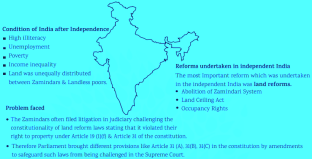
3. Golaknath Vs. State of Punjab (1967): Under “Punjab’s Land Reforms Act, 1953”, which was based on DPSPs (Article 39(b) & (c)), the government imposed a land ceiling and took away excess land from large landowners.
- The Golaknath family challenged the land ceiling law, arguing that it violated their Fundamental Right to Property (Article 19(1)(f) and Article 31).
- The Supreme Court held that Fundamental Rights are sacrosanct and cannot be amended, even by Parliament. This decision restricted the power of Parliament to enforce DPSPs by curtailing Fundamental Rights.
- Bank Nationalization Case (R.C. Cooper v. Union of India, 1970):
- The Indira Gandhi government nationalized 14 major banks under the Banking Companies (Acquisition and Transfer of Undertakings) Act, 1969.
- R.C. Cooper, a shareholder of one such bank, challenged the nationalization as violating his Fundamental Rights (Articles 14, 19(1)(g), and 31).
- The nationalization of banks was challenged as violating the right to trade and property.
- The Supreme Court struck down parts of the nationalization law, holding that: The law violated Article 31 as it did not provide fair compensation for the property acquired. The law also affected Article 19(1)(g) (Right to carry on business).
Reaction by Indira Gandhi government in backdrop of Judicial verdicts
24th and 25th Amendments of the Indian Constitution :
- Both the 24th and 25th Constitutional Amendments were passed by the Indira Gandhi government in 1971 to enhance Parliament’s power and limit the Supreme Court’s ability to strike down laws related to DPSPs and socio-economic reforms.
- These amendments were a direct response to the Supreme Court’s rulings in the Golaknath Case (1967) and R.C. Cooper Case (1970).
- 24th Constitutional Amendment Act 1971: Did amendments in “article 13” and “article 368” of the constitution. Added these two articles in the constitution.
- Article 368 (3): Nothing in article 13 shall apply to any amendment made under this article. Also made it binding on the president to give assent to Constitutional amendment bills.
- Article 13 (4): Nothing in this article shall apply to any amendment of this Constitution made under article 368.
- 25th Amendment Act, 1971 :
- Overruled R.C. Cooper Case (1970), which had struck down bank nationalization laws.
- Limited the Right to Property (Article 31) to give priority to DPSPs (Article 39(b) & (c).
- It Amended Article 31 (Right to Property) – Allowed the government to acquire private property for public welfare by paying only “amount” instead of “compensation”(meaning no judicial review of compensation adequacy).
- It also Inserted a new “Article 31C” – Provided that: Laws implementing DPSPs (Article 39(b) & (c)) would be immune from judicial review, even if they violate Fundamental Rights (Articles 14, 19).
- The 25th Amendment weakened the Right to Property to facilitate land reforms and wealth redistribution.
- Article 31C was added to the Constitution of India in 1971 by the 25th Amendment Act giving effect to certain DPSPs (Articles 39(b) and 39(c)) without the risk of violating Fundamental Rights.
- Article 39(b): “That the ownership and control of the material resources of the community are so distributed as best to subserve the common good.”
- Article 39(c): “That the operation of the economic system does not result in the concentration of wealth and means of production to the detriment of the common good.
- The 42nd Amendment (1976) expanded Article 31C to cover all DPSPs. The amendment added a new clause to Article 31C: “No law shall be deemed to be void on the ground that it is inconsistent with or takes away or abridges any of the rights conferred by Article 14, Article 19, or Article 31 if such law is made to give effect to the policy of the State towards securing all or any of the Directive Principles specified in Part IV.”
- So the 42nd amendment provided primacy to DPSPs over the FRS. The Minerva Mills Case (1980): In the Minerva Mills case, the Supreme Court examined the 42nd Amendment to Article 31C (which expanded the scope of the Article). The Court held that:
- Article 31C should not be used to override Fundamental Rights, particularly Article 14(Right to Equality) and Article 19 (Right to Freedom of Speech and Expression).
- The Court ruled that the balance between Fundamental Rights and Directive Principles is a basic feature of the Constitution, and this balance must be maintained. Therefore, the primacy of Fundamental Rights cannot be ignored by the enactment of laws under Article 31C.
- The Court struck down the portion of Article 31C (after the 42nd Amendment) that allowed laws implementing any DPSPs to violate Fundamental Rights. The Minerva Mills case effectively limited the extent to which DPSPs could be used to override Fundamental Rights.
The judgment established that:
- Fundamental Rights hold primacy and cannot be subordinated to DPSPs.
- DPSPs should complement, not override, Fundamental Rights.
- A harmonious interpretation of both sets of provisions is essential for ensuring social justice without compromising individual freedoms.
Supreme Court’s Ruling in Minerva Mills (1980):
- Struck Down Part of Article 31C : The Court declared unconstitutional the provision that gave DPSPs supremacy over Fundamental Rights (Articles 14 & 19). It ruled that Fundamental Rights and DPSPs must be harmonized, not allow one to dominate the other.
- Balanced FRs & DPSPs : The Court held that neither Fundamental Rights nor DPSPs are absolute, and both must be read together to maintain constitutional harmony. While DPSPs aim for social justice, they cannot override individual liberties and equality.
Conclusion:
- The judicial interpretation of FRs and DPSPs has evolved from a conflict-based approach (1950s-60s) to a harmonization approach (1980s onwards).
- Today, DPSPs are seen as guiding principles that help in the realization of Fundamental Rights, ensuring social justice, economic welfare, and environmental sustainability. The judiciary plays a crucial role in striking a balance, ensuring neither is sacrificed but rather mutually reinforced.
Articles 31A, 31B, and 31C
- Articles 31A, 31B, and 31C of the Indian Constitution provide special provisions to protect certain laws from being challenged on the grounds of violating Fundamental Rights. These articles were introduced to ensure the implementation of socio-economic reforms, especially related to land reforms and the Directive Principles of State Policy (DPSP).
Article 31A. Protection of Laws Related to Agrarian Reforms.
- It protects laws related to land reforms, including the acquisition of estates and rights by the State. Such laws cannot be challenged on the grounds of violating Article 14 (Right to Equality) or Article 19 (Freedom of Property, Trade, etc.).
- It was added by the First Amendment Act, 1951 to safeguard laws related to Zamindari abolition and Agrarian reforms.
- It applies to laws related to:
- Acquisition of estates or rights by the State.
- Management of properties by the State.
- Amalgamation of corporations in the public interest.
Article 31B – Validation of Certain Laws under the Ninth Schedule
- The IXth Schedule was introduced by the First Amendment Act, 1951, to protect certain laws from judicial review, particularly land reforms. Article 31B of the Indian Constitution was introduced by the First Amendment Act, 1951 to provide constitutional protection to certain laws placed in the IXth Schedule. It ensures that such laws cannot be challenged on the grounds of violating Fundamental Rights.
- Over time, many laws-including those violating Fundamental Rights-were placed under the IXth Schedule to shield them from legal challenges.
- In the Kesavananda Bharati case (1973), the Supreme Court ruled that laws under the Ninth Schedule are subject to judicial review if they violate the Basic Structure of the Constitution. In the Waman Rao Case (1981) the Court ruled that laws added to the IXth Schedule before April 24, 1973 (Kesavananda ruling date) are valid. However, laws added after this date can be challenged if they violate Fundamental Rights.
- In the I.R. Coelho case (2007) reaffirmed that no law is above the Constitution. Even laws in the IXth Schedule must adhere to Fundamental Rights and the Basic Structure Doctrine.
Article 31C – Protection of Laws Implementing Directive Principles
- It was introduced by the 25th Amendment Act, 1971 to protect laws made for implementing Directive Principles of State Policy (DPSP) under Article 39(b) and (c). Such laws cannot be challenged on the grounds of violating Article 14 (Equality) or Article 19 (Freedom of Speech, Property, etc.).
Article 39(b) and (c) deal with:
- Equal distribution of wealth and resources to prevent economic disparity.
- Prevention of the concentration of wealth in a few hands.
- The ambit of Article 31C was expanded by 42nd Amendment Act 1976, protecting all laws implementing any Directive Principle, but in the Minerva Mills case (1980), the Supreme Court ruled that only laws implementing Article 39(b) & (c) are protected, not all DPSPs.
Challenges of DPSP implementation in Bihar
1. Economic Backwardness: Bihar is one of the most economically backward states in India, with a high poverty rate, poor infrastructure, and limited industrialization. Implementing DPSPs related to economic justice (like welfare programs, education, and healthcare) faces challenges due to insufficient state resources. The state’s dependency on central funding and its strained fiscal situation further complicate the implementation of long-term social welfare policies.
2. Conflict with Fundamental Rights: DPSPs often conflict with Fundamental Rights (Part III of the Constitution), particularly when it comes to right to equality. Judicial review has also complicated matters, as courts sometimes strike down laws passed by legislature if they are seen as violating Fundamental Rights, even if they are aimed at fulfilling DPSPs.
3. Lack of Political Will: The political environment sometimes lacks the will to implement policies that reflect the true spirit of DPSPs, as they often involve difficult decisions such as redistributing wealth, land reforms, or imposing progressive taxation policies.
4. Bureaucratic Inertia and Corruption: In many cases, bureaucratic inefficiency and corruption lead to poor implementation of welfare programs, causing the diversion of resources meant for marginalized communities.
5. Caste Discrimination and Social Inequality: Caste-based inequalities persist in Bihar, particularly in rural areas, where marginalized communities face discrimination and exclusion from mainstream social and economic life. Policies promoting the welfare of women, backward classes, and tribal communities often face resistance from conservative social groups.
6. Weak Governance : Political instability and frequent changes in government leadership contribute to the inconsistent application of policies and laws. Due to weak governance and change in government frequently many welfare programs meant to fulfill the DPSPs are often poorly implemented or delayed.
Conclusion:
- While the Directive Principles of State Policy (DPSPs) are integral to shaping India’s social and economic justice framework, the implementation challenges-especially in Bihar-are multi-faceted.
- Overcoming these obstacles requires a combination of political commitment, efficient governance, increased funding, and social reforms. Bihar, in particular, needs substantial policy interventions to address its economic challenges, improve governance, and combat social inequality to effectively implement the DPSPs and ensure that the benefits reach its marginalized populations.
FAQs
1. Select the incorrect pair of DPSPs
(A) Article 39 (d) – Free legal Aid
(B) Article 47 – Public Health
(C) Article 48 – Modernisation of Agriculture
(D) Article 51 – India’s International Relations
Ans (A) Article 39 (d) – Free legal Aid
- Pair in option (A) is incorrect, because Article-39 (d) stands for Equal pay for equal work and Free legal Aid is mentioned in Article-39A (added by 42nd Amendment, 1976).
2. Select the correct statements :
I. Right to form co-operative society is a Fundamental Right exclusively under article 21 of the constitution.
II. The provisions related to co-operative societies were added by 42nd CAA-1976.
(A) I only (B) II only
(C) Both I and II (D) Neither I nor II
Ans (D) Neither I nor II
- Statement I is incorrect because right to form co-operative society is a Fundamental Right exclusively under article 19(1)(C) of the constitution.
- Statement II is also incorrect because the provision related to co-operative societies were added by 97th CAA, 2011.
3. Select the incorrect pair of Article & its provisions.
(A) Article 39 (d) – Equal pay for equal work
(B) Article 49 – Protection of Agriculture
(C) Article 47 – Promotion of Public Health
(D) Article 42 – Provision for Maternity relief
Ans (B) Article 49 – Protection of Agriculture
- Article 49 is about protection of monuments.
4. Select the correct statements :
I. The independence of judiciary is assured by one of the directive principles
II. Article 51 allows India to wage war and acquire foreign territories.
(A) I only (B) II only
(C) Both I and II (D) Neither I nor II
Ans (A) I only
- Article 50 is about separation of judiciary from executive.
5. Select the incorrect statements regarding DPSPs.
I. These are justiciable rights like fundamental rights.
II. D.P.S.Ps compliment Fundamental Rights.
(A) I only (B) II only
(C) Both I and II (D) Neither I nor II
Ans (A) I only
- Statement I is incorrect because DPSPs are non-justiciable, meaning they are not enforceable in court, unlike fundamental rights.
- Statement II is correct because, DPSPs are not enforceable, they are considered fundamental in the governance of the country and are meant to be implemented by the state.
6. Which of the following establishes socio-economic democracy and welfare state in India.
(A) Preamble (B) Fundamental Rights
(C) Fundamental Duties (D) D.P.S.Ps
Ans (D)D.P.S.Ps
- Directive Principles of State Policy (DPSPs) establishes socio-economic democracyand welfare state in India.
- Article-38 provides a mandate for the state to secure.
- Social order for the promotion of the welfare of the people. It reflects the social welfare sprit of the Indian Constitution.
Mains Practice Question
1. What are the different classifications of Directive Principles of State Policy. [38 marks]
2. Which directive principles exhibit the Gandhian’s ideology. [8 marks]
3. DPSPs are non-justiciable, yet they are important in shaping government policies.
Discuss. [38 marks]
4. How have the Directive Principles of State Policy been implemented in the development
of the welfare state in India? [38 marks]
5. How did the Minerva Mills case affect the relationship between Fundamental Rights and
DPSPs? [38 marks]
6. How can the implementation of the Directive Principles of State Policy be improved to
address the emerging challenges in India? [38 marks]
7. Discuss the role of DPSPs in the formulation of Bihar’s policies and welfare schemes.
[38 marks