
- Part-IV(A) & Article-51 (A) of the constitution is related to Fundamental Duties.
- Fundamental Duties were not the part of the constitution initially but it was added by 42nd amendment of the constitution.
- Fundamental Duties are applicable to the citizens only. It is not applicable to non-citizens.
- Initially there were 10 Fundamental Duties but later on one more duty was added by 86th Constitutional Amendment Act-2002. Thus as of we have eleven (10+1=11) Fundamental Duties.
- The Fundamental Duties are non-justiciable in nature.
- It was added on the recommendation of Swaran Singh Committee which was constituted by Indira Gandhi government.
- It is inspired from USSR Constitution.
FUNDAMENTAL DUTIES
51A. Fundamental duties – It shall be the duty of every citizen of India-
(a) To abide by the Constitution and respect its ideals and institutions, the National Flag and the National Anthem;
(b) To cherish and follow the noble ideals which inspired our national struggle for freedom;
(c) To uphold and protect the sovereignty, unity and integrity of India;
(d) To defend the country and render national service when called upon to do so;
(e) To promote harmony and the spirit of common brotherhood amongst all the people of India transcending religious, linguistic and regional or sectional diversities; to renounce practices derogatory to the dignity of women;
(f) To value and preserve the rich heritage of our composite culture;
(g) To protect and improve the natural environment including forests, lakes, rivers and wild
life, and to have compassion for living creatures;
(h) To develop the scientific temper, humanism and the spirit of inquiry and reform;
(i) To safeguard public property and to abjure violence;
(j) To strive towards excellence in all spheres of individual and collective activity so that the nation constantly rises to higher levels of endeavour and achievement;
(k) Who is a parent or guardian to provide opportunities for education to his child or, as the case may be, ward between the age of six and fourteen years.
Classification of Fundamental Duties
(a) National Duties : Respect the Constitution, National Flag and National Anthem (Article 51A(a)), Uphold and protect the sovereignty, unity and integrity of India (Article 51A(c)), Defend the country and render national service when required (Articel 51A(d). Inculcate and cherish the ideal of freedom struggle.
(b) Societal Duties : Promote harmony and spirit of common brotherhood among all citizens (Article 51A(e)), Value and preserve the rich heritage of India’s composite culture (Article 51A(f), Safeguard public property and abjure violence (Article 51A(i)).
(c) Environmental Duties : Protect and improve the natural environment, including forests, lakes, rivers and wildlife and have compassion for living creatures (Article 51A(g)). It promotes sustainable development.
(d) Scientific Duties : Develop a scientific temper, humanism and spirit of inquiry and reform (Article 51A (h)).
(e) Educational Duties and Social Reform: Strive for excellence in all spheres of individual and collective activity (Article 51A(j)) Provide opportunities for education to children between 6-14 years of age (Added by 86th Amendment, 2002) (Article 51A(k)).
Relevance of Fundamental Duties in Modern India
(a) Strengthening National Integrity: Ensures citizens actively contribute to nationbuilding and maintain sovereignty and unity.
(b) Promoting Social Cohesion & Ethical Conduct: Encourages communal harmony, respect for diversity, and protection of culture and heritage. Helps in preventing conflicts and fostering brotherhood.
(c) Environmental Protection & Sustainable Development: Mandates citizen responsibility towards environment conservation. Encourages government and NGOs to enforce climate friendly policies.
(d) Preventing Crimes & Violence : Duty to safeguard public property discourages vandalism, riots and destruction.
(e) Boosting Scientific and Rational Thinking : Encourages scientific temper to counter superstitions and misinformation.
(f) Supporting Education & Social Upliftment: Citizens must ensure children get compulsory education (Right to Education Act, 2009), Human Capital.

Limitations of Fundamental Duties
- Not Legally Enforceable – No direct legal punishment for violation.
- Lack of Awareness – Many citizens are unaware of these duties.
- No Specific Guidelines for Implementation – Duties are broad and undefined.
Criticisms of Fundamental Duties
- Although Fundamental Duties (Article 51A) were introduced to promote civic responsibility and national integrity, they have faced several criticisms:-
- Non-Justiciable and Non-Enforceable – Fundamental Duties cannot be enforced by courts, making them mere moral obligations rather than legally binding duties. Citizens are not punished for failing to follow them.
- Vague and Ambiguous – Some duties, such as developing a scientific temper, humanism, and the spirit of inquiry, are too broad and subjective. Their interpretation depends on individual perspectives, making them difficult to implement.
- Lack of Clarity in Scope – Certain duties, like preserving heritage and promoting harmony, are unclear in terms of responsibilities. There is no proper mechanism to define or measure compliance.
- Absence of Direct Implementation Mechanism – The Constitution does not provide a specific authority or law to ensure that citizens fulfill their Fundamental Duties. Unlike Fundamental Rights, which can be enforced by the judiciary, these duties lack a structured implementation framework.
- Burden on Citizens, Not the State – While Fundamental Rights impose restrictions on the State, Fundamental Duties place responsibilities only on citizens, ignoring the role of the government in creating an environment where these duties can be practiced effectively.
- Inspired by Socialist Ideologies – The Fundamental Duties were borrowed from the USSR Constitution, leading to criticism that they reflect a socialist and authoritarian approach, rather than being rooted in India’s democratic traditions.
- Added Arbitrarily Without Public Consultation – These duties were introduced through the 42nd Amendment Act, 1976, during the Emergency, without proper public debate or discussion, making them seem imposed rather than organically developed.
- No Duties for Government and Institutions – The Constitution only defines citizens’ duties but does not mention duties of the government, institutions, or leaders, leading to an imbalance in responsibilities.
Conclusion
- While Fundamental Duties promote national unity and responsibility, their lack of enforceability, vague nature, and one-sided burden on citizens have led to criticisms. Some experts suggest making them legally binding or linking them with Fundamental Rights to make them more effective.
Significance of Fundamental Duties
- Promote Civic Responsibility – Fundamental Duties remind citizens that rights come with responsibilities, encouraging a culture of discipline, respect, and national service.
- Strengthen National Unity and Integrity – Duties like upholding sovereignty, promoting harmony, and respecting national symbols help foster a sense of patriotism and national pride.
- Support Fundamental Rights – While citizens enjoy Fundamental Rights, duties ensure that these rights do not lead to misuse or harm to others. For example, the duty to safeguard public property ensures collective welfare.
- Help in Social and Environmental Protection – Duties like protecting the environment, forests, rivers, and wildlife encourage ecological awareness and sustainable development.
- Develop a Progressive and Scientific Mindset – The duty to develop scientific temper, humanism, and the spirit of inquiry fosters rational thinking and innovation, helping in national progress.
- Guide the Judiciary in Decision-Making – Though non-enforceable, Fundamental Duties act as guiding principles for courts when interpreting laws and delivering judgments. Courts have often linked duties with rights to promote justice.
- Encourage Respect for Cultural and National Heritage – Duties like valuing and preserving the rich heritage of India instill pride and responsibility in maintaining the country’s cultural legacy.
- Prevent Anti-National Activities – The duty to uphold sovereignty and defend the nation discourages anti-national and separatist tendencies, reinforcing national security.
- Promote Ethical and Moral Values – By emphasizing responsibilities such as respecting national symbols and protecting public property, Fundamental Duties help develop a responsible and lawabiding society.
- Help in Policy Formulation – The government can use Fundamental Duties as a basis for framing laws and policies related to environment, education, and public safety.
Way Forward
- Although Fundamental Duties are not legally enforceable, they serve as a moral compass for citizens. ensuring that rights are exercised responsibly. Their proper implementation through awareness and education can help build a more disciplined, patriotic, and socially responsible society.
Acts That Enforce Fundamental Duties in India
- Although Fundamental Duties (Article 51A) are not directly enforceable, several existing laws and acts help in their implementation. Below are some key legislations that support various Fundamental Duties :
1. Respect for the National Flag and National Anthem (Article 51A(a)) :
- “Prevention of Insults to National Honour Act, 1971”
- Prohibits disrespect to the National Flag, National Anthem, and the Constitution.
- Punishable by fine or imprisonment.
2. Sovereignty, Unity, and Integrity of India (Article 51A(c)) :
- “Unlawful Activities (Prevention) Act, 1967 (UAPA)”
- Bans activities that threaten national unity and integrity. Used against terrorist and separatist movements.
- “National Security Act, 1980”
- Allows preventive detention to protect national security.
3. Defending the Nation (Article 51A(d)) :
- “The Defence of India Act, 1962”
- Grants special powers to the government during wartime.
- The Army Act, 1950 – Regulates the conduct of the armed forces.
4. Promoting Harmony and Brotherhood (Article 51A(e))
- Protection of Civil Rights Act, 1955 : Prohibits caste-based discrimination and untouchability.
- Scheduled Castes and Scheduled Tribes (Prevention of Atrocities) Act, 1989 :Punishes offenses against SC/ST communities.
5. Protecting the Environment (Article 51A(g)
- Environmental Protection Act, 1986 : Regulates pollution control and environmental conservation.
- Wildlife Protection Act, 1972 : Protects endangered species and national parks.
- Forest conservation Act, 1980 : Prevents deforestation and illegal land use.
- Bio-diversity Act-2002
6. Safeguarding Public Property (Article 51A(i))
- The Prevention of Damage to Public Property Act, 1984: Punishes destruction of government buildings, vehicles, and utilities.
7. Promoting Scientific Temper and Inquiry (Article 51A(h))
- Right to Information (RTI) Act, 2005: Promotes transparency, accountability, and informed decision-making.
- Drugs and Magic Remedies (Objectionable Advertisements) Act, 1954: Restricts superstitious and misleading claims.
8. Providing Education for Children (6-14 Years) (Article 51A(k))
- Right to Education (RTE) Act, 2009: Provides free and compulsory education for children between 6-14 years.
Relation between Rights and Duties
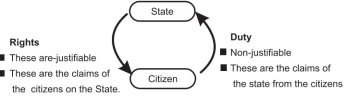
- The Indian Constitution grants Fundamental Rights to citizens to ensure freedom, equality, and justice. However, these rights must be exercised responsibly. The absence of corresponding duties can lead to their misuse, social disorder, and anarchy.
Interdependence of Rights and Duties
- Rights Ensure Freedom, Duties Ensure Order : Fundamental Rights like freedom of speech (Article 19) allow citizens to express opinions. However, if misused to spread hate speech or misinformation, it can lead to social unrest. The duty to promote harmony and respect national symbols (Article 51A(a), (e)) ensures responsible behavior.
- Duties Prevent the Misuse of Rights: Rights without duties may lead to selfish individualism, where citizens demand entitlements but ignore responsibilities. For example, the Right to Education (Article 21A) is complemented by the duty of parents to provide education to children (Article 51A(k)).
- Preventing Anarchy Through Civic Responsibility: The duty to safeguard public property (Article 51A(i)) ensures that rights like freedom of assembly (Article 19) are not misused for riots or vandalism. Similarly, the duty to protect the environment (Article 51A(g)) ensures sustainable use of resources.
Consequences of Rights Without Duties
- Social Disorder & Lawlessness: Unchecked exercise of rights (e.g., freedom of speech) can lead to hate speech, misinformation, and communal violence.
- Misuse of Rights: Rights like Right to Freedom (Article 19) may be exploited for unlawful protests, vandalism, or sedition if not balanced by duties.
- Erosion of National Unity: Demanding rights without respecting national symbols, Constitution, or communal harmony can weaken national integrity.
- Environmental Degradation: People demand a clean environment (Article 21) but fail to fulfill their duty to protect nature (Article 51A(g)), causing pollution and deforestation.
- Weakening of Democracy: Without civic responsibility, corruption, selfish interests, and disregard for law increase, harming governance.
- Moral & Ethical Decline : Ignoring duties like scientific temper (Article 51A(h)) leads to superstitions, regressive mindsets, and lack of rational thinking.
- Violation of Others’ Rights: If individuals exercise their rights irresponsibly, it can infringe upon the rights of others, leading to legal and social conflicts.
Way Forward
- Rights and duties are two sides of the same coin. While Fundamental Rights empower individuals, Fundamental Duties ensure their responsible exercise. A society where people only claim rights but ignore duties leads to anarchy and chaos. Therefore, to maintain a balanced democracy, both must be upheld together.
FAQs
1. The Fundamental Duties in the Indian Constitution were incorporated to promote a sense of discipline and commitment among citizens. Which of the following statements regarding Fundamental Duties is correct?
1. They were added through the 42nd Constitutional Amendment in 1976.
2. They are borrowed from the Constitution of the USA.
3. They are non-justiciable, meaning they cannot be enforced by courts.
4. Originally, there were 10 Fundamental Duties, but the 86th Amendment increased them to 11.
(A) 1, 2, and 3 only (B) 1, 3, and 4 only (C) 2, 3, and 4 only (D) 1, 2, 3, and 4
Ans :- (B) 1, 3, and 4 only
- Fundamental Duties were added by the 42nd Amendment in 1976.
- They were inspired by the Soviet Union (Russia), not the USA.
- They are non-justiciable, meaning citizens cannot be punished for not following them.
- The 86th Amendment (2002) added the 11th Fundamental Duty, which mandates that parents/guardians provide education to children aged 6-14 years.
2. Which of the following is NOT listed as a Fundamental Duty under Article 51A of the Constitution?
(A) To develop a scientific temper, humanism, and a spirit of inquiry.
(B) To uphold and protect the sovereignty, unity, and integrity of India.
(C) To vote in elections and participate in governance.
(D) To safeguard public property and abjure violence.
Ans :- (C) To vote in elections and participate in governance.
- Voting is a legal right, not a Fundamental Duty. While it is encouraged, it is not constitutionally mandated. The other options are explicitly mentioned in Article 51A.
3. The Swaran Singh Committee (1976) recommended the inclusion of Fundamental Duties. Which of the following recommendations of the committee were NOT accepted?
1. Making Fundamental Duties legally enforceable.
2. Imposing punishment for violating Fundamental Duties.
3. The inclusion of Fundamental Duties in a separate Part IV-A.
4. The addition of more duties than the ones included in the 42nd Amendment.
(A) 1 and 2 only (B) 3 and 4 only (C) 1, 2, and 4 only (D) 2 and 3 only
Ans :- (C) 1, 2, and 4 only
- The Swaran Singh Committee recommended making Fundamental Duties legally enforceable with penalties for violations, but this was not accepted. Also, it proposed more than 10 duties, but only 10 were included in the 42nd Amendment 1976.
4. The Fundamental Duties in the Indian Constitution are aimed at ensuring that citizens contribute towards national integrity and unity. Which of the following duties specifically address national security and patriotism?
1. To uphold and protect the sovereignty, unity, and integrity of India.
2. To safeguard public property and abjure violence.
3. To cherish and follow the noble ideals that inspired our freedom struggle.
4. To defend the country and render national service when required.
(A) 1, 2, and 4 only (B) 1, 3, and 4 only (C) 2, 3, and 4 only (D) 1, 2, 3, and 4
Ans :- (D) 1, 2, 3, and 4
- All these duties contribute to national security, patriotism, and integrity by ensuring that citizens remain committed to the nation’s unity and safety.
5. In which of the following Supreme Court cases did the court state that Fundamental Duties can
be used to interpret ambiguous laws and Fundamental Rights?
(A) Kesavananda Bharati v. State of Kerala (1973) (B) Minerva Mills v. Union of India (1980)
(C) M.C. Mehta v. Union of India (1988) (D) Ramesh Thappar v. State of Madras (1950)
Ans :- (C) M.C. Mehta v. Union of India (1988)
- The Supreme Court ruled that courts could use Fundamental Duties to interpret laws, especially in environmental protection cases.
6. Which of the following Fundamental Duties emphasize scientific and ethical progress in Indian society?
1. To strive towards excellence in all spheres of individual and collective activity.
2. To develop a scientific temper, humanism, and a spirit of inquiry and reform.
3. To safeguard public property and abjure violence.
4. To provide education to children between 6-14 years.
(A) 1 and 2 only (B) 1, 2, and 3 only (C) 2, 3, and 4 only (D) 1, 2, 3, and 4
Ans :- (D) 1, 2, 3 and 4
- These duties promote intellectual development and scientific reasoning, which are essential for social progress.
7. The Fundamental Duties were introduced in the Indian Constitution to remind citizens of their
responsibilities towards the nation. Consider the following statements:
1. The Fundamental Duties were added to the Constitution through the 42nd Constitutional Amendment Act of 1976.
2. These duties were inspired by the Constitution of Ireland.
3. Fundamental Duties are non-justiciable in nature, meaning they cannot be enforced by courts.
4. The 86th Constitutional Amendment in 2002 added the 11th Fundamental Duty, related to providing education to children.
Which of the statements given above is/are correct?
(A) 1 and 2 only (B) 1, 3, and 4 only (C) 2, 3, and 4 only (D) 1, 2, 3, and 4
Ans :- (B) 1, 3, and 4 only
- The Fundamental Duties were inspired by the Soviet Union (USSR), not Ireland. The 86th Amendment Act of 2002 added the 11th duty, which obligates parents/guardians to provide education to children aged 6–14 years.
8. Which of the following is a Fundamental Duty under Article 51A of the Indian Constitution?
(A) To respect the National Flag and the National Anthem.
(B) To vote in elections and participate in governance.
(C) To pay taxes regularly.
(D) To protect and improve the environment.
Ans :- (D) To protect and improve the environment.
- Voting and paying taxes are not listed under Fundamental Duties. The duty to protect and improve the natural environment is explicitly mentioned under Article 51A(g).
9. Which of the following Fundamental Duties relate(s) directly to the preservation of cultural heritage in India?
1. To value and preserve the rich heritage of our composite culture.
2. To develop a scientific temper, humanism, and the spirit of inquiry.
3. To safeguard public property and abjure violence.
4. To promote harmony and the spirit of common brotherhood among all people.
(A) 1 only (B) 1 and 4 only (C) 1, 2, and 3 only (D) 2, 3, and 4 only
Ans :- (A) 1 only
- The duty “to value and preserve the rich heritage of our composite culture” directly aims at protecting India’s cultural diversity.
- The duty “to promote harmony and the spirit of common brotherhood” indirectly contributes to cultural preservation.
10. The Prevention of Insults to National Honour Act, 1971 was enacted to ensure respect for national symbols. Under this law, which of the following actions is punishable?
1. Disrespecting the National Flag 2. Preventing the singing of the National Anthem
3. Damaging public property during protests 4. Insulting the Constitution of India
(A) 1 and 2 only (B) 1, 2, and 3 only (C) 1, 2, and 4 only (D) 1, 2, 3, and 4
Ans :- (C) 1, 2, and 4 only
- The Prevention of Insults to National Honour Act, 1971 protects the National Flag, the Constitution, and the National Anthem but does not directly cover public property damage (which is covered under the Prevention of Damage to Public Property Act, 1984).
11. The Unlawful Activities (Prevention) Act, 1967 (UAPA) was enacted to prevent threats to
national integrity. It helps enforce which Fundamental Duty?
(A) To uphold and protect the sovereignty, unity, and integrity of India
(B) To safeguard public property and abjure violence
(C) To promote harmony and the spirit of common brotherhood
(D) To strive towards excellence in all spheres of activity
Ans :- (A) To uphold and protect the sovereignty, unity, and integrity of India
- The UAPA Act, 1967, criminalizes activities that threaten India’s unity and sovereignty, in line with Article 51A(c).
12. Select the correct statements regarding Fundamental Duties.
I. Like Fundamental Right these duties are justiciable in nature.
II. Voting in the parliamentry elections is one of the significant Fundamental Duty.
(A) I only (B) II only (C) Both I and II (D) Neither I nor II
Ans :- (D) Neither I nor II
- Statement I is incorrect because Fundamental Duties are non-justiciable in nature.
- Statement II is also incorrect because voting in the parliamentary elections isn’t mentioned in Article-51 (A) (a-k).
13. Which of the following is not a Fundamental Duty.
(A) Protecting the Sovereignty, Unity & Integrity of India. (B) Safeguarding Public Properties.
(C) Compassion for living creatures. (D) Paying income taxes.
Ans :- (D) Paying income taxes.
- Paying income taxes isn’t a Fundamental Duties.
14. Select the correct statements :
I. Fundamental Duties are inspired from USSR constitution.
II. There were ‘10’ Fundamental Duties originally when constitution came into force.
III. Sarkariya Commission recommended the provision related to Fundamental Duties.
(A) I & II only (B) I & III only (C) I only (D) I, II and III
Ans :- (C)I only
- Statement I is correct because Fundamental Duties are inspired from USSR Constitution.
- Statement II is incorrect because as we know the constitution of India came into force on 26 Jan, 1950 and that time there wasn’t any Fundamental Duties mentioned in the constitution, later it was added to the constitution by 42nd Amendment Act 1976.
- Statement III is also incorrect becuase Swaran Singh Committee recommended the provisions related to Fundamental Duties.
15. Select the correct statements regarding Fundamental Duties
I. These are non-justiciable in natue but promote responsible citizens.
II. Fundamental Duties are similar to legal duties.
(A) I only (B) II only (C) Both I and II (D) Neither I nor II
Ans :- (A) I only
- Statement II is not correct because Fundamental Duties aren’t similar to legal Duties.
- If legal duties are not fulfilled then legal actions can be taken. Ex – Paying Tax, GST etc.
Mains Model Questions
Q1) How do Fundamental Duties contribute to good governance and responsible citizenship in India? [8 marks]
Q2) Despite their inclusion in the Constitution, Fundamental Duties are often ignored by citizens. Analyse the reasons and suggest measures to promote awareness.[8 marks]
Q3) Discuss the significance of Fundamental Duties in the Indian Constitution. How do they complement Fundamental Rights? [38 marks]
Q4) “Rights without duties lead to anarchy.” Analyse this statement in the context of Fundamental Duties in India.