
• Article-52 (Part-V) of the constitution states that there shall be a president of India.
• President symbolises the republican nature of India Republic means the head of the state shall be an elected head.
• President is the head of the state.
• President is also the nominal (de jure) head of the union executive.
• However, the real (de facto) head of the union executive is prime minister. It is because in India the parliamentary system is followed.
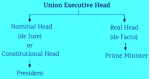
• All the executive actions of the union are taken in the name of President.
• President of India is the Supreme commander of the defence forces. ‘
Eligibility/Qualifications for the office of President
(i) Citizen of India
(ii) Minimum 35 years of age
(iii) Should be qualified to be the member of Lok Sabha.
(iv) Does not hold any office of profit.
Tenure of the office of President
▪ The term of the office of President is 5 years.
▪ A President is eligible for re-election for ‘n’ number of times.
▪ The President is administered oath by the Chief Justice of India according to Article -60.
Method of Election
▪ The President of India is chosen by Indirect election.
▪ The method used is proportional representation by means of single transferrable vote.
▪ It is conducted through secret ballet.
▪ The electoral College for the Presidential election consists of elected members of both houses of parliament and elected members of the legislative assemblies of states and those of union territories (Delhi, Puducherry, J&K).
Note :
▪ The Nominated members do not participate in the elections of the President.
▪ Also the Members of the Legislative Council (MLC) don’t participate in the Presidential elections.
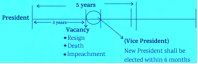
• The President generally remains in the office for the term of 5 years. But a vacancy can arise in the office of the president by means of –
(i) Resignation
(ii) Death
(iii) Impeachment (Article-61)
• The President can tender his resignation to the Vice-President.
• The President can be impeached according to the procedure led in Article-61 of the constitution.
• The ground on which the President can be impeached is “Violation of Constitution”.
• In case of vacancy in the office of President the Vice-President assumes the charges of the President’s office. However in such cases the Presidential election shall be conducted within 6 months.
• It means the Vice-President cannot remain in the office of President for more than 6 months.
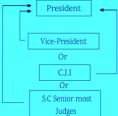
• If for any reason the Vice-President is not able to perform the duty of President then the Chief Justice of India will act as the President of India. And in the absence of Chief Justice of India the Senior most judge of the Supreme Court will act as the President.
Note :
• There is one incident when the Chief Justice of India became the acting President.
• After the death of Zakir Hussain (President) in 1969 the V.V. Giri (Vice President) took charge as the acting president but V.V. Giri resigned in order to contest the Presidential election.
• In this back ground, the Chief Justice of Indian Md. Hidyatullah assumed the charges of the President.
• Later on V.V. Giri won the Presidential election and assumed the office as President.
Election Disputes regarding office of President & Vice-President
• The elections to the offices of President and Vice-President is conducted by the Election Commission of India.
• However the election disputes related to Presidential and Vice-Presidential elections are resolved by the Supreme Court of India.
• The election of the President and Vice-President cannot be declared invalid on the ground that the electoral college was incomplete.
• If the Presidental election is declared invalid then President will have to vacate the office. However his earlier works while remaining in office cannot be declared invalid.
Election of President
• The President of India is elected through an indirect election by an Electoral College, following the system of proportional representation by means of a single transferable vote. The process is governed by Article 54 and Article 55 of the Indian Constitution.
• Electoral College consists of :
▪ Elected Members of Parliament (MPs) from both Lok Sabha and Rajya Sabha
▪ Elected Members of the Legislative Assemblies of States and Union Territories (Delhi, Puducherry and Jammu & Kashmir).
• Nominated members (Both MPs and MLAs) and members of Legislative Councils (MLCs) do not participate in the election.
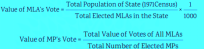
• Value of Votes : Since the election follows proportional representation, votes are weighted
based on representation :
(a) Value of an MLA’s vote
Voting Method
▪ Secret Ballot System (For marking the vote, the Commission will supply particular pens. Electors have to mark the ballot only with this particular pen and not with any other pen. Voting by using any other pen shall lead to invalidation of the vote at the time of counting. It is also clarified that political parties cannot issue any whip to their MPs and MLAs in the matter of voting in the Presidential election.)
▪ Single Transferable Vote (STV) system (Preferential Voting)
▪ Each voter (MP or MLA) marks their preference (1st, 2nd, 3rd, etc.) on the ballot paper.
▪ If no candidate secures more than 50% of the total valid votes in the first round, the candidate with the least votes is eliminated and their votes are transferred to the next preference.
• President is the head of the state.
• Therefore the MPs and MLAs participate in the elections of the President.
• Proportional representation by means of Single Transferable Vote.
• The Presidential election is done through ballot paper and secret ballot.
• Secret ballot means the MPs and MLAs can’t disclose their votes to others. It must remain confidential.
• The party guidline & whip are not applicable in the presidential elections.
• The MPs & MLAs cast their preference of the Presidential candidates in the ballot paper.
• When the votes are counted the 1st preference votes are counted first.
• If any candidate secures 50% of the value of valid votes then that candidate is declared elected.
• But if none of the candidate gets the desired quota of votes then the ballot of that candidate which has got least first preference votes are cancelled and his votes are transferred to other candidates.
• In case if no candidate gets 50% of valid votes then the candidature of candidate which has got least 1st preference will cancelled and his votes will be transferred to the other candidate.
Powers and Functions of the President of India
- The President of India is the Constitutional head of State and the Supreme Commander of the armed forces. Though largely a ceremonial figure, the president has several important powers and functions under the Indian Constitution. These can be categorised as follows –
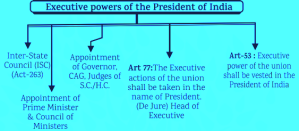
1. Executive Powers (Article 53-77)
- The President is the executive head of India, but these powers are exercised on the aid and advice of the Council of Minister (Article 74).
Union Executive
▪ To implement the laws made by the parliament.
▪ To make policies.
▪ The real powers of union executive is vested in the Council fo Ministers headed by Prime Minister (PM).
Appointments by the President
▪ Appoints the Prime Minister and on his advice, other ministers.
▪ Appoints Governors of states, the Chief Justice & Judges of the Supreme Court & High Courts.
▪ Appoints Chief Election Commissioner (CEC), Comptroller and Auditor General (CAG), Attorney General and Chiefs of Armed Forces.
▪ Nominates 12 members of Rajya Sabha.
Administration
▪ All executive actions of the Government of India are formally taken in his/her name (Article 77).
▪ Seeks information from PM related to administration of the union and proposals for legislation. (Article 78).
▪ Constitutes an Inter-State Council. (Article 263).
➢ Inter-State Council is a forum of co-operative federalism.
▪ Declaration of any area as scheduled area. (5th Schedule)
▪ The President administers Union Territories through Lieutenant Governors and Administrators.
• Diplomatic Role
▪ Represents India in international affairs.
▪ Appoints Ambassadors and receives foreign diplomats.
▪ All international treaties and agreements are signed in the President’s name (but require Parliament’s approval).
2. Legislative Powers (Article 79-111)
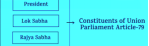
- The President is a part of the Parliament of India (along with Lok Sabha & Rajya Sabha)
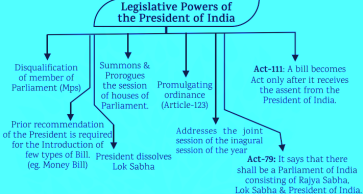
- Summons – Beginning of the session of Parliament.
- Prorogues – To end the session of Parliament.
- Dissolves the Lok Sabha – It means the Fresh Lok Sabha election will be held.
• Ordinance
▪ The ordinance is promulgated by the President of India during the recess of the houses of Parliament. Races means when the houses of the Parliament are not in session.
▪ It is mentioned in Article-123 of the constitution.
▪ Ordinance is like a process of law making when either of the houses or both of the houses of Parliament are not in session.
Law Making is the primary function of Parliament of India
▪ Bill is drafted & introduced in Parliament.
- Bill : it is a proposal of legislation.
▪ It is passed in both houses.
▪ President gives the assent to the bill then it becomes an act.
• When the ordinance is issued it has the same authority as an act of the Parliament.
• As it is promulgated during the recess of the Parliament it is presented before both houses of the Parliament when house reassembles.
• The ordinance must be ratified by both the houses of Parliament within six weeks after assembly.
• If the houses do not ratify the ordinance within six weeks then it will lapse.
• Through ordinance the ordinary legislation & the money bills can be brought, but through ordinance the amendment of the constitution cannot be done.
• An ordinance can be withdrawn by the President by subsequent ordinances.
• The ordinance is not the discretionary power of the President of India. It is promulgated by the President on the advice of Union Council of Ministers.
Misuse of Ordinance
• The provisions of the ordinance are misused by the central government by bypassing the legislature.
• The same ordinance has been re-promulgated.
• Sometimes the houses are prorogued intentionally to promulgate ordinances.
Supreme Court Judgment in relation to ordinance
• The Supreme Court in RC Cooper case (1970) & D.C. Wadhwa case has stated that the ordiances are subjected to judicial review & it should not be misused.
• Re-promulgation of the ordinances with the intention of bypassing legislature is a fraud on the constitution.
Note :
- Article : Separation of judiciary from executive.
- Ordinance : It is promulgated by the Executive, However executive misuse the ordinance powers.
▪ Therefore judiciary checks whether ordinance was issued on bonafide merit or malafide motive.
Funda of 6 months 6 weeks
• It is said that an ordinance if not ratified by the houses of the parliament then it can ideally survive for a maximum period of 6 months 6 weeks.
• Reason is that the constitution says that between the two consecutive sessions of the house of Parliament the time shouldn’t lapse for more than 6 months.
• Therefore it is mandatory to summon the session of the parliament not exceeding 6 month gap.
Veto Powers of the President of India
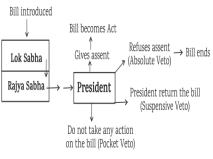
• A bill only becomes an act if the assent is given by the president.
• But there are situations when the president can refuse to give the assent or return the bill for reconsideration of the houses of Parliament or does not take any action on the bill.
• So these situations are classified as Veto powers of the president of India.
• By the use of Veto powers the President stops the bill from becoming an act and the bill ends.
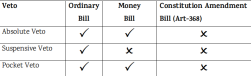
• The Veto powers of the Indian President are classified as Absolute Veto, Suspensive Veto and Pocket Veto.
1. Absolute Veto
• It means the President refuses to give his assent to the bill. In such cases the bill ends and it does not become law.
• Absolute veto can be applied in ordinary bills and money bills and not in cases of constitution amendment bills.
• For example :- The President Dr. Rajendra Prasad used absolute veto on PEPSU Appropriation Bill.
2. Suspensive Veto
• It means when the President returns the bill for the reconsideration of the houses of Parliament.
• The house may pass the bill again with or without amendments.
• Now it is again sent to the President for his assent. It becomes binding on the President to give his assent now.
• For example :- The President A.P.J. Kalam used suspensive veto on Office of Profit Bill during the term of Dr. Manmohan Singh as Prime Minister.
3. Pocket Veto
• The constitution does not provide a time limit within which the president must give the assent to the bills.
• So pocket veto means the President does not take any action on the bill for indefiniteperiod of time.
• For example :- The President Zail Singh used Pocket veto on the Post Office (amendment) Bill which was a controversial bill brought during Rajiv Gandhi govt.
Concept
• The veto power is not applicable in cases of constitutional amendment bills.
• The money bills cannot be returned for reconsideration of the houses of Parliament.
Note
▪ The Indian President’s veto powers are weaker compared to countries like the USA where the President has a Qualified Veto.
▪ A Qualified Veto is a type of veto where the executive (President) can return a bil to the legislature, but the legislature can still override the veto with a higher majority.
▪ The President of India does not have a Qualified Veto. The President can veto a bill, but Congress can override the veto with a two-thirds majority in both houses
Objectives of the veto powers of the President
• To prevent hasty and ill-conceived legislation by Parliament.
• To prevent the legislation that may be unconstitutional
• To act as a safeguard for the Rule of Law by ensuring all legislation adheres to the constitutional framework.
• To provide a check against legislative errors that may have occurred during the law making process.
• To encourage mort comprehensive deliberation and revision of balls within Parliament.
• The veto power is essential for maintaining a balance between the executive and legislative branches of goverment. It ensures the laws are carefully examined before becoming enforecable.
Instances of Presidential Veto in India
1. PEPSU Appropriation Bill: In 1954, President Rajendra Prasad exercised his absolute veto on the PEPSU Appropriation Bill. He believed the bill was unconstitutional, marking a significant moment in Indian legislative history. The bill aimed to grant retrospective approval for certain unauthorized expenditure made by the Patiala and East Punjab States Union (PEPSU) government. Dr. Prasad believed that allowing such a bill would set a bad precedent, encouraging financial irregularities in governance.
▪ This was one of the rare instances where the President used this power, which allows for a permanent block on legislation. The PEPSU appropriation Bill was passed by the Parliament during the President’s rule in the state of PEPSU (Patiala and East Punjab States Union).
▪ About PEPSU (Patiala and East Punjab States Union): The Patiala and East Punjab States Union (PEPSU) was a short-lived state in India that existed from 1948 to 1956 before being merged with Punjab. It was created in 1948 by merging eight princely states, including Patiala, Jind, Nabha, and Kapurthala. In 1952, PEPSU held its first and only state elections, and the Indian National Congress (INC) lost to the Akali Dal-Praja Mandal coalition led by Gurnam Singh. However, due to political instability and misgovernance, PEPSU was placed under President’s Rule in 1953.
2. Indian Post Office (Amendment) Bill: In 1986, President Zail Singh is thought to have used a pocket veto on the Indian Post Office (Amendment) Bill. By not signing the bill before Parliament was dissolved, he effectively prevented it from becoming law.
▪ About the Bill: The Indian Post Office (Amendment) Bill, 1986 was introduced by the Rajiv Gandhi government to amend the Indian Post Office Act, 1898.
▪ The bill aimed to grant sweeping powers to the government, especially in terms of surveillance and censorship of postal communication. It gave the government powers to intercept and censor mail, which was seen as a threat to privacy and civil liberties.
▪ This use of pocket veto highlighted the President’s ability to delay legislation without a formal rejection.
▪ It showed how a President can delay or stop a controversial bill without directly rejecting it. It set a precedent for future Presidents in handling politically sensitive legislation.
3. Office of Profit Bill : The suspensive veto was officially used for the first time in 2006 by President A. P. J. Abdul Kalam on the Office of Profit Bill. He returned the bill to Parliament for reconsideration, expressing concerns about its implications for disqualification of members. However, Parliament passed the bill again, and it was ultimately signed into law by the President.
▪ About the Bill: The Parliament (Prevention of Disqualification) Amendment Bill, 2006 was introduced by the UPA government under Prime Minister Manmohan Singh to amend the original Parliament (Prevention of Disqualification) Act, 1959.
▪ The bill aimed to exempt certain offices from the definition of “Office of Profit”, thereby preventing the disqualification of certain Members of Parliament (MPs). The bill added 56 new offices to the list of positions that would not be considered as an “Office of Profit.”
▪ These included positions such as Chairpersons and Directors of various government bodies, trusts, and advisory councils. The bill was seen as a way to protect Sonia Gandhi, who was the Chairperson of the National Advisory Council (NAC), a position considered an Office of Profit under existing laws. To avoid disqualification, Sonia Gandhi resigned as an MP in March 2006 but was re-elected later.
▪ President Dr. A.P.J. Abdul Kalam refused to sign the bill and sent it back to Parliament for reconsideration (Suspensive Veto). He raised concerns over the lack of transparency and fairness in deciding which offices should be exempt. However, when Parliament passed the bill again without any changes, Kalam was constitutionally bound to sign it in August 2006.
3. Financial Powers (Articles 110–117)
• The President plays a crucial role in financial adminsitration of the country.
• The powers related with the matters of finances come under financial powers of the President of India.
1. Money Bills : The Prior recommendation of the President of India is required for the introduction of Money bill.
Note on Money bills :
▪ The Money bills are the legislative bill defined under Article-110 of the constitution.
▪ It is related to the matters of taxation, expenditure from consolidated fund of India, custody of contingency fund of India etc.
▪ The Money bills can be introduced only in the Lok Sabha.
▪ It cannot be introduced in Rajya Sabha.
▪ Prior recommendation of the President is required for the introduction of Money bill in Lok Sabha.
2. Presentation of Budget :
▪ The word budget is not mentioned in the constitution.
▪ The word “Annual financial statement” is mentioned in Article-112 of the constitution.
▪ Article-112 mandates that it is the duty of the President to ensure that “Annual Financial Statement :It led before both houses of the Parliament.
3. Demand for Grant :
▪ No demand for grant can be made except on the recommendation of the President.
▪ Demand for grant is the money demanded by Ministries and its department and it is made part of the budget.
| Fund | ||
| Consolidated fund of IndiaArticle- 266(1) | Public accounts of IndiaArticle- 266(2) | Contingency fundArticle-267 |
Consolidated Fund
• It is the fund in which the tax collection, borrowings, interests, loans etc are credited.
• No money can be withdrawn from the consolidated fund of India except on the approval of Parliament.
Public Accounts of India
• The government brings various small saving schemes. For example – Pension schemes, Insurance schemes, social security schemes etc.
• The Public buys and invests in these schemes. The fund raised by the government becomes a part of Public Account of India.
• The expenditure from the public account of India does not require approval of Parliament.
Contingency Fund
• President is the custodian of contingency fund so as to approve expenditure from its to meet unforeseen circumstances.
Demand for grants
• It is the part of budget.
• It is the money demanded by the ministries for incurring the annual expenses.
• Budget is compiled by the Finance Ministry by asking for demand for grants from each ministries.
Annual Financial Statement (Budget)
4. Establishment of Finance Commission
• Finance Commission is a constitutional body constituted under Article-280 of the constitution.
• It is constituted by the President every five years to recommend the sharing of revenues between the centre and the states.
• The Finance Commission is a five member body and it recommends the principles on which the funds need to be distributed between the union and the states.
• The Finance Commission submits its report to the President of India who lays these reports in both the houses of Parliament.
• The recommendations of the finance commission is not binding on the government.
5. CAG submits its Audit Report to the President of India
• CAG (Comptroller and Auditor General of India) Article 148.
• It audits the accounts of the union government as well as state government.
• CAG is also appointed by the President of India.
Judicial powers of the President of India
• Pardoning powers of the President of India (Article 72)
• Appointment of Supreme Court & High Court judges on the recommendation of Collegium.
• Advisory jurisdiction of Supreme Court. (Article 143)
▪ The President can ask for the Advice of Supreme Court on any matter.
▪ The advice tendered by the Supreme Court is not binding on the President.
Pardoning powers of the President of India (Article 72)
• It is related to grant of different types of Pardons to a convict who has filed a mercy petition to the President.
• Under Article 72 the President can grant –
▪ Pardon
▪ Commutation
▪ Reprieve
▪ Respite
▪ Remission
1. Pardon : Complete cancellation of the sentence. It means the convict walks free and all charges are removed from him.
2. Commutation : Substitution of one form of punishment with the lighter one. For ex.-Death Sentence can be commuted to life imprisonment.
3. Remission : Reducing the duration of Punishment without changing its character. For ex.- The Jail term of 5 years can be remitted to 1 year.
4. Respite : In some special cases the punishment can be reduced due to old age, sickness etc.
- Reprieve : Temporary suspension of the punishment (especially death sentence)
Note :
• The Pardoning powers of the President of India is not his discretionary powers. It is utilised by the president on the advice of council of Ministers headed by Prime Minister.
• The Governors have also the pardoning powers similar to the President. But governor can Pardon only in case of conviction related to State laws.
• The death sentence in the cases related to the State laws can be completely pardoned by the President of India & not the governor of the states.
• Aslo the convicts under military courts can be pardoned only by the President of India.
Emergency Powers
• These are provided to the President of India under Article 352, 356 & 360 of the constitution.
Article 352 :
▪ National Emergency
▪ It is proclaimed by the President of India on the written recommendation of Union Cabinet.
▪ It can be proclaimed on the grounds of War, External Aggression or Armed Rebellion.
▪ When the emergency is in operation the Union government become more powerful.
Article 356
▪ It is called as State Emergency or the President’s rule.
▪ It can be proclaimed when there is failure of constitutional machinery in the state.
▪ Also it can be imposed in the state as per Article 365 of the constitution.
▪ As per Article 365 if the state government fails to comply with the directions of the
union then it will be treated as failure of constitutional machinery in State.
Article 360
▪ It is related to the financial emergency.
▪ It can be proclaimed by the President when the credit of India or any part of it is under threat.
▪ So far it has never been implemented in India.
Impeachment of President
• Impeachment means removal of President from his office.
• The procedure for impeachment is provided in Article-61 of the Constitution.
• The impeachment motion can be introduced in either houses of the parliament with a notice of at least 1/4th members signing for it.
• The ground on which the President can be impeached is Violation of the Constitution.
• The impeachment resolution must be passed by at least 2/3rd of the total membership of that house.
• Then the other house investigates the matter and an inquiry committee is constituted.
• If the other house also passes the resolution with the majority of 2/3rd of the total membership then the president stands removed.
• The President has right to defend before the committee.
FAQs
1. The ordinance making power of the President is mentioned in which article?
(A) Article-120 (B) Article-121 (C) Article-122 (D) Article-123
Ans (D) Article 123
2. An ordinance must be ratified by both houses of parliament within :
(A) 1 month (B) 3 month (C) 6 month (D) None of the above
Ans (D) None of the above
- An ordinance must be ratified by both houses of Parliament within 6 weeks.
3. Select the incorrect statements :
I. The ordinance making power is the discretionary power of the President of India.
II. The Constitution can be amended by means of ordinance.
(A) I only (B) II only (C) Both I and II (D) Neither I nor II
Ans (C)Both I and II
- Statements I is incorrect because the ordinance making power is not the discretionary power of the President of India. It is promulgated by the President on the advice of union council of ministers.
- Statement II is also incorrect because the constitution cannot be amended by means of ordinance. The amendment of the constitution is not the legislative power of India. It is called as the constituent power of the Parliament of India. It means that when Parliament amends the constitution, it acts as the constituent assembly.
4. Without the ratification of the houses of Parliament an ordinance can remain maximum for how much period.
(A) 6 month (B) 6 weeks (C) 6 month 6 weeks (D) None fo these
Ans (C)6 month 6 weeks
- An ordinance if not ratified by the houses of the parliament then it can ideally survive for a maximum period of 6 month 6 weeks.
5. Select the correct statements :
I. Suspensive veto can be applied in cases of Money bills.
II. Constitutional amendment bills are immune from veto powers of the President.
III. The ordinary bills are subjected to all three types of veto powers.
(A) I only (B) I and II only (C) II and III only (D) I, II and III
Ans (C) II and III only
- Statement I is incorrect because suspensive veto cannot be applied in case of money bills.
- Statement II is correct because constitutional amendment bills are immune from veto powers of the president.
- Statement III is also correct because the ordinary bills are subjected to all three types of veto powers.
6. What is the time limit within which the President must give assent to the Bills passed by both houses of Parliament.
(A) One month (B) 2 month (C) 6 month (D) None
Ans (D) None
- The constitution does not provide any time limit within which the president must give assent.
7. Select the incorrect statements :
I. The word Budget is mentioned in the constitution in Article 112 of the constitution.
II. The Budget is presented by the Finance Minister.
(A) I only (B) II only (C) Both I and II (D) Neither I nor II
Ans (A) I only
- Statement I is incorrect because the word Budget is not mentioned in the constitution rather the word “Annual Financial Statement” is mentioned.
- Statement II is correct because the budget is presented by the Finance Minister.
8. Whose duty is to make sure that the annual financial statement is presented in parliament.
(A) Finance Minister (B) Prime Minister (C) Speaker of Lok Sabha (D) President
Ans (D) President
9. Select the correct statements regarding Money bills :
I. It can be introduced in either houses of the Parliament.
II. Article 110 defines Money bills.
III. Prior recommendation of President is required before introduction of Money bills.
(A) I and II only (B) I and III only (C) II and III only (D) I, II and III
Ans (C)II and III only
- Statement I is incorrect because it can only be introduced in Lok Sabha.
- Statement II and Statement III are correct.
10. What should be the minimum age for the office of President.
(A) 25 years (B) 18 years (C) 30 years (D) 35 years
Ans (D) 35 years
- Article – 58 of the constitution sets the principle qualifications one must meet to be eligible to the office of the President. A President must be :- a citizen of India; 35 years of age or above; qualified to become a member of Lok Sabha.
11. Which of the following are part of electoral college which elects the President of India.
I. All members of Rajya Sabha.
II. Elected members of Lok Sabha.
III. Members of Legislative Council.
IV. Elected members of legislative assembly.
(A) I, II, III, IV (B) I, II and IV only (C) II and IV only (D) II, III, IV only
Ans (C) II and IV only
- Statement I is incorrect because nominated members of Rajya Sabha don’t participate in the election of President.
- Statement II is correct because elected members of Lok Sabha are the part of electoral college.
- Statement III is incorrect because members of legislative council do not take part in Presidential election.
- Statement IV is correct because elected members of the legislative Assembly are the part of electoral college which elect the President of India.
12. Select the correct statements :
I. The Chief Justice of India administers the oath to the President.
II. The President resigns from his office by writing to the Chief Justice of India.
(A) I only (B) II only (C) Both I and II (D) Neither I nor II
Ans (A) I only
- Statement I is correct because the Chief Justice of India administers the oath to the President.
- Statement II is incorrect because the President resigns from his office by writing to the Vice-President, not to the Chief Justice of India.
13. Select the correct statements regarding President.
I. The term is of 5 years.
II. On the completion of term if the election is not conducted then the Vice-President assumes charge of the office of President.
(A) I only (B) II only (C) Both I and II (D) Neither I nor II
Ans (A) I only
- The election to the office of President shall be conducted before the completion of the term.
- But for any reason if the election could not be conducted then the President continues in his office, in this case the Vice-President does not get the chance to assume the office of President.
14. Consider the following statements regarding the President of India:
1. The President is the nominal head of the State and exercises powers on the advice of the Council of Ministers.
2. The President is elected by an electoral college consisting of elected and nominated members of both Houses of Parliament and State Legislative Assemblies.
3. The President can be re-elected multiple times.
Which of the statements given above is/are correct?
(A) 1 and 2 only (B) 1 and 3 only (C) 2 and 3 only (D) 1, 2, and 3
Ans :- (B) 1 and 3 only
▪ Statement 1 is correct: The President is a constitutional head and must act as per the advice of the Council of Ministers under Article 53.
▪ Statement 2 is incorrect: The Electoral College only includes elected members of Parliament and State Legislative Assemblies (Article 54). Nominated members do not vote.
▪ Statement 3 is correct: There is no restriction on the number of times a President can be re-elected (Article 57).
15. With reference to the qualifications required for the election of the President of India, consider the following statements:
1. The candidate must be an Indian citizen.
2. He/she must be at least 35 years of age.
3. He/she must be a member of either Lok Sabha or Rajya Sabha.
Which of the statements given above are correct?
(A) 1 and 2 only (B) 2 and 3 only (C) 1 and 3 only (D) 1, 2, and 3
Ans :- (A) 1 and 2 only
▪ Statement 1 is correct: The President must be a citizen of India (Article 58).
▪ Statement 2 is correct: The minimum age for contesting Presidential elections is 35 years (Article 58).
▪ Statement 3 is incorrect: There is no requirement that a candidate must be a Member of Parliament. However, he/she must be qualified for election as a Lok Sabha MP.
16. Which of the following statements is/are correct regarding the election process of the President of India?
1. The election is conducted by a proportional representation system with a single transferable vote.
2. The value of an MLA’s vote is determined by the population of the state as per the 2011 Census.
3. Voting is conducted through an open ballot system.
Select the correct answer using the code below:
(A) 1 only (B) 1 and 2 only (C) 1 and 3 only (D) 1, 2, and 3
Ans :- (A) 1 only
▪ Statement 1 is correct: The election follows a proportional representation system using a single transferable vote (Article 55).
▪ Statement 2 is incorrect: The value of an MLA’s vote is determined using the 1971 Census, not the 2011 Census.
▪ Statement 3 is incorrect: Voting in Presidential elections is done through a secret ballot system (Article 55).
17. Consider the following statements about the President of India:
1. The President has the right to address and send messages to the Council of Ministers to elicit specific information.
2. The President can call for information relating to proposals for legislation.
3. All decisions of the Council of Ministers relating to the administration of the Union must be communicated to the President
Which of the statements given above is/are correct?
(A) 1 and 3 only (B) 2 and 3 only (C) 1 and 2 only (D) 1, 2, and 3
Ans :- (D) 1, 2, and 3
▪ The President of India : The President of India is the head of state of the Republic of India. The President is the formal head of the executive, legislature and judiciary of India and is also the commander- in- chief of the Indian Armed Forces.
▪ Under Article 78: The President has the right to address and send messages to the Council of Ministers to elicit specific information. Hence statement 1 is correct.
▪ It is the duty of the Prime Minister to communicate to the President all decisions of the Council of Ministers relating to the administration of the affairs of the union and proposals for legislation. Hence
statements 2 and statement 3 are correct.
▪ It is the duty of the Prime Minister to furnish such information relating to the administration of the affairs of the Union and proposals for legislation as the President may call for.
18. Which of the following statements regarding the Presidential election is correct?
(A) The Supreme Court supervises and conducts the Presidential election.
(B) The election is held through direct voting by Indian citizens.
(C) The President is elected by an Electoral College, including both elected and nominated members of Parliament.
(D) Disputes regarding the election of the President are decided by the Supreme Court.
Ans :- (D) Disputes regarding the election of the President are decided by the Supreme Court.
▪ The Election Commission of India conducts the Presidential election (Article 324).
▪ The President is elected indirectly by an Electoral College, which excludes nominated members (Article 54).
▪ The Supreme Court has the power to resolve election disputes (Article 71).
19. In the case of a mid-term vacancy of the President’s office, the Vice President serves as the acting President for a maximum period of:
(A) 1 month (B) 3 month (C) 6 month (D) 1 year
Ans :- (C) 6 month
▪ If the President’s post falls vacant, the Vice President serves as acting President for a maximum of six months, during which a new President must be elected (Article 62).
20. Consider the following statements regarding the election process of the President of India:
1. The election follows the principle of proportional representation by means of a single transferable vote.
2. The election of the President takes place through an open ballot system.
3. The elected representatives of State Legislative Councils participate in the election of the President.
Which of the statements given above is/are correct?
(A) 1 only (B) 1 and 2 only (C) 1 and 3 only (D) 1, 2, and 3
Ans :- (A) 1 only
▪ Statement 1 is correct: The President is elected by an electoral college through proportional representation with a single transferable vote (Article 55).
▪ Statement 2 is incorrect: The voting takes place by secret ballot, not an open ballot.
▪ Statement 3 is incorrect: Members of State Legislative Councils do not vote in Presidential elections.
21. Which of the following correctly describes the process of the Presidential election in India?
(A) Elected MPs and MLAs vote, and their votes carry equal value.
(B) The election is conducted by the Supreme Court of India.
(C) A candidate must secure more than 50% of the valid votes to win.
(D) The President is elected through a direct election by Indian citizens.
Ans :- (C) A candidate must secure more than 50% of the valid votes to win.
▪ Elected MPs and MLAs vote, but their votes carry different values based on state population and Parliament membership.
▪ The Election Commission of India conducts the election, not the Supreme Court.
▪ The winning candidate must secure more than 50% of the total valid votes, calculated as per the quota formula.
22. If the office of the President falls vacant, the new election must be held within:
(A) 30 days (B) 60 days (C) 90 days (D) 6 months
Ans :- (D) 6 months
▪ As per Article 62, if the office of President becomes vacant, an election must be conducted within 6 months.
▪ Until the election, the Vice President acts as President (Article 65).
23. The oath of office to the President of India is administered by:
(A) Prime Minister of India (B) Chief Justice of India
(C) Vice President of India (D) Speaker of Lok Sabha
Ans :- (B) Chief Justice of India
▪ As per Article 60, the Chief Justice of India administers the oath to the President.
▪ If the Chief Justice is unavailable, the seniormost Supreme Court judge does so.
▪ The President takes oath to preserve and defend the constitution (Article – 60).
24. Consider the following statements regarding the executive powers of the President:
1. The President is the Supreme Commander of the Defence Forces of India.
2. The President appoints the Chief Minister of every state.
3. The President can remove the Prime Minister at his will.
4. The President appoints the Attorney General of India.
Which of the statements given above is/are correct?
(A) 1 and 4 only (B) 1, 2 and 4 only (C) 1, 3 and 4 only (D) All of the above
Ans :- (A) 1 and 4 only
▪ Statement 1 is correct: As per Article 53, the President is the Supreme Commander.
▪ Statement 2 is incorrect: The Governor, not the President, appoints the Chief Minister.
▪ Statement 3 is incorrect: The President cannot remove the PM at will; the PM holds office as long as they enjoy the confidence of the Lok Sabha.
▪ Statement 4 is correct: The Attorney General is appointed by the President under Article 76.
25. Which of the following statements regarding the legislative powers of the President is/are correct?
1. The President can summon and prorogue the Parliament.
2. The President nominates two members to the Lok Sabha from the Anglo-Indian community.
3. The President can dissolve the Lok Sabha.
(A) 1 and 2 only (B) 1 and 3 only (C) 1, 2 and 3 (D) 2 and 3 only
Ans :- (B) 1 and 3 only
▪ Statement 1 is correct: Under Article 85, the President can summon and prorogue sessions of Parliament.
▪ Statement 2 is incorrect: The 104th Amendment Act (2020) abolished AngloIndian nomination.
▪ Statement 3 is correct: The President can dissolve the Lok Sabha on the advice of the Council.
26. Consider the following statements:
1. A bill becomes law only after the President gives assent.
2. The President has the power to return a nonmoney bill for reconsideration.
3. The President cannot withhold assent to a Constitutional Amendment Bill.
Which of the above statements are true?
(A) 1 and 2 only (B) 2 and 3 only (C) 1 and 3 only (D) All of the above
Ans :- (D) All of the above
▪ The President’s assent is necessary for a bill to become law.
▪ Non-money bills can be returned once for reconsideration.
▪ As per Article 368, the President must give assent to a Constitutional Amendment Bill; he has no veto power in this case.
27. Which of the following powers of the President are legislative in nature?
1. Addressing Parliament at the commencement of the first session.
2. Sending a message to either House.
3. Promulgating Ordinances when Parliament is not in session.
(A) 1 and 2 only (B) 2 and 3 only (C) 1 and 3 only (D) All of the above
Ans :- (D) All of the above
▪ These powers are provided in Articles 86, 87, and 123 respectively, and are legislative in
character though exercised by the executive head.
28. Consider the following statements:
1. The President appoints the Prime Minister and other ministers on the advice of the Prime Minister.
2. The President can ask for any information relating to the administration of affairs of the Union.
3. All executive actions of the Government of India are taken in the name of the President.
Which of the above statements are correct?
(A) 1 and 2 only (B) 2 and 3 only (C) 1, 2, and 3 (D) 1 and 3 only
Ans :- (C) 1, 2, and 3
▪ Article 75: The President appoints the PM and other ministers based on the PM’s advice.
▪ Article 78: The President can seek information from the PM.
▪ Article 77: All executive actions are taken in the President’s name.
29. The President exercises his executive powers with the aid and advice of:
(A) Chief Justice of India (B) Council of Ministers
(C) Speaker of Lok Sabha (D) Chairman of Rajya Sabha
Ans :- (B) Council of Ministers
▪ Article 74 mandates that there shall be a Council of Ministers to aid and advise the President. The President is bound by their advice.
30. With reference to the ordinance-making power of the President, consider the following:
1. An ordinance can amend a tax law.
2. An ordinance must be approved by both Houses within six weeks of reassembly.
3. The President can promulgate an ordinance even during a joint sitting.
Which statements are correct?
(A) 1 and 2 only (B) 2 and 3 only (C) 1 and 3 only (D) All of the above
Ans :- (A) 1 and 2 Only
▪ Ordinances can cover all matters Parliament can legislate, including taxation.
▪ Ordinances lapse if not approved within six weeks of reassembly.
▪ A joint sitting implies that Parliament is in session, so ordinance power cannot be used.
31. Which of the following statements about the President’s legislative role is incorrect?
(A) He addresses the first session of each year. (B) He can summon and dissolve the Lok Sabha.
(C) He can propose bills in Parliament. (D) He nominates members to the Rajya Sabha.
Ans :- (C) He can propose bills in Parliament.
▪ The President has no power to indroduce bills. Bills are introduced by ministers of MPs.
▪ Other options are correct as per Articles 85, 87 and 80.
32. Consider the following:
1. Money Bills cannot be introduced without the President’s prior recommendation.
2. The President has the power to veto Money Bills.
3. The President may return a Money Bill for reconsideration.
Which are correct?
(A) 1 only (B) 1 and 2 only (C) 2 and 3 only (D) 1, 2 and 3
Ans :- (B) 1 and 2 only
▪ Statement 1 is correct: Article 110 requires President’s recommendation for Money Bills.
▪ Statement 2 is correct because President has the power to veto money bills.
33. Who among the following can be directly appointed by the President?
1. Comptroller and Auditor General 2. Chief Election Commissioner
3. Chairman of UPSC 4. Governor of a State
Choose the correct option:
(A) 1, 2, and 3 Only (B) 2, 3 and 4 Only (C) All of the above (D) 1 and 4 Only
Ans :- (C) All of the above
▪ All these are constitutional appointments made by the President under Articles 148, 324, 316 and 155.
34. Which of the following statements is correct about the President’s veto powers?
(A) The President can return a Constitutional Amendment Bill for reconsideration.
(B) The President can return a Money Bill for reconsideration.
(C) The President can delay giving assent to a bill indefinitely.
(D) The President can convert a bill into an ordinance.
Ans :- (C) The President can delay giving assent to a bill indefinitely.
▪ Pocket veto allows indefinite delay (used for Postal Bill in 1986).
▪ Constitutional and Money Bills cannot be returned.
35. When Parliament is not in session and immediate action is necessary, the President can:
(A) Call a joint sitting. (B) Refer the matter to Supreme Court.
(C) Promulgate an ordinance. (D) Dissolve the Lok Sabha.
Ans :- (C) Promulgate an ordinance.
▪ Under Article 123, ordinance can be issued when Parliament is not in session and action is urgent.
36. Consider the following statements regarding the Financial Powers of the President:
1. Money Bills can be introduced in Parliament only with the prior recommendation of the President.
2. The Annual Financial Statement is caused to be laid before Parliament by the President.
3. The President can withdraw money from the Consolidated Fund of India at his will.
Which of the above statements are correct?
(A) 1 and 2 only (B) 2 and 3 only (C) 1 and 3 only (D) All of the above
Ans :- (A) 1 and 2 only
▪ The President’s recommendation is mandatory for introducing Money Bills in the Lok Sabha (Art. 110).
▪ The Annual Financial Statement (Union Budget) is presented in Parliament on behalf of the President (Art. 112).
▪ However, the President cannot withdraw money from the Consolidated Fund without parliamentary approval.
37. Which of the following statements is true about the Contingency Fund of India?
(A) It is held by the Prime Minister.
(B) It can be used only with Parliament’s approval.
(C) It is placed at the disposal of the President.
(D) It is used for long-term expenditures.
Ans :- (C) It is placed at the disposal of the President.
▪ The Contingency Fund of India is used for urgent, unforeseen expenditures.
▪ It is placed at the disposal of the President, who authorizes its use (Art. 267).
▪ Expenditure is later regularized by Parliament.
38. Consider the following statements:
1. No tax can be levied or collected without the President’s assent.
2. Demand for grants can be made only on the recommendation of the President.
3. President has no role in the appropriation of money.
Which of the above statements are true?
(A) 1 and 2 only (B) 2 only (C) 2 and 3 only (D) 1, 2 and 3 only
Ans :- (B) 2 only
▪ Taxation requires a law passed by Parliament, not directly by the President.
▪ Demand for grants originates in the Lok Sabha only on the President’s recommendation.
▪ The President signs the Appropriation Bill, giving it legal effect.
39. The Comptroller and Auditor General (CAG) of India submits its audit reports to which of the following authorities?
- The Prime Minister (B) The President of India
(C) The Finance Minister (D) The Chief Justice of India
Ans :- (B) The President of India
▪ The Comptroller and Auditor General (CAG) of India is a constitutional authority under Article 148 of the Indian Constitution. One of the key duties of the CAG is to audit the accounts related to all expenditures from the Consolidated Fund of India, of each state, and of each union territory having a Legislative Assembly.
▪ According to Article 151 of the Constitution, the CAG submits its audit reports relating to the accounts of the Union government to the President of India. The President then causes these
reports to be laid before both Houses of Parliament (Lok Sabha and Rajya Sabha). For the states, the CAG submits the reports to the respective Governors, who then present them before the State Legislature.
▪ This ensures transparency and accountability in the financial operations of the government, and allows the Public Accounts Committee (PAC) of the Parliament to examine the findings and hold the executive accountable.
▪ Hence, the correct answer is President of India, not the Prime Minister or any minister, as the CAG is an independent authority not answerable to the executive branch.
40. Which Article of the Constitution empowers the President to grant pardon?
(A) Article 72 (B) Article 74 (C) Article 32 (D) Article 123
Ans :- (A) Article 72
▪ Article 72 gives the President power to grant pardon, reprieve, respite, or remission of punishment, especially in death penalty and military court cases.
41. Consider the following judicial powers of the President:
1. He can pardon punishment under all laws in India.
2. He is the final authority to decide constitutional matters.
3. He can consult the Supreme Court under Article 143.
Which of the above statements are correct?
(A) 1 and 2 only (B) 2 and 3 only (C) 1 and 3 only (D) 3 only
Ans :- (D) 3 only
▪ The President can consult the Supreme Court on legal matters under Article 143.
▪ Supreme court is the guardian and final interpreter of the constitution.
▪ Governor has similar powers under Art. 161 but for state laws only.
42. Which of the following statements is/are correct about pardoning power of the President?
1. It applies to court-martial cases.
2. It can override the decision of the Supreme Court.
3. It is subject to judicial review.
(A) 1 and 2 only (B) 1 and 3 only (C) 2 and 3 only (D) All of the above
Ans :- (B) 1 and 3 only
▪ Pardoning power includes military courtpunishments.
▪ It does not override judicial decisions, though it can nullify punishments.
▪ The Supreme Court can review the manner of exercise (e.g., if arbitrary).
43. The President’s power to refer legal questions to the Supreme Court is under:
(A) Article 131 (B) Article 143 (C) Article 136 (D) Article 227
Ans :- (B) Article 143
▪ Under Article 143, the President can refer any legal or constitutional questionto the Supreme Court for advisory opinion.
44. Consider the following statements about the National Emergency under Article 352:
1. It can be proclaimed by the President only on written advice of the Cabinet.
2. The National Emergency must be ratified by the parliament within two months.
3. The President is empowered to suspend all Fundamental Rights during a National Emergency.
Which of the above statements are correct?
(A) 1 only (B) 2 and 3 only (C) 1 and 3 only (D) All of the above.
Ans :- (A) 1 only
▪ After the 44th Amendment, the President can proclaim National Emergency only on the written advice of the Union Cabinet, not just the PM (Statement 1 is correct).
▪ It must be approved within one month and can then be extended every 6 months indefinitely (Statement 2 is incorrect).
▪ However, not all Fundamental Rights are suspended. Only Article 19 gets automatically suspended and others can be affected via Article 359—not a blanket suspension (Statement 3 is incorrect).
▪ Article 20 & 21 can never be suspended.