
VICE-PRESIDENT
• Article-63 of the constitution says that there shall be a Vice-President of India.
• The Vice-President of India is the ex-officio chairman of Rajya Sabha.
• Though Vice-President is the chairman of Rajya Sabha but he is not the member of Rajya Sabha. On the other hand the speaker of the Lok Sabha is the member of Lok Sabha.
• Since the Vice-President is not the member of Rajya Sabha he does not vote in the Rajya Sabha. However in the equality of votes he has the casting vote to break the tie.
• If there is a vacancy in the office of President then the Vice-President acts as the President of India.
• The vacancy in the office of the President can be caused by Resignation, Impeachment, Death or Invalidation of the Presidential election.
• When acting as the President the Vice-President does not preside in the Rajya Sabha. In such cases the deputy chairman will preside in Rajya Sabha.
• The Vice-President is elected by Proportional Representation by means of Single Transferable vote.
• Therefore the Vice-President is elected indirectly by an electoral college consisting of all the members of both houses of Parliament.
• The State legislature do not participate in the elections of Vice-President.
• The election of Vice-President is conducted by the election commission of India.
• The Supreme Court is the final authority to decide on the matters related to election disputes of Vice-President and its decision is final.
• The term of Vice-President is 5 years. However he can tender his resignation to the President.
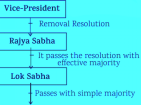
• Also the Vice-President can be removed from his office by a resolution passed in Rajya Sabha by effective majority (Majority of the then members of Rajya Sabha) and agreed by Lok Sabha with Simple majority.
• The constitution does not mention the time limit to fill the vacancy in the office of Vice-President. Instead the Constitution says that the election must be held as soon as possible.
Note :-
Absolute Majority :-
• It includes existing members as well as vacant seats.
• Suppose, we have 100 members then
Absolute majority = + 1 = 51
Effective Majority :-
• It includes only the existing members, it doesn’t include vacant seats.
• Suppose there are 10 vacant seats then effective membership = 100 – 10 = 90
Thus, Effective majority = + 1 = 46
• The President administers the Oath to the Vice-President. Whereas the Chief Justice of India administers Oath to the President of India.
• Qualification for Vice-President
▪ Citizen of India
▪ Minimum 35 years of age
▪ Doesn’t hold any office of profit
▪ He should be qualified to be a member of Rajya Sabha.
• The ground for removal of Vice-President is not mentioned in the constitution.
Attorney General of India
• Attorney General of India is the Constitutional Post under Article-76 of the constitution.
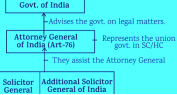
• The Attorney General of India is the Chief legal advisor of the government of India.
• He is the highest law officer in the country.
• The Attorney General of India is appointed by the President of India.
• There is no fixed term of the Attorney General of India. He remains in the office during the pleasure of the President.
• His remuneration shall be such as decided by the President.
• Qualifications : He should be qualified to be a judge of the Supreme Court.
roles & responsibilites
▪ He is the Chief legal advisor of the government of India.
▪ He represents the union government in the Supreme Court or High Courts or any other courts in India.
▪ He can participate in the proceedings of the houses of Parliament or of the committee of which he is the member but he does not have the right to vote.
• Current Attorney General of India – R. Venkartaramani
• First Attorney General of India – M.C. Setalvad
Note :
• The Attorney General of India, not the Chief Justice of India (CJI), is considered the highest law officer because the Attorney General of India serves as the Chief Legal advisor to the government and represents the Union Government in the Supreme Court, a role distinct from the CJI’s judicial duties.
• The Attorney General is a part of the Union Executive, while the CJI is part of Judiciary.
• The Attorney General’s primary role is to advise and represent the government, while the CJI’s primary role is to interpret the law and ensure the proper functioning of the judiciary.
Limitations on the powers of Attorney General
• Despite being the Chief legal advisor to the Govt. of India, the Attorney General (AGI) has several limitations on their powers and functions. These includes –
▪ Cannot defend against the govt. : The AGI cannot represent any party against the Government of India in any legal matter.
▪ Cannot Appear in Private Cases without Permission : Although allowed to engage in Private legal pracice, the AGI must take permission from the government before accepting any private cases. Cannot advise private clients in cases where the government is involved.
▪ No right to vote in Paliament : While the AGI can attend and participate in proceedings of both houses of Parliament and their committees, they do not have voting rights.
▪ No fixed term or security of tenure : The AGI holds office at the pleasure of the President, meaning they can be removed at any time without any formal procedure.
▪ Can’t become a director in a company : The Prior permission of the Government of India is required.
Solicitor General of India (SGI) and Additional Soliator Generals (ASGs)
• The solicitor General of India (SGI) and Additional Solicitor Generals (ASGs) assist the Attorney General of India (AGI) in performing their legal duties.
• These positions are not mentioned in the Constitution but are created by the Government of India.
• The Solicitor General of India (SGI) and Additional Solicitor Generals (ASGs) function as sub ordinate law officers under the Ministry of law and justice, specifically under its Department of legal Affairs.
FAQs
1. Consider the following statements regarding the Vice-President of India:
1. He is elected by the members of both Houses of Parliament.
2. He is elected by a system of proportional representation by means of a single transferable vote.
3. He must be a member of the Rajya Sabha at the time of election.
Which of the above statements is/are correct?
(A) 1 and 2 only (B) 1 and 3 only (C) 2 and 3 only (D) 1, 2 and 3
Ans :- (A) 1 and 2 only
▪ The Vice-President is elected by an electoral college consisting of members of both Houses of Parliament, including nominated members, through proportional representation by means of a single transferable vote (Article 66). However, he need not be a member of Rajya Sabha at the time of election; he becomes the ex-officio Chairman of Rajya Sabha after election.
2. Which of the following are qualifications for the office of Vice-President of India?
1. Must be a citizen of India.
2. Must have completed the age of 30 years.
3. Must be qualified for election as a member of the Rajya Sabha.
Select the correct answer using the codes below:
(A) 1 and 2 only (B) 2 and 3 only (C) 1 and 3 only (D) 1, 2 and 3
Ans :- (C) 1 and 3 only
As per Article 66(3), the qualifications for VicePresident are:
▪ He must be a citizen of India.
▪ He must have completed 35 years of age (not 30 years, so statement 2 is incorrect).
▪ He must be qualified for election as a member of the Rajya Sabha.
3. Consider the following statements:
1. The Vice-President can act as President in case of a vacancy due to resignation or death.
2. During such period, he enjoys all powers and emoluments of the President.
3. The maximum period for which the VicePresident can act as President is six months.
Which statements are correct?
(A) 1 and 2 only (B) 2 and 3 only (C) 1 and 3 only (D) 1, 2 and 3
Ans :- (D) 1, 2 and 3
▪ According to Article 65, the Vice-President acts as President in case of death, resignation,
or removal of the President. He enjoys all the powers and privileges of the President during
this period. A new President must be elected within six months, which is the maximum
duration for which the Vice-President can act as President.
4. Who administers the oath office to the VicePresident of India?
(A) President (B) Chief Justice of India (C) Speaker of Lok Sabha (D) Chairman of Rajya Sabha
Ans :- (A) President
▪ As per the second schedule and Article 69, the Vice-President takes oath before the president of India.
5. Consider the following statements regarding the Attorney General of India:
1. He is the highest law officer in the country.
2. He is a member of the Union Cabinet.
3. He has the right to speak in Parliament and take part in its proceedings.
4. He is appointed by the Chief Justice of India.
Which of the above statements is/are correct?
(A) 1 and 3 only (B) 1, 2 and 3 only (C) 1, 3 and 4 only (D) 1 only
Ans :- (A) 1 and 3 only
▪ The Attorney General (AG) is the highest law officer in India under Article 76 of the Constitution.
▪ He is not a member of the Cabinet; he only advises the government on legal matters.
▪ The AG has the right to speak and participate in the proceedings of both Houses of Parliament but cannot vote.
▪ He is appointed by the President, not the Chief Justice.
6. Consider the following statements:
1. The Attorney General of India must be a person qualified to be appointed as a judge of the Supreme Court
2. The tenure of the Attorney General is fixed for five years.
3. He holds office during the pleasure of the President.
Which of the above is/are correct?
(A) 1 and 2 only (B) 2 and 3 only (C) 1 and 3 only (D) 1, 2 and 3
Ans :- (C) 1 and 3 only
▪ A person is qualified to be AG if they are eligible to be a Supreme Court judge (i.e…5 years as judge
in High Court or 10 years as an advocate in High Court or a distinguished jurist).
▪ There is no fixed term; he serves at the pleasure of the President.
7. Consider the following statements:
1. The President may require the Council of Ministers to reconsider its advice.
2. If the Council of Ministers reiterates its advice, the President is bound to act on it.
3. The constitution explicitly provides a time limit for the President to act on the advice.
Which of the above is/are correct?
(A) 1 and 2 only (B) 2 and 3 only (C) 1, 2 and 3 (D) only 2
Ans :- (A) 1 and 2 only
▪ Article 74(1) (after 44th Amendment) allows the President to return the advice once for reconsideration.
▪ If the Council reiterates the advice, the President must comply.
▪ No specific time limit is Prescribed in the Constitution for such action.
8. Who can assume the office of the President in some situations?
(A) Vice-President of India (B) Chief Justice of India
(C) Senior most judge of the Supreme Court (D) All of the above
Ans (D) All of the above
▪ In the event of a vacancy created for the President’s post due to death, resignation, removal etc Article-65 of the Indian Constitution says that the Vice-President will have to discharge his duties, and when vacancies occur in the offices of the President and of the Vice-President simultaneously, owing to removal, death, resignation of the incumbent or otherwise.
▪ In such an eventuality, the Chief justice of India or in his absence, the senior most judge of the Supreme Court of India available discharges the functions of the President until a newly elected President begins to act as President under Article-65 of the constitution, whichever is the earlier. ▪ Hence the correct anser will be option (D).
9. Who administers the oath to the Vice-President?
(A) Chief Justice of India (B) Speaker of Lok Sabha
(C) President of India (D) Deputy Chairman of Rajya Sabha
Ans (C)President of India
▪ The oath or affirmation of office to the Vice-President is administered by the President or some person appointed in that behalf by him/her.
10. The vacancy in the office of Vice-President must be filled within –
(A) 1 month (B) 2 month (C) 6 month (D) None of these
Ans (D)None of these
▪ The constitution does not provide any time frame. Rather the word “as soon as possible” is mentioned.
11. Which of the following is not common to the electoral college of President and VicePresident?
I. Elected members of Lok Sabha
II. Nominated members of Rajya Sabha
III. Members of Legislative Assemblies
(A) I only (B) I and II only (C) II and III only (D) I, II and III
Ans (C)II and III only
▪ Nominated members participate in Vice-President election but not Presidential election.
▪ MLAs participate in Presidential election but not in Vice-Presidential election.
12. Select the correct statements regarding Attorney General of India:
I. Attorney General of India is appointed by the President of India.
II. He should be qualified to be appointed as the judge of Supreme Court.
III. He is removed like the judge of the Supreme Court.
(A) I and II only (B) II and III only (C) I and III only (D) I, II and III
Ans (A) I and II only
▪ The Supreme Court judges do not hold office during the pleasure of the President.
▪ They can be removed by a removal motion passed by both houses of the Parliament by special majority and on the grounds of proved misbehavior or incapacity.
▪ On the other hand the Attorney General of India does not have a fixed tenure and can be removed from his office any time.