
Council of Minister
• The provisions regarding Council of Minsiters are mentioned in Article-74 & 75 of the constitution.
• Article-74 says that there shall be a Council of Ministers headed by the Prime Minister to aid and advise the President of India.
• Also the 42nd amendment of the constitution provided that the President must act in accordance with the advise tendered by the Council of Ministers. It made advise binding on the President.
• However 44th Amendment Act-1978 of the constitution provided an opportunity to the President to ask the Council of Ministers to reconsider the advise once.
• The advise tendered by the Council of Ministers is not questioned in any court.
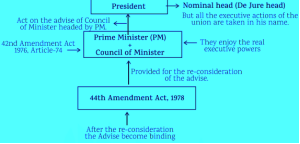
• Therefore it is rightly said that the President of India does not have any constitutional discretion.
• The Prime Minister and his Council of Ministers enjoy the real executive powers in the Paliamentary democracy. The PM is the real executive authority (de facto executive) in the parliamentary system.
• The President of India Acts as the nominal executive (de jure executive) and he works on the aid and advise fo the Prime Minister and Council of Ministers.
ARTICLE-75
• It provides the provisions related to Union Council of Ministers.
• The Prime Minister and the Council of Ministers are appointed by the President of India.
• The ministers are appointed by the President on the advice of Prime Minister.
• The 91st constitutional Amendment Act-2003 limited the size of the Council of Minister to the maximum of 15% of the total membership of Lok Sabha.
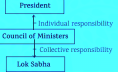
• Article-75(3) : It says that Council of Ministers are collectively responsible to the house of the people. It is the basis of Parliamentary form of government in India. Because the Parliamentary form of government is defined as the government in which Executive is responsible towards the legislature.
• The Council of Ministers hold the office during the pleasure of the President. It means the ministers are individually responsible towards the President. But it does not mean that the Ministers can be removed by the President at his will. The ministers are removed by the President on the advise of the Prime Minister. [Article–75(2)]
• The ministers are administered oath of their office by the President of India as per the provisions of 3rd schedule. The Minister takes two oaths and these are oath of office and oath of secrecy.
• The ministers will cease to hold the office if they are not the member of Parliament for 6 months.
Few concepts regarding Council of Minsiters
• Maximum strength including Prime Minister = 15% of the Lok Sabha seats.
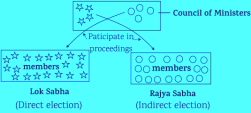
• The Council of Ministers can be either from Lok Sabha or Rajya Sabha or both.
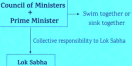
• But they are collectively responsible towards the Lok Sabha only. It means they swim and sink together.
• The ministers have the privilege to participate in the proceedings of the both houses of the Parliament but they can vote only in that house of which they are the member. (Article-88)
Prime Minister
• Prime Minister is the central authority in the Parliamentary system of governance.
• The real executive authority (de facto executive) is enjoyed by the Prime Minister.
• Prime Minister is the nucleus of the Council of Ministers.
• It is the discretion of the Prime Minister to choose the person to his Council of Ministers.
• On his advice the President appoints the ministers. The ministers must be the member of the Parliament either from Lok Sabha or from Rajya Sabha. If they are not the member of the Parliament then they must become member in 6 months.
• Prime Minister is the leader of Lok Sabha if he is the member of Lok Sabha. If the Prime Minister is from Rajya Sabha then he nominates one of the Ministers from Lok Sabha as the leader of Lok Sabha.
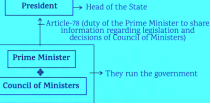
• Article-78 says that it is the duty of the Prime Minister to share information regarding legislations and decisions of Council of Ministers with the President.
Prime Minister and Council of Ministers
- The Prime Minister of India is the head of the government and plays a pivotal role in the administration and governance of the country. The role and functions of the Prime Minister are derived from the Constitution of India, conventions, and practices. Below are the key roles and functions :
1. Head of the Government: The Prime Minister is the leader of the executive branch of the Government of India. He is the “de facto executive” where as the President is the “de jure executive”.
2. Formation of the Council of Ministers: The Prime Minister selects and on his recommendation the President appoints ministers to the Council of Ministers, allocates portfolios, and can reshuffle or dismiss them. He guides and coordinates the functioning of various ministries and departments.
3. Leader of the Lok Sabha: The Prime Minister is the leader of Lok Sabha. The PM represents the government in Parliament. Leads discussions and debates. Ensures the passage of government bills. In Lok Sabha, the Prime Minister usually functions as the Leader of the House; if he is not a member of this House, a Minister, who is a member of the Lok Sabha and is nominated by the Prime Minister functions as such. Leader of the House is an important Parliamentary functionary.
4. Chief Spokesperson of the Government: The Prime Minister represents the government both domestically and internationally. They communicate government policies and decisions to the public and the Parliament.
5. Link Between the President and the Council of Ministers: The Prime Minister acts as the primary channel of communication between the President and the Council of Ministers.
6. Advice on Key appointments: He advises the President on key appointments, such as Attorney General of India, CAG, UPSC Chairman and Members, Finance Commission, and other high-ranking officials.
7. Diplomatic Role: The Prime Minister represents India in international forums and bilateral/multilateral engagements. He plays a key role in shaping India’s foreign policy and strengthening diplomatic ties.
8. Policy Formulation and Implementation: The Prime Minister is responsible for shaping national policies and ensuring their implementation. He is the chairman of NITI Aayog, Inter-State Council. The Prime Minister is the head of Nuclear Command Authority, Appointments Committee of the Cabinet, Department of Atomic Energy, Department of Space and Ministry of Personnel, Public Grievances and Pensions.
9. Crisis Management: Takes charge during emergencies like wars, natural disasters, and internal disturbances. Directs security and defence operations.
Classification of Council of Ministers
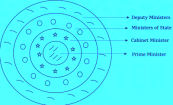
Cabinet Ministers
• These ministers hold the independent charge of a ministry and they hold the most important portfolios.
• For example – Home Ministry, Defence Ministry, External affairs Ministry etc.
• The Cabinet Ministers participate in the Cabinet meetings called by the Prime Minister.
• The word Cabinet is mentioned in Article-352 (National Emergency) and it was added by the 44th Constitutional Amendment Act 1978.
Ministers of State
• They are also part of Council of Ministers. But they are not the rank of Cabinet Ministers
• They can be given independent charge or may be attached with a department of a Ministry.
• They may participate in the Cabinet meetings if they are invited.
Deputy Ministers
• They are also the part of Council of Ministers but they are not given any independent charge.
• They are attached with the office of Cabinet Ministers and Ministers of State and they assist them. They do not participate in the Cabinet meetings.
Council of Ministers : Collective Responsibility
- The Principle of Collective responsibility means that the Council of Ministers (headed by the Prime Minister) is collectively accountable to the Lok Sabha for all its decisions and policies. If the Lok Sabha passes a vote of no confidence against the government, the entire Council of Ministers, including the Prime Minister, must resign.
- This principle is based on Article 75(3) of the Indian Constitution, which states that “The Council of Ministers shall be collectively responsible to the house of the People (Lok Sabha)”.
How is Collective Responsibility Ensured by Lok Sabha?
1. No Confidence Motion : If the Lok Sabha passes the no confidence motion then the P.M will have to resign. Also on the resignation of the Prime Minister, the whole Council of Minister will resign automatically. It is not introduced in Rajya Sabha.
2. Money Bill/Budget : If the Money bill is not passed by the Lok Sabha then the Prime Minister and his Council has to resign.
3. Motion of confidence : The Prime Minister may seek a trust vote to prove that the government has the support of the majority in the Lok Sabha.
4. Censure Motion : The Lok Sabha can pass a censure motion against specific policies of the government through it does not lead to resignation but act as a warning.
Significane of Collective Responsibility
• Ensures political stability and accountability.
• Promotes uniformity in government decisions.
• Prevents Ministers from publicly opposing government policies.
• Thus, collective responsibility ensures that the government remains accountable to Parliament and ultimately to the people
Evolution of PM’s role
- The role of the Prime Minister of India has evolved significantly since Independence. Initially, the PM was the undisputed leader in a single-party system. However, during the coalition era, the PM had limited authority. In recent years, with a strong parliamentary majority, the PM has regained centralised power, making major policy decisions independently. The office of the PM remains the most powerful in the Indian political system and continues to evolve with changing political dynamics.
| Period | Key Features | PM’s Power |
| 1947-1964 (Nehru Era) | Nation-building, centralized leadership, socialist economy | Strong |
| 1964-1989 (Indira & Rajiv Gandhi Era | Emergency rule, economic nationalism, early Liberlization | Strong but Unstable |
| 1989-2014 (Coalition Era) | Weak PMs, coalition politics, corruption issues | Weak |
| 2014-Present (Modi Era) | Centralized governance, strong PMO, economic and foreign policy reforms | Strongest since Nehru-Indira |
Evolution of the Role of PM After Independence
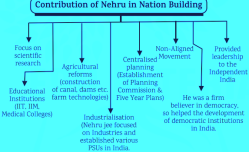
1. The Nehruvian Era (1947-1964): Jawaharlal Nehru, the first PM, played a dominant role in shaping India’s socialist economy, foreign policy (Non-Aligned Movement), and industrialization. The PM had unquestioned authority within the party and the government. He played a central role in nation-building, focusing on economic planning (Five-Year Plans), industrialization, and foreign policy (Non-Aligned Movement).
▪ The PMO (Prime Minister’s Office) functioned as an advisory body with limited bureaucratic control.
Non-Aligned Movement
• This was the foreign policy of India after independence.
• After the second world war which ended in 1945 there emerged a bipolar world with the USA & USSR being the two powerful countries.
• However the cold war started between these two countries.
• Each of them tried to dominate the world with their policies while restraining the influence of each other.
• Therefore in this backdrop India adopted the Non-Aligned policy and didn’t join either of the blocks.
2. Transition Phase: Institutionalization of Power (1964-1989): The post-Nehru period (1964-1989) saw significant political shifts. Lal Bahadur Shastri (1964-66) maintained Nehru’s policies but emphasized on agriculture and food security. However, with Indira Gandhi’s rise (1966-77), the PM’s role became even more powerful, as she centralised authority and weakened the influence of senior Congress leaders. She introduced economic nationalism, bank nationalisation, and the abolition of the Privy Purse.
▪ The Emergency (1975-77) marked the peak of prime ministerial control, where fundamental rights were suspended, and the PM’s office dictated governance. However, the return of democracy in 1977 brought unstable coalition governments led by Morarji Desai and Charan Singh, where the PM struggled to exercise authority. The 1980s saw Indira Gandhi return to power, followed by Rajiv Gandhi (1984-89), who introduced technology-driven reforms, but internal party conflicts limited the PM’s dominance.
3. Coalition Era: Decline in PM’s Authority (1989-2014): (Weak PMs and Coalition Governments (1989-2004)): During the coalition era (1989-2014), the PM’s authority weakened due to the rise of regional parties and the need for alliances. P.V. Narasimha Rao (1991-96), despite being a coalition leader, managed to introduce economic liberalization and globalization but had limited control due to political instability.
Coalition Government
• It is that government which forms by the coalition of various parties when a single party cannot form the government on its own.
• The coalition governments are unstable governments as the coalition partners may withdraw support from the government
▪ Atal Bihari Vajpayee (1998-2004) led a stable coalition and advanced economic growth, nuclear tests, and diplomatic relations, but still had to accommodate allies in decisionmaking.The role of the PM weakened further under Manmohan Singh (2004-2014), where governance was largely influenced by the Congress leadership, particularly Sonia Gandhi. Despite strong economic growth and foreign policy achievements, the PM’s office was affected by corruption scandals and coalition pressures.
4. Strong Executive Era: Resurgence of PM’s Power (2014-Present) (Narendra Modi Era (2014-Present)): The strong executive era (2014-Present) marks a resurgence of PM power. Narendra
Modi’s leadership (since 2014) has re-established a centralised decision-making model, where major policy decisions are taken directly by the PMO.
▪ His government has focused on economic reforms (GST, Digital India, Demonetisation, JAM Trinity, etc), national security (Surgical strikes, Hot Pursuits), and foreign policy (Act East, stronger global ties, G20, Voice of Global South, etc).
JAM Trinity
• JAM trinity means the trinity of Jan dhan, Aadhar & Mobile.
• Its main purpose is to increase the level of financial inclusion in India.
• Financial inclusion means providing the welfare to the Marginalised sections of the society by bringing them in the formal financial framework.
• The JAM trinity is a tool to promote DBT (Direct Benefit Transfer) which promotes financial inclusion.
▪ Unlike previous coalition-era PMs, Modi operates with a strong parliamentary majority, allowing him greater control over governance and policy implementation.
Conclusion :
- Thus, the evolution of the Prime Minister’s role reflects India’s broader political and economic journey. From Nehru’s centralized leadership to coalition-era limitations and the return of a strong executive, the role has adapted to changing political dynamics. The future of the PM’s office will depend on maintaining a balance between executive power, democratic institutions, and governance efficiency
Coalition Politics and Prime Minister
- Coalition politics significantly affects the power of the Prime Minister (PM) in India, particularly by limiting decision-making authority, increasing dependence on allies, and weakening centralized governance. When no single party secures a majority in the Lok Sabha, multiple parties form a coalition government, forcing the PM to share power with alliance partners. This restricts the PM’s ability to make independent decisions and often leads to compromises in policy-making, governance, and administration.
Impact of Coalition Politics on PM’s Powers
1. Reduced Decision-Making Authority: The PM in a coalition government cannot take unilateral decisions, as they must consult coalition partners before implementing policies. Important reforms may be diluted due to opposition from allies who have different ideological positions.
▪ For instance P.V. Narasimha Rao (1991-1996) introduced economic liberalisation (1991 LPG reforms),but had to balance the demands of allies, leading to hesitations in fullscale privatisation.
2. Dependence on Regional and Smaller Parties : Coalition governments rely on regional parties, which may demand special benefits or policies favouring their states. The PM has to accommodate the demands of these allies, sometimes at the cost of national policies.
3. Compromises in Ministerial Appointments: The PM cannot choose all ministers freely as key portfolios are often distributed among coalition partners. Some ministers may be appointed based on political bargaining rather than merit, affecting governance efficiency.
4. Policy Paralysis and Delays: The need for consensus-building among multiple parties often leads to delayed decision-making. Key economic and social reforms may get blocked or watered down due to disagreements.
5. Challenges in Handling Corruption and Scandals: Coalition governments often face corruption issues, and the PM may struggle to take strict action against ministers from allied parties to avoid breaking the alliance.
▪ For instance the “2G scam” happened under the United Progressive Alliance (UPA) government, led by Manmohan Singh. The 2G spectrum scam was one of the largest corruption scandals in India, related to the allocation of telecom licenses and spectrum at below-market prices in 2008. It caused an estimated loss of 1.76 lakh crore ($30 billion) to the Indian government, as reported by the Comptroller and Auditor General (CAG) of India
▪ A. Raja, the then Telecom Minister from the DMK (Dravida Munnetra Kazhagam), was the key accused. The scam severely damaged the UPA government’s image, leading to massive protests and public anger.
▪ It became a major issue in the 2014 general elections, helping the BJP-led NDA win a landslide victory.
Merits of Coalition Politics
- Coalition politics, where multiple parties come together to form a government, is often seen as a challenge due to instability and compromises. However, it also has several merits, particularly in a diverse country like India, where multiple regional, social, and ideological interests must be represented.
1. Promotes Inclusiveness and Representation : In a diverse country like India, coalition governments ensure that regional parties, minority groups, and different communities get a voice in national governance. It prevents the dominance of a single party and promotes a more balanced decision-making process.
▪ The United Progressive Alliance (UPA) and National Democratic Alliance (NDA) included regional parties like DMK, TDP, and Shiv Sena, ensuring diverse representation.
2. Prevents Authoritarian Rule : A coalition government limits the power of a single leader or party, reducing the chances of an authoritarian regime. It ensures checks and balances, as different parties must agree on policies before they are implemented. For Example, during Atal Bihari Vajpayee’s NDA government (1998-2004), the BJP had to moderate its policies (e.g., put Ram Mandir on hold) to keep coalition partners united.
3. Encourages Consensus-Based Decision Making : Policies are discussed and debated among multiple parties, leading to broader agreement and better decision-making. Unlike singleparty rule, where policies may be imposed, coalition politics encourages negotiations and compromise.
4. Strengthens Federalism and Regional Autonomy: Coalition politics gives regional parties a share in power, ensuring that state issues are addressed at the national level. It helps in decentralising power, making governance more state-focused. For instance Tamil Nadu’s DMK, Andhra Pradesh’s TDP, and West Bengal’s Trinamool Congress, Bihar’s JDU, RJD, LJP, etc have influenced national policies by being part of coalition governments.
5. Encourages Multi-Party Democracy: Coalition politics ensures that multiple political parties remain relevant, preventing the monopoly of one party. It creates healthy competition, encouraging parties to perform better and remain accountable to voters.
▪ The rise of regional parties like SP, BSP, AIADMK, TMC has ensured that national parties cannot ignore state-specific concerns.
Conclusion
- Coalition politics, despite its challenges, plays a crucial role in strengthening democracy, ensuring representation, and preventing authoritarian rule. It encourages consensus-driven governance, respects regional aspirations, and makes policies more inclusive. While it may sometimes lead to instability or slow decision-making, its benefits in promoting democratic values outweigh the drawbacks.
| Type of Government | Definition | Characteristics | Examples of India |
| Majority Government | A government where a single party has more than 50% seats in the Lok Sabha. | • The ruling party can make decisions without depending on other parties. • Stable and efficient governance. • The Prime Minister has strong decision making authority. | • Jawaharlal Nehru (1952,1957, 1962) – Congress• Rajiv Randhi (1971) –Congress• Narendra Modi (2014, 2019) – BJP |
| Minority Government | A government where the ruling party has less than 50% seats but continues to govern with external support | • The government survives with outside support from other parties. • Often unstable and at risk of collapsing if support is withdrawn. • PM has limited control over policy decisions. | • V.P. Singh (1989-90) –Janata Dal with outside support from BJP & Left.• P.V. Narasimha Rao (1991-96)- Congress (Started as Minority Govt, later gained majority)• Manmohan Singh (2004-2009) – Congress led UPA (Supported by Left parties initially |
| Coalition Government | A government formed by two ormore political parties sharing power to secure a majority. | • Power sharing agreement between parties. • Requires consensusbased decision-making• Can be unstable if alies withdraw support. | • Atal Bihari Vajpayee (1998-2004) – NDA Government• Manmohan Singh (2009-2014) – UPA Government |
| Caretaker Government | A temporary government that remains in power until a new government is elected or formed. | • Has limited decision making powers • Cannot introduce major policies or reforms. • Ensures smooth transition of power. | • Gulzarilal Nanda (1964, 1966) – After the deaths of Nehru & Shastri • Atal Bihari Vajpayee (1996) – BJP governmnet lasted only 13 days, functioned as a caretaker• Manmohan Singh (2014). After elections, before Modi took office. |
Atal Bihari Vajpayee’s case : 13 Din Ki Sarkar
• The 1996 Indian general elections resulted in a hung Parliament, with no party winning a majority. The BJP emerged as the single largest party with 161 seats in the 543-member Lok Sabha. The President of India, Dr. Shankar Dayal Sharma, invited Atal Bihari Vajpayee to form the government, as the BJP was the largest party.
• Vajpayee took oath as Prime Minister on May 16, 1996, and was given two weeks to prove his majority in the Lok Sabha.
• The Congress (140 seats), United Front (190 seats), and Left parties refused to support Vajpayee. Instead, they backed a non-BJP coalition, preventing the BJP from forming a stable government.
• On May 27, 1996, Vajpayee addressed the Lok Sabha, defending his government and policies. Realizing he lacked the numbers, he resigned before the confidence vote to avoid defeat.
• After Vajpayee’s resignation, a United Front government was formed under H.D. Deve Gowda with Congress’ outside support. Atal Bihari Vajpayee’s 13-day government in 1996 was a result of a hung Parliament and the BJP’s inability to gather enough support. Vajpayee returned as Prime Minister in 1998 and 1999, forming a stable National Democratic Alliance (NDA) government that lasted until 2004.
Atal Bihari Vajpayee’s case : 13 Month Ki Sarkar !
Background
• Before the 1998 Lok Sabha elections, Inder Kumar Gujral was the Prime Minister of India, serving from April 21, 1997, to March 19, 1998.
• He led a United Front government with Congress’ outside support, but his tenure was short-lived.
• In November 1997, Congress withdrew its support over differences related to the DMK’s alleged links to the LTTE, leading to the collapse of his government.
• After the fall of the United Front government in 1998, fresh Lok Sabha elections were held in February-March 1998. The results led to a fractured mandate, with no single party winning an outright majority.
• Election Results (1998): BJP emerged as the largest party with 182 seats. Congress won 141 seats, while regional parties like AIADMK, TDP, DMK, and others held a crucial position. The United Front, weakened by internal conflicts, could not form a government.
• Formation of the Vajpayee Government: Vajpayee formed the National Democratic Alliance (NDA), securing support from regional allies like: AIADMK (Jayalalithaa), TDP (Chandrababu Naidu), Biju Janata Dal (BJD), Samata Party (George Fernandes), Shiromani Akali Dal (SAD), etc With their backing, Vajpayee reached the majority mark and was sworn in as Prime Minister on March 19, 1998.
• Fall of government by just 1 Vote:
▪ The fall of Atal Bihari Vajpayee’s government in April 1999 by just 1 vote (269-270) was a historic moment in Indian politics. This was the narrowest margin by which a government had ever lost a confidence motion in the Lok Sabha.
▪ In April 1999, AIADMK leader Jayalalithaa withdrew support, demanding the removal of Tamil Nadu Chief Minister M. Karunanidhi and corruption cases against her to be dropped. Vajpayee’s government faced a trust vote on April 17, 1999, and lost by just one vote (269-270).
▪ Return of Vajpayee in 1999: After losing the confidence vote by just 1 vote (269-270) on April 17, 1999, Atal Bihari Vajpayee resigned as Prime Minister. Since no other party could form a government, fresh elections were held in September-October 1999.
▪ Unlike 1998, Vajpayee ensured a more stable coalition by securing stronger commitments from allies. The AIADMK (Jayalalithaa), which withdrew support earlier, was no longer part of the NDA.
▪ The BJP-led National Democratic Alliance (NDA) won 270+ seats, securing a clear majority.
▪ Vajpayee was sworn in as Prime Minister on October 13, 1999, and led the first full-term successful coalition government (1999-2004).
FAQs
1. Consider the following statements regarding the constitutional provisions related to the
Prime Minister and the Council of Ministers:
1. Article 75(1) states that the Prime Minister shall be appointed by the President.
2. The Constitution does not prescribe any specific procedure for the selection of the Prime Minister.
3. The advice of the Prime Minister is binding on the President in the appointment of other ministers.
Which of the above statements is/are correct?
(A) 1 and 2 only (B) 2 and 3 only (C) 1 and 3 only (D) All of the above
Ans :- (D) All of the above
▪ Statement 1 is correct: Article 75(1) clearly states that the Prime Minister shall be appointed by the President.
▪ Statement 2 is also correct: The Constitution does not specify the process of selecting the Prime Minister. It is governed by parliamentary convention, under which the President appoints the person who commands a majority in the Lok Sabha.
▪ Statement 3 is correct as well: Article 75(1) also says that the other ministers shall be appointed by the President on the advice of the Prime Minister, making this advice binding.
2. With reference to the concept of collective responsibility, consider the following statements:
1. The Council of Ministers is collectively responsible to the Lok Sabha.
2. A no-confidence motion passed in Lok Sabha leads to resignation of the entire Council of Ministers
3. Collective responsibility ensures internal unity among ministers despite individual differences.
Which of the statements given above is/are correct?
(A) 1 and 2 only (B) 2 and 3 only (C) 1 and 3 only (D) All of the above
Ans :- (D) All of the above
▪ Article 75(3) mandates that the Council of Ministers shall be collectively responsible to the Lok Sabha.
▪ If the Lok Sabha passes a no-confidence motion, the entire Council including the Prime Minister must resign.
▪ Collective responsibility implies that all ministers publicly support Cabinet decisions, even if they privately disagree.
3. Under Article 78, the Prime Minister has several obligations towards the President. Consider the following:
1. The Prime Minister must communicate to the President all decisions of the Council of Ministers
2. The Prime Minister must provide information to the President as and when asked.
3. The Prime Minister is not bound to reconsider Cabinet decisions if the President requests so.
Which of the statements given above is/are correct?
(A) 1 and 2 only (B) 2 and 3 only (C) 1 and 3 only (D) All of the above
Ans :- (A) 1 and 2 only
▪ Article 78 outlines the PM’s duties toward the President, including communication of all decisions and providing information when sought.
▪ If the President requests reconsideration of a decision, the PM is constitutionally bound to submit the matter to the Cabinet again.
4. Regarding the tenure of the Prime Minister, consider the following statements:
1. The Prime Minister holds office during the pleasure of the President.
2. The Prime Minister must always enjoy the confidence of the Lok Sabha.
3. The President may dismiss the Prime Minister even when he enjoys majority support in Lok Sabha.
Which of the statements given above is/are correct?
(A) 1 and 2 only (B) 2 and 3 only (C) 1 and 3 only (D) All of the above
Ans :- (A) 1 and 2 only
▪ Article 75(2) uses the phrase “pleasure of the President,” but in a parliamentary system, this means as long as the PM has Lok Sabha’s confidence.
▪ The President cannot dismiss a PM who commands majority support. So, Statement 3 is incorrect.
5. Consider the following statements regarding the structure and functioning of the Council of Ministers:
1. It consists of Cabinet Ministers, Ministers of State, and Deputy Ministers.
2. The Council of Ministers is collectively responsible to the Rajya Sabha.
3. The Prime Minister allocates portfolios among ministers.
Which of the statements given above is/are correct?
(A) 1 and 3 only (B) 2 and 3 only (C) 1 and 2 only (D) All of the above
Ans :- (A) 1 and 3 only
▪ The Council of Ministers includes three ranks of ministers.
▪ It is collectively responsible only to the Lok Sabha, not Rajya Sabha.
▪ The Prime Minister decides which minister will handle which portfolio.
6. With reference to the distinction between Cabinet and Council of Ministers, consider the following:
1. The Cabinet is a smaller body within the Council of Ministers.
2. The Cabinet makes key policy decisions and directs the functioning of the government.
3. All Ministers of State are part of the Cabinet.
Which of the statements given above is/are correct?
(A) 1 and 2 only (B) 2 and 3 only (C) 1 and 3 only (D) All of the above
Ans :- (A) 1 and 2 only
▪ The Cabinet is the core decision-making body within the broader Council.
▪ Ministers of State are not part of the Cabinet unless specifically designated.
▪ The Cabinet handles high-level decisions, while the full Council includes ministers with varying roles
7. Consider the following statements regarding the powers of the Prime Minister in relation to the Council of Ministers:
1. The Prime Minister can advise the President to dismiss any minister.
2. The Prime Minister decides the agenda of Cabinet meetings.
3. The Prime Minister cannot alter the portfolios of ministers without approval of the Cabinet.
Which of the statements given above is/are correct?
(A) 1 and 2 only (B) 2 and 3 only (C) 1 and 3 only (D) All of the above
Ans :- (A) 1 and 2 only
▪ The Prime Minister can recommend dismissal of any minister, and the President is bound to act on that advice.
▪ The PM also fixes the agenda and presides over Cabinet meetings.
▪ Statement 3 is incorrect: The PM has the authority to reallocate portfolios without needing Cabinet approval.
8. With reference to the Cabinet system in India, consider the following statements:
1. The Cabinet is mentioned explicitly in the Constitution.
2. The Cabinet is responsible for policymaking and administration.
3. Decisions taken by the Cabinet are binding on all members of the Council of Ministers.
Which of the statements given above is/are correct?
(A) 1 and 2 only (B) 2 and 3 only (C) 1 and 3 only (D) All of the above
Ans :- (D) All of the above
▪ The word “Cabinet” is mentioned in Article-352 of the constitution and it was added by the 44th Constitutional Amendment Act, 1978.
▪ The Cabinet plays a central role in governance and its decisions bind all ministers, due to the principle of collective responsibility.
9. Consider the following with reference to the relationship between the President and the Prime Minister as per Article 78:
1. The Prime Minister is obligated to keep the President informed of the affairs of the Union.
2. The President can seek written information from the Prime Minister regarding decisions taken by ministers.
3. The Prime Minister must submit matters for reconsideration if so desired by the President.
Which of the statements given above is/are correct?
(A) 1 and 2 only (B) 2 and 3 only (C) 1 and 3 only (D) All of the above
Ans :- (D) All of the above
▪ Article 78 outlines the Prime Minister’s constitutional duties toward the President, which include:
➢ Communicating decisions,
➢ Providing requested information, and
➢ Reconsidering matters when asked by the President.
10. Which of the following correctly describes the status and role of the Prime Minister in the Indian parliamentary system?
1. He is the chief advisor to the President.
2. He is the real executive authority in the country.
3. He functions as the link between the President and the Council of Ministers.
Which of the statements given above is/are correct?
(A) 1 and 2 only (B) 2 and 3 only (C) 1 and 3 only (D) All of the above
Ans :- (D) All of the above
▪ The PM is the chief executive authority, acting as the head of the government.
▪ He advises the President on key matters, leads the Council, and acts as a bridge between the nominal (President) and real (Cabinet) executives.
11. Consider the following statements:
1. The Prime Minister is appointed by the President but must enjoy the confidence of the Lok Sabha.
2. The Prime Minister can be removed by the President without any parliamentary procedure.
Which of the above statements is/are correct?
(A) 1 only (B) 2 only (C) Both 1 and 2 (D) Neither 1 nor 2
Ans :- (A) 1 only
▪ Statement I is correct as the Prime Minister is formally appointed by the President, but must command the majority in the Lok Sabha to remain in office.
▪ Statement II is incorrect because the President cannot remove the Prime Minister arbitrarily; removal must follow parliamentary procedures like a noconfidence motion in the Lok Sabha.
12. Consider the following statements:
1. The Prime Minister is the chief coordinator among government departments.
2. The Prime Minister acts as a link between the President and the Council of Ministers.
Which of the statements given above is/are correct?
(A) 1 only (B) 2 only (C) Both 1 and 2 (D) Neither 1 nor 2
Ans :- (C) Both 1 and 2
▪ Statement I is correct as the PM plays the role of chief coordinator in resolving inter-departmental conflicts and formulating unified policies.
▪ Statement II is also correct since under Article 78, the PM serves as the main communication channel between the President and the Council of Ministers.
13. Consider the following statements:
1. Cabinet includes all ministers in the Council of Ministers.
2. Cabinet is the supreme decision-making body of the government.
Which of the statements given above is/are correct?
(A) 1 only (B) 2 only (C) Both 1 and 2 (D) Neither 1 nor 2
Ans :- (B) 2 only
▪ Statement I is incorrect because the Cabinet is a smaller, more powerful group within the Council of Ministers, typically comprising senior ministers only.
▪ Statement II is correct since the Cabinet serves as the core decision-making body in the executive branch of government.
14. Consider the following statements:
1. The Prime Minister allocates portfolios to ministers and reshuffles the Cabinet.
2. The President can reassign ministerial duties independently of the Prime Minister’s advice.
Which of the statements given above is/are correct?
(A) 1 only (B) 2 only (C) Both 1 and 2 (D) Neither 1 nor 2
Ans :- (A) 1 only
▪ Statement I is correct as the PM has the authority to distribute and reshuffle ministerial portfolios.
▪ Statement II is incorrect because the President is bound by the advice of the Prime Minister and cannot independently reassign ministerial duties.
15. Consider the following statements:
1. Collective responsibility means every minister is accountable individually to the Prime Minister.
2. It means all ministers are jointly responsible to the Lok Sabha.
Which of the statements given above is/are correct?
(A) 1 only (B) 2 only (C) both 1 and 2 (D) Neither 1 nor 2
Ans :- (B) 2 only
▪ Statement I is incorrect because collective responsibility does not imply individual accountability to the PM; it is a group principle.
▪ Statement II is correct as per Article 75(3), which holds the Council of Ministers jointly accountable to the Lok Sabha for all decisions and actions.
16. Consider the following statements:
1. The Prime Minister is called the ‘keystone of the Cabinet arch’.
2. The Constitution explicitly defines all the powers of the Prime Minister.
Which of the statements given above is/are correct?
(A) 1 only (B) 2 only (C) Both 1 and 2 (D) Neither 1 nor 2
Ans :- (A) 1 only
▪ Statement I is correct. The phrase ‘keystone of the Cabinet arch’ reflects the Prime Minister’s central and pivotal role in the parliamentary system.
▪ Statement II is incorrect because the Constitution gives only a broad outline of the PM’s role; most powers are derived from convention and political practice.
17. Consider the following statements :
1. Cabinet Committees are extraconstitutional bodies.
2. They reduce the burden of decisionmaking on the full Cabinet.
Which of the statements given above is/are correct?
(A) 1 only (B) 2 only (C) Both 1 and 2 (D) Neither 1 nor 2
Ans :- (C) Both 1 and 2
- Statement I is correct. Cabinet Committees are not mentioned in the Constitution, making them extraconstitutional in nature.
- Statement II is also correct because these committees handle specific issues, thereby streamlining Cabinet workload and enabling quicker decisions.
18. Consider the following statements:
1. The total number of ministers including the Prime Minister shall not exceed 15% of the Lok Sabha strength.
2. This limitation was imposed by the 91st Constitutional Amendment Act, 2003.
Which of the statements given above is/are correct?
(A) 1 only (B) 2 only (C) Both 1 and 2 (D) Neither 1 nor 2
Ans :- (C) Both 1 and 2
▪ Statement I is correct. Article 75(1A) provides that the total number of ministers shall not exceed 15% of Lok Sabha strength.
▪ Statement II is also correct. This cap was introduced by the 91st Constitutional Amendment Act, 2003 to curb excessive cabinet expansion.
19. Consider the following statements:
1. Cabinet Ministers do not attend Cabinet meetings and hold independent charges.
2. Ministers of State may either assist Cabinet Ministers or hold independent charge.
Which of the statements given above is/are correct?
(A) 1 only (B) 2 only (C) Both 1 and 2 (D) Neither 1 nor 2
Ans :- (B) 2 only
▪ Statement I is incorrect because Cabinet Ministers are senior members who attend Cabinet meetings and do not merely hold independent charge.
▪ Statement II is correct as Ministers of State may assist a Cabinet Minister or be assigned independent charge of departments.
20. Consider the following statements:
1. The Prime Minister can recommend the dissolution of the Lok Sabha.
2. The President is constitutionally bound to act on the advice of the Council of Ministers.
Which of the statements given above is/are correct?
(A) 1 only (B) 2 only (C) both 1 and 2 (D) Neither 1 nor 2
Ans :- (C) Both 1 and 2
▪ Statement I is correct. The PM has the authority to recommend dissolution of the Lok Sabha, usually when early elections are called or the house loses functionality.
▪ Statement II is also correct as per Article 74(1), which states that the President shall act on the aid and advice of the Council of Ministers, making such advice binding.
21. The Council of Ministers are individually responsible towards the :-
(A) Lok Sabha (B) Rajya Sabha (C) Prime Minister (D) President
Ans (D) President
▪ The Council of Ministers are individually responsible towards the President.
▪ The principle of individual responsibility is embodied in Article -75(2).
22. Select the correct statements :
I. The Prime Minister must be from the Lok Sabha.
II. The Prime Minister is elected directly by the people of India.
(A) I only (B) II only (C) Both I & II (D) Neither I nor II
Ans (D) Neither I nor II
▪ Statement I is incorrect because the Prime Minister can be either from Lok Sabha or from Rajya Sabha.
▪ For ex- Dr. Manmohan Singh was Prime Minister but member from Rajya Sabha.
▪ Statement II is incorrect because the Prime Minister is appointed by the President of India, not elected directly by the people of India.
23. Select the correct statements :
I. The maximum strength of the Council of Minister excluding the Prime Minister is 15% of the Lok Sabha seats.
II. The Cabinet is a part of Union Council of Ministers.
III. The word Cabinet was added in the Constitution by 42nd amendment act, 1946.
(A) I & II only (B) I & III only (C) II and III only (D) II only
Ans (D) II only
▪ Statement I is incorrect because the maximum strength of the Council of Ministers including (not excluding) the Prime Minister is 15% of the Lok Sabha seats.
▪ Statement II is correct because the cabinet is a part of Union Council of Ministers.
▪ Statement III is incorrect because the word Cabinet was added in the constitution by 44th amendment act, 1978. (Not by 42nd amendment act, 1976)
24. Select the incorrect statements :
I. The President of India is the de facto head of the Union executive.
II. It is the discretionary power of the President of India to appoint the ministers.
III. Dr. Manmohan Singh was a member of Lok Sabha when he was Prime Minister.
(A) I & II only (B) II & III only (C) III only (D) I, II & III
Ans (D) I, II & III
▪ Statement I is incorrect because the President of India is the de jure (not de facto) head of the Union executive. Prime Minister is the de facto head of the Union executive.
▪ Statement II is incorrect because it is not the discretionary power of the President of India to appoint the ministers. The ministers are appointed by the President on the recommendation of Prime Minister.
▪ Statement III is also incorrect because Dr. Manmohan Singh was a member of Rajya Sabha (not a member of Lok Sabha) when he was Prime Minister.
25. Select the correct statements regarding Council of Ministers.
I. The Council of Ministers are collectively responsible towards the Lok Sabha.
II. Lok Sabha ensures the collective responsibility by means of no confidence motion.
III. If the No Confidence Motion is passed in Lok Sabha then only the Prime Minister will resign but its council may not resign.
(A) I and II only (B) I and III only (C) II and III only (D) I, II and III
Ans (A) I and II only
▪ Statement I is correct because Article-75(3) of the constitution states that the Council of Ministers shall be collectively responsible to the house of people (Lok Sabha).
▪ Statement II is also correct because Lok Sabha ensures the collective responsibility by means of no-confidence motion it means when the Lok Sabha passes the no confidence motion then the PM will have to resign, also on the resignation of the PM the whole Council of Ministers will resign automatically.
▪ Statement III is incorrect because if the No Confidence Motion is passed in Lok Sabha then the PM will have to resign together with Council of Ministers.
26. Select the correct statements :
I. The President of India acts on the advise of Council of Ministers headed by the Prime Minister.
II. The President must oblige with the advise and he cannot send it for the reconsideration.
III. The advise tendered by the ministers to the President cannot be questioned in any court.
(A) I only (B) I and II only (C) I and III only (D) I, II and III
Ans (C)I and III only
▪ The statement II is incorrect because the 44th amendment of the constitution provided that the president may ask the Council of Ministers to reconsider the advise once. After wards the advise become binding after reconsideration.