
• India has adopted Parliamentary System from the UK, which is referred as Westminster model. It is called so because the British Parliament is located in Palace of Westminster (London).
• The Parliamentary System is based on the doctrine of fusion of powers between executive and legislature where the collective responsibility of the executive is towards the legislature.
• Though the Parliamentary System of India is similar to the Parliamentary System of UK but there are differences also.
• The key difference between both countries are as follows –
(i) India is a republic where the head of the state is elected whereas Britain is a Constitutional Monarchy where the head of the state is a Monarch which is hereditary in nature.
(ii) The Indian Constitution is a written constitution whereas the UK Constitution is unwritten. It is based on the laws made by Parliament and conventions.
(iii) In India the doctrine of constitutional supermacy is followed. It means the constitution is supreme in India and all the organs (Legislature, Executive & Judiciary) of the government derive their powers and authority from the constitution. On the other hand the British Parliament is Sovereign. It follows the Principle of Sovereignty of Parliament as it is not limited by any written constitution.
(iv) In India the courts have the powers of judicial review. It means the laws made by the Parliament can be declared null & void by the Supreme court & High Courts. However British Courts do not have such powers.
• Indian Parliament
▪ It derives its powers from the constitution.
▪ It is not a sovereign body like the British Parliament because in India there is a written constitution which limits the powers of Indian Parliament.
What limits the Sovereignty of Indian Parliament?
Sovereignty of Indian Parliament is limited by –
• Written Constitution
• Judicial review
• Fundamental Rights
• Doctrine of basic structure
• Federalism
1. Written Constituion : Constitution is supreme law of land in India. All the organs of the government derive their powers from the constitution itself. Therefore the Indian Parliament has to work within the limits set by the constitution. Therefore written nature of Indian Constitution limits the Sovereignty of Indian Parliament.
2. Judicial Review : Judicial review means the judiciary can check the constitutionality of the laws made by the legislature. In India the Supreme Court and the High Courts have the power of Judicial review and they can declare the laws made by the parliament Null & Void if such laws are unconstitutional. Therefore the powers of the Parliament of India are limited by Judicial review.
3. Fundamental Rights
▪ These rigts are guaranteed by the Constituion under Part-III of the Constitution.
▪ Article-13 states that laws which violate fundamental rights will be void. Therefore Parliament cannot make laws which abrogate the fundamental rights of the citizens.
▪ Therefore fundamental rights limit the sovereignty of Indian Parliament.
4. Basic Structure
▪ The doctrine of basic structure was propounded by the Supreme Court in the Kesavananda Bharati Case-1973.
▪ According to this doctrine the Parliament of India cannot ammend the basic features/structures of the constitution.
▪ Therefore the doctrine of basic structure limits the powers of Parliament to amend the constitution.
5. Federalism
▪ Federalism means division of powers between the centre and the states.
▪ The Constitution of India has demarcated the legislative and executive powers of the union and the states.
▪ For example – The seventh schedule has demarcated the subjects of legislation between the Union list, State list and Concurrent list.
▪ The Parliament can’t legislate on the subjects enumerated in the state list except in some circumstances.
▪ Therefore the principles of federalism limit the sovereignty of Indian Parliament.
Note :
▪ In Britain there is no written constitution therefore there is no authority above the British Parliament to limit it. Therefore it is a sovereign body and it follows the principle of sovereignty of Parliament.
▪ In India there is a written constitution therefore the Parliament is limited by the authority of the constitution. Therefore India follows the principle of supermacy of constitution.
Indian Model vs British Model of Parliament System
| Feature | Indian Model (India) | British Model (United Kingdom) |
| Type of Constitution | Written and detailed Constitution | Unwritten (largely based on conventions) |
| Nature of State | Republic – Head of State is an elected President | Monarchy – Head of State is the hereditary Monarch (King/Queen) |
| Head of State’s Role | President: Constitutional head with limited powers | Monarch: Ceremonial head, acts on advice of PM |
| Head of Government | Prime Minister (real executive) | Prime Minister (real executive) |
| Sovereignty | Constitution is supreme | Parliament is sovereign |
| Judicial Review | Exists; judiciary can strike down unconstitutional laws | No true judicial review; Parliament is supreme |
| Federalism | Federal system- Union + States | Unitary system – Power centralized in Westminster |
| Council of States/ Upper House | Rajya Sabha – Permanent, but with limited powers | House of Lords – Largely advisory and ceremonial |
| Secularism | Explicitly mentioned and constitutionally guaranteed | Not explicitly mentioned, Church of England is the state religion |
| Election of Executive | President elected indirectly | Monarch inherits position; not Elected |
| Impeachment / No Confidence | President can be impeached; PM can be removed by noconfidence motion | Monarch cannot be removed; PM removed by no-confidence motion |
| Political Culture | More legal-rational (written rules Heavily based on conventions and dominate) | Heavily based on conventions and customs |
Note :
- In Britain the Prime Minister should be a member of the lower house. Also the Ministers have legal responsibility in Britain which means they are required to countersign the official acts of Monarch. Also there is a shadow cabinet in British Cabinet system.
| UK Parliament | Indian Parliament |
| • Sovereign• Bicameralism• It means there are two houses in Britain Parliament. The upper house is called as “House of Lords” and the lower is called as “House of Commons”.• In Britain the Prime Minister must be from the houses of commons. | • Non-Sovereign• Bicameralism• It means Indian Paliament has two houses. The Upper house is called “Council of States” (Rajya Sabha) and the lower house is called “House of the people” (Lok Sabha). • In India the Prime Minister can be either from Lok Sabha or Rajya Sabha. It is not necessary that the PM should be from Lok Sabha only |
| “House of Lords” | “House of Commons |
| • It is the upper house • The members are not elected but they are appointed on the basis of hereditary, Bishops etc. • The membership is lifetime. | • It is the lower house• They are elected directly by the people of Britain.• The term is 5 years but can be dissolved earlier by no confidence motion. |
Indian Parliament
• According to Article-79 of the constitution there shall be a parliament of India consisting of the President, Council of States (Rajya Sabha), the house of the People (Lok Sabha).

Why President is the part of Parliament of India?
• Due to following reasons –
(i) He gives assent to the bills passed by both houses only then it becomes an act.
(ii) The President summons and prorogues the sessions of the houses of the Parliament.
(iii) The President dissolves the Lok Sabha.
(iv) When the houses are not in session then the President Promulgates ordinances.
(v) The President disqualifies member of Parliament.
Rajya Sabha
• It is the upper house of the Indian Parliament.
• It is also referred as “Council of States”.
• Rajya Sabha represents the states and UTs in India therefore it is also referred as federal house.
• Article-80 of the constitution is about composition of Rajya Sabha.
• The members of the Rajya Sabha are indirectly elected by the members of the state assemblies.
• Also 12 members of the Rajya Sabha are nominated by the President.
• The nominated members of Rajya Sabha are from the field of art, literature, science and social service.
| Rajya Sabha | |
| Elected Members (238) | Nominated members (12) |
| • By indirect election• By MLA’s | • By the President of India |
• The maximum strength of Rajya Sabha = 250 = 238 (elected) + 12 (nominated)
• But at present the Rajya Sabha has 245 members [225 (from states) + 8 (UTs) + 12 (nominated)]
• The 4th schedule of the constitution allocates Rajya Sabha seats to the states & UTs.
• The allocation of seats in Rajya Sabha is not equal among the states. The populated states have more seats alloted to them in Rajya Sabha. On the other hand the senate (upper house of USA Congress) is uniform in the sense that each of the 50 states of USA gets two seats in senate (50 × 2 = 100)
• All the states in India get representation in Rajya Sabha. (28 states)
• But only the 3 out of 8 union territories get representation in Rajya Sabha. (Delhi, Puduchery, J&K)
• The remaining 5 UTs do not have representation in Rajya Sabha because their population is not significant.
• The seats in Rajya Sabha are not reserved for anyone. [The reservation of seats for SCs, STs, women etc are not applicable in the case of Rajya Sabha]
• The minimum age required to be a member of Rajya Sabha is 30 years.
• The most important feature of Rajya Sabha is that it is a permanent house and it not subjected to dissolution.
• Therefore the tenure of Rajya Sabha is not fixed like that of Lok Sabha.
• However, the 1/3rd members of Rajya Sabha retire every two years. Therefore the term of a Rajya Sabha member becomes 6 years.
• The Vice-President of India is the presiding officer of Rajya Sabha. (He is the ex-officio Chairman of Rajya Sabha).
Lok Sabha
• It is refered as the lower house. It is also called as the house of the people.
• The members of Lok Sabha are directly elected by the citizens from a constituency.
• The voting age for Lok Sabha elections is 18 years. But earlier it was 21 years, it was reduced to 18 years by the 61st Constitution Amendment Act, 1988.
• The minumum age required for being a member of Lok Sabha is 25 years.
• Earlier maximum 2 members from the Anglo-Indian Community were nominated to Lok Sabha by the President of India. But this nomination of Anglo-Indians in Lok Sabha and State Assemblies have been discontinued by 104th Constitution Amendment Act-2019.
• Therefore as of now no members from Anglo-Indian Community could be nominated in Lok Sabha by the President.
• All the States and all the UTs are represented in Lok Sabha.
• At present the Lok Sabha has 543 members out of which 524 members are from states and 19 members from UTs.
• The speaker of Lok Sabha is the Presiding officer of the house. He is chosen by the house among its members.
• The term of the Lok Sabha is generally 5 years but it can be dissolved also before completion of its term. Therefore Lok Sabha is not a permanent house like the Rajya Sabha.
• The elections to the Lok Sabha is based on First-Past-the- Post System.
• It means that candidate will be declared winner who secures the maximum votes amongst other candidates.
Articles- 82 to 87 Delimitation, Sessions and Address
• Article 82: Delimitation of constituencies after every census.
Delimitation Exercise :
▪ Article 82 of the Indian Constitution provides for the readjustment of Lok Sabha after constituencies every census to reflect changes in population, This process, known as delimitation, is carried out by a Delimitation Commission established through a law passed by Parliament.
▪ The purpose is to ensure fair and equal representation by redrawing constituency boundaries and, if necessary, reallocating seats among the states.
▪ However, to encourage population control, the 42nd Amendment Act of 1976 froze the allocation of seats among states until the year 2000 and limited the allocation of seats on the basis of 1971 census. This freeze was further extended to 2026 by the 84th Amendment Act of 2001.
▪ While the 87th Amendment Act of 2003 allowed delimitation within states based on the 2001 census, it did not permit changes in the number of seats.
▪ As a result, since 1971, no state has gained or lost Lok Sabha seats. A major redistribution of seats is expected after the 2026 census which could significantly alter the political landscape, especially in favor of more populous states.
Delimitation Commission :
▪ In India, Delimitation Acts are the legal foundation for conducting the delimitation of constituencies for the Lok Sabha and State Legislative Assemblies.
▪ These Acts are passed by Parliament under the provisions of Article 82 and Article 170 of the Constitution after every census. So far, India has enacted four major Delimitation Acts-in 1952 1962, 1972, and 2002 corresponding to the censuses of 1951, 1961, 1971, and 2001 respectively.
▪ Each Act provided for the establishment of a Delimitation Commission, an independent body tasked with redrawing the boundaries of constituencies to ensure fair representation based on population changes.
• Article 83: Tenure of Houses – Rajya Sabha is a permanent house though 1/3rd of its members retire every 2 years. Lok Sabha has a term of 5 years but it can be dissolved earlier also. Also during the operation of National Emergency the term of the Lok Sabha can be extended by 1 year at a time. However the extension shall be more than 6 months after the emergency has ceased to operate.
• Article 86: Right of President to address and send messages to Houses. It empowers the President to address either House of Parliament or both Houses assembled together and to send messages regarding any pending matter. The President may also require the attendance of members in either House to receive such an address.
• Article 87: Special address by the President (mainly at the beginning of the first session after each general election and at the first session of each year).
Census :
▪ All the demographic profile including population size, age structure, gender, sex ratio etc are provided by the Census.
▪ It is conducted every 10 years.
• Delimitation Commission
▪ Constituted by the Parliament of India
▪ It is a statutory body
▪ It decides the area of the Constituency & its name and its decision is final.
Note :
- It is clearly evident that the new census reveals the change demographic profile of the states. Therefore the states like B will be allotted less Lok Sabha seats than before. On the other hand states like C and E will get more seats in Lok Sabha. Therefore those states which have introduced population control measures fear to lose Lok Sabha seats.
Article-83
• It provides for the tenure of the houses of the Parliament.
• Rajya Sabha is a permanent house and it is not subjected to dissolution. However 1/3rd of its members retire every two years.
• The term of the Lok Sabha shall be 5 years from its 1st sitting.
• However the term of the Lok Sabha can be extended by one year when there is national emergency in operation.
National Emergency :
▪ It is declared by the President of India on the written recommendation of the Union Cabinet.
▪ The grounds for the imposition of National Emergency are War, External Aggression & Armed Rebellion.
▪ During national emergency it is obvious that the parliamentary election could not be done.
▪ Therefore the term of Lok Sabha is extended by one year at a time when the emergency is in operation.
▪ When the emergency ceases to operate then within 6 months the Lok Sabha elections must be conducted so as to constitute a new Lok Sabha.
▪ Emergency can be revoked by the President any time or the Lok Sabha can also pass a resolution with simple majority to revoke the national emergency.
Article-84
• Qualifications for membership
Qualifications to be the member of Parliament are as follows-
▪ Article-84 mentions the qualification for becoming a member of Parliament.
(i) Citizen of India
(ii) The members subscribe to an oath before election commission.
(iii) The minimum age required for being a member of Lok Sabha is 25 years and for being the member of Rajya Sabha is 30 years.
(iv) Other qualifications prescribed by the Parliament.
➢ Representation of People Act – 1951 (RP Act-1951)
Article-85
• Sessions, Prorogation and dissolution etc are mentioned in Article-85.
• Summon : It means calling for the start of the session of the houses of Parliament. The President of India summons the houses of the Parliament.
• Session : It means the start of the sitting of the houses. In a session there are multiple sittings.
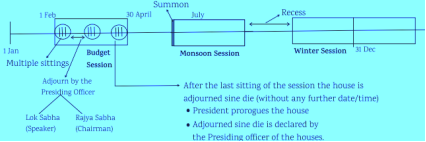
• Adjourn : When the sittings of the houses are stopped for a temporary period then it is called as adjournment of the house. The adjournment of the house does not end the session of the house. The sittings of the houses are adjourned by the Presiding officer (Speaker in case of Lok Sabha and Chairman in case of Rajya Sabha).
• Adjournment Sine die : It is also declared by the Presiding officer. It is generally declared when the house has completed its work assigned for a particular session. When the house is declared adjourned sine die then no time for its reassembly is provided.
• Prorogue : After the house is adjourned sine die the President declares that the houses are prorogued. The prorogation of the house ends the session of the houses.
• Recess : It is the time duration between the two consecutive sessions of the Parliament.
▪ Recess cannot be more than 6 months.
Note :
• The constitution does not mention about the Budget Session, Mansoon Session or the Winter Session of the Parliament.
• The constitution mentions that there should not be more than 6 months gap between the two consecutive session of the houses of Parliament.
• Therefore the houses must meet at least twice a year.
| Disqualifications of Member of Parliament | |
| Article-102 | Xth Schedule |
| (1) (a) – Office of profit (b) – Unsound mind (must be declared so by a competent court) (c) – Undischarged insolvent (d) – Changing Citizenship (e) -Other grounds made by Parliament• R.P. Act-1951▪ Election offences ▪ Conviction of cases in which more than two years imprisonment is provided. ▪ Not declaring election expenses.▪ Disqualification of member of parliament is done by the President of India in these cases. | • It is related to Anti-defection law.• It was added by 52nd constitutional Amendment Act-1985.• An MP/MLA can be disqualified on the grounds of defection. • If an MP leaves his party to join another party. • If an MP does not follow the whip order or votes against the party guidelines. • If an independent member joins a political party.• If the Nominated members join a politicalparty after 6 months of nomination. • The presiding officer is the final authority to decide disqualification under Xth schedule. |
Vacation of Seats
• The following cases leads to the vacation of seats in the houses of Parliament.
(i) Double membership – The provisions are provided in the R.P. Act-1951.
(ii) Resignation – The member of Parliaments can resign to the Presiding Officers.
(iii)Disqualification – When an MP is disqualified on the basis of Article-102 or Xth Schedule
of the constituion.
(iv) Absence – If the MPs remain absent for 60 days without notice.
Comparision of Both houses of Parliament
• Rajya Sabha and Lok Sabha are the two houses of Parliament. In some instances both these houses have the equal powers, but in few cases Rajya Sabha has more powers than Lok Sabha and in few cases Lok Sabha has more powers than Rajya Sabha.
Cases when both houses have equal powers
(i) In the cases related to the introduction and passage of ordinary bills and the Constitutional Amendment Bills.
(ii) Elections of the President and Vice-President.
(iii) Impeachement of President (Article-61).
(iv) Removal of the judges of SC, HCs, removal of CAG.
(v) Ratification of the emergency proclaimed by the President.
(vi) The reports of the constitutional bodies are submitted to the President of India who lays down these reports in both houses of Parliament.
(vii)The ministers in the Central Govt. can be either from the Lok Sabha or Rajya Sabha.
(viii) Ratification of Ordinance : It means the ordinance must be passed within 6 weeks after the reassmebly of the houses.
(ix) Approval of National Emergency (Article-352), President’s Rule (Article-336) and Financial
Emergency (Article-360).
Situation when the Lok Sabha has more powers than Rajya Sabha
(i) In context of Money bills : Money bills can be introduced in Lok Sabha only. Rajya Sabha has very limited powers in context of money bills.
(ii) The speaker of Lok Sabha has the authority to decide whether a bill is a money bill or not.
(iii) The budget is voted only in Lok Sabha. (Demand for grants can not be voted in Rajya Sabha).
(iv) In the joint sitting of the houses the will of Lok Sabha prevails because of more strengths than Rajya Sabha.
(v) Council of Ministers are collectively responsible towards the Lok Sabha.
(vi) No Confidence Motion can be introduced only in Lok Sabha.
(vii) The resolution for discontinuation of national emergency can be passed only in Lok Sabha.
Situation when the Rajya Sabha has more powers than Lok Sabha
(i) Authorisation for legislation in State list (Article-249). Parliament can make laws on subjects in the State List if Rajya Sabha passes a resolution with a two-thirds majority, stating that it is in the national interest. This resolution is valid for one year and can be extended annually by another resolution. Once the resolution expires, the law remains valid only for six more months unless revalidated.
| 7th Schedule | ||
| Union List | State List | Concurrent List |
| Only the Parliament can make laws | • The state can make laws. • In few circumstances the Parliament can make Laws | Both Union & State can make laws |
• Article-246 → Division of legislative powers between the centre and the state.
(ii) Creation of All India Services (Article-312) common to both centre and states.
• Article-312
▪ It is about creation of All India Services.
▪ All India Services are those services in which recruitment is done by the centre but the members serve the state govenments.
▪ For example : IAS, IPS, IFS (Indian Forest Services) are the All India Services in India.
▪ Rajya Sabha can pass a resolution for the creation of new All India Services.
(iii) Initiation of a move for the removal of Vice-President (Article-67).
(iv) Rajya Sabha is a permanent house and it is not subjected to dissolution (one-third of members retire every 2 years), while Lok Sabha can be dissolved.
Legislative Procedure in Parliament
- The legislative procedure in the Parliament of India refers to the formal process by which laws are made. This procedure ensures that a proposed law (called a Bill) is carefully examined and debated before it becomes an Act (a law).
• Bill : Bill is a proposal for legislation.
▪ Government Bill : A bill introduced by minister.
▪ Private Member Bill : A bill introduced by non-minister.
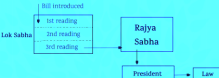
1. Introduction of the Bill (First Reading): A Bill can be introduced in either Lok Sabha or Rajya Sabha (except Money Bills, which must be introduced in Lok Sabha). The Bill is introduced by a Minister (Government Bill) or a private member (Private Member’s Bill). No discussion takes place at this stage-only permission to introduce the Bill is sought. The mover of the bill introduces the bill by reading its titles and objectives. The introduction of the bill and its publication in the Gazette constitute the first reading of the bill.
2. Second Reading: This stage has three sub-stages:
(a) General Discussion: Members discuss the principles and purpose of the Bill. No detailed discussion or amendments are allowed yet. At the end, the House may: Refer the Bill to a Select Committee or Joint Committee. or it may be circulated to elicit public opinion or Send it directly to the next stage.
(b) Committee Stage: The Bill is examined clause by clause by the committee. The committee may suggest amendments. After detailed scrutiny, it submits a report to the House.
(c) Consideration Stage: The House considers the Bill clause by clause, along with any amendments. Each clause is debated and voted upon.
3. Third Reading : The final version of the Bill (as amended) is presented. Only formal discussions on whether to pass or reject the Bill. The Bill is then voted on. In this stage no amendments are allowed in the bill.
4. Bill in the Other House: The Bill then goes to the other House, where it follows the same procedure.
• The second House can:
▪ Pass the Bill as it is (Without amendments)
▪ Pass the bill with amendments and return the bill to the 1st house for reconsideration.
▪ Reject the Bill
▪ Don’t take any action for 6 months
• If both Houses disagree, a joint sitting may be called (except for Money Bills) to break the deadlock.
5. Assent of the President : After both Houses pass the Bill, it goes to the President for assent.
• The President may :
▪ Give assent → Bill becomes law
▪ Withhold assent → Bill ends and does not become act
▪ Return the Bill (except Money Bills) for reconsideration, If both Houses pass it again, the President must give assent.
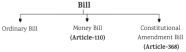
Ordinary Bill
• Introduction of Ordinary Bill is called as 1st reading of the bill.
Joint sitting of the houses of Parliament
• Article-108 of the constitution provides for the joint sitting of the both houses of Parliament to resolve a deadlock over the passage of bill.
• Joint sitting is called by the President of India.
• Speaker of Lok Sabha presides in the joint sitting of the both houses of the Parliament.
• Chairman of Rajya Sabha cannot preside in any joint sitting.
• If the speaker is absent then the Deputy Speaker presides the joint sitting. But if Deputy Speaker is also not present then the Deputy Chairman of Rajya Sabha will preside.
• The majority required in join sitting is simple majority. (Majority of members present and voting).
• The will of the Lok Sabha prevails in the joint sitting of the houses of Parliament because of its numerical strength.
• Joint sitting can not be called in the cases of Money bills & Constitutional Amendment Bills.
What is the situation of deadlock?
• A deadlock over the passage of the bill arises in following by the cases.
(i) When a bill is rejected by the other house.
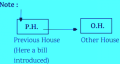
(ii) When the other houses passes the bill with amendments which is not acceptable to the previous house.
(iii) The other house does not take any action on the bill for six months.
• So far the joint sitting of the both houses of Parliament have been called three times to resolve a deadlock.
(i) Dowry prohibition bill (1961)
(ii) Banking Services Commission (Repeal) Bill – 1977
(iii) Prevention of Terrorism (POTA) Bill – 2002
Money Bills
• The Money Bills are defined under Article-110 of the constitution.
• It is related with the introduction of taxes, expenditure from the consolidated fund of
India, custody of contingency fund, declaring expenditure as charged expenditure, etc.
A bill is considered a Money Bill only if it deals exclusively with one or more of the following:
▪ Imposition, abolition, remission, alteration or regulation of taxes.
▪ Borrowing of money by the government.
▪ Custody of the Consolidated Fund or Contingency Fund of India.
▪ Appropriation of money from the Consolidated Fund.
▪ Declaration of expenditure charged on the Consolidated Fund.
▪ Receipt of money on account of the Consolidated Fund or Public Account of India.
▪ Any matter incidental to the above.
Important points regarding Money bills
• Defined in Article-110
• Speaker of Lok Sabha has the final authority to decide whether a bill is a money bill or not.
• Money bills can only be introduced in Lok Sabha.
• It cannot be introduced in Rajya Sabha.
• Money bills can only be introduced as a government bill. It means only the ministers can
introduced a money bill in the Lok Sabha.
• The money bills before its introduction in Lok Sabha needs the prior approval of the
President of India.
Limited Role of Rajya Sabha in Money bills :
▪ Money bills cannot be introduced in Rajya Sabha.
▪ Once the money bill passed in Lok Sabha and sent to Rajya Sabha it carries the certificate
of the speaker of Lok Sabha that it is a money bill.
▪ Rajya Sabha can’t reject a money bill.
▪ Rajya Sabha can’t amend a money bill.
▪ However Rajya Sabha may recommend amendments in money bills subjected to the approval of Lok Sabha.
▪ It means Lok Sabha may or may not accept the recommendations of Rajya Sabha.
• There is no provision for joint sitting in cases related to the money bills.
• Once the bill is send to the President for his assent then he can either give assent or refuse to give assent but he can’t return a money bill for reconcideration of houses.
Financial bills
• Financial bills are mentioned in Article-117.
• These are the bills which don’t exclusively contain the provisions of Article-110 but it
contains few general provisions and few provisions of Article-110.
• The Financial bills also can be introduced only in Lok Sabha with the prior recommendation of President.
• However other provisions are similar to ordinary bills.
Definition of “Money Bills” :
(1) A Bill shall be deemed to be a Money Bill if it contains only provisions dealing with all or any of the following matters, namely.
(a) The imposition, abolition, remission, alteration or regulation of any tax.
(b) The regulation of the borrowing of money or the giving of any guarantee by the Government of India, or the amendment of the law with respect to any financial obligations undertaken or to be undertaken by the Government of India.
(c) The custody of the Consolidated Fund or the Contingency Fund of India, the payment of moneys into or the withdrawal of moneys from any such Fund.
(d) The appropriation of moneys out of the Consolidated Fund of India:
(e) The declaring of any expenditure to be expenditure charged on the Consolidated Fund of India or the increasing of the amount of any such expenditure.
(f) The receipt of money on account of the Consolidated Fund of India or the public account of India or the custody or issue of such money or the audit of the accounts of the Union or of a State; or
(g) Any matter incidental to any of the matters specified in sub-clauses (a) to (f).
(2) A Bill shall not be deemed to be a Money Bill by reason only that it provides for the imposition of fines or other pecuniary penalties, or for the demand or payment of fees for licences or fees for services rendered, or by reason that it provides for the imposition, abolition, remission, alteration or regulation of any tax by any local authority or body for local purposes.
(3) If any question arises whether a Bill is a Money Bill or not, the decision of the Speaker of the House of the People there on shall be final.
(4) There shall be endorsed on every Money Bill when it is transmitted to the Council of States under article 109, and when it is presented to the President for assent under article 111, the certificate of the Speaker of the House of the People signed by him that it is a Money Bill.
Budget
• The word budget doesn’t find mention in the constitution.
• Insted of Budget the constitution uses the phrase “Annual Financial Statement”.
• It is mentioned in Article-112 of the constitution.
• The Budget is introduced in Lok Sabha.
• According to Article-112 of the constitution it shall be the duty of President of India to ensure that an Annual Financial Statement is presented in both houses of Parliament.
• In practice the Union Fianance Minister presents the Budget in Lok Sabha with a Budget speech.
• The Rail Budget has been merged with the Union Budget. Now they are not presented separately.
Stages in the Enactment of Budget in Parliament :
1. Presentation of the Budget: Presented by the Finance Minister in the Lok Sabha, usually on February 1 every year.
▪ Includes: Annual Financial Statement (Article 112), Finance Bill (taxation proposals), Appropriation Bill (expenditure proposals). After presentation, a copy is laid in Rajya Sabha as well.
2. General Discussion : Held in both Houses (mainly Lok Sabha). Focuses on the broad policies and priorities of the government. No voting takes place.
3. Scrutiny by Departmental Standing Committees: After general discussion, the House is adjourned for about 3-4 weeks. Budget documents are examined by 24 Departmentally Related Standing Committees. Committees study Demands for Grants of each ministry and submit reports to Parliament.
4. Discussion and Voting on Demands for Grants: Takes place only in Lok Sabha (Rajya Sabha can only discuss).
▪ Each ministry’s Demand for Grants is taken up. Members may move: Policy cut motion, Economy cut motion or Token cut motion. After discussion, Demands are put to vote.
▪ Guillotine : Due to limited time, remaining Demands are put to vote without discussion. This process is called the Guillotine, done on the last day of this stage.
5. Passing of the Appropriation Bill : Authorizes the government to withdraw funds from the Consolidated Fund of India.
▪ Covers both charged and voted expenditures. Treated as a Money Bill → Sent to Rajya Sabha for recommendations only. After passage, sent to the President for assent.
6. Passing of the Finance Bill: Contains tax proposals (e.g., changes in income tax, excise, customs).
▪ Also a Money Bill. After Lok Sabha passes it and Rajya Sabha gives recommendations, it goes to the President for assent.
Vote on Account
• Before passing of the full budget the Parliament can approve few exependiture for government to run daya to day administration.
• It is generally provided for 2 month period.
Interim Budget
• Not specified in constitution
• But it is presented in an election year
Cut Motions
There are three types of Cut Motions which are tools that allow members of Lok Sabha to express their disapproval of government policies, control expenditure, and hold the executive accountable. They are moved during the discussion on Demands for Grants in the Budget process.
1. Policy Cut Motion : To express disapproval of a specific policy of the government. It reduces the demand for grant to Rs.1. It is a symbolic way to criticize the entire policy or the ministry itself. If a member disagrees with the defense policy, they may move a policy cut motion on the Defense Ministry’s budget.
2. Economy Cut Motion: To suggest that government expenditure is too high and can be reduced. It proposes a specific amount of reduction in the demand for grant. It does not question the policy but objects to the wasteful or excessive spending. Example: Proposing to reduce ₹500 crore from a ministry’s budget for being inefficient.
3. Token Cut Motion: To raise a specific issue of public importance. It seeks to reduce the demand by token amount of 100. It is used to highlight a particular grievance or issue, not the whole policy or expenditure. Example: Reducing 100 from a grant to protest delays in railway services.
Utility of Rajya Sabha in India
• Representation of States and Union Territories (Federal Structure) : The Rajya Sabha represents the states and union territories of India, ensuring that states have a say in the legislative process at the national level.
• Revisionary and Revising Role (Bill Scrutiny): The Rajya Sabha acts as a revising chamber. It reviews and revises bills passed by the Lok Sabha, ensuring they are well- thought-out, balanced, and not hasty.
• Representation of Diverse Interests (Nominated Members): Some members of the Rajya Sabha are appointed by the President for their contributions to fields like art, science, literature, and social service. This brings diverse perspectives to legislative debates and decisions.
• Safeguard Against Hasty Legislation (Checks and Balances): Rajya Sabha acts as a check on the impulsive decision-making of the Lok Sabha. This helps prevent hasty or poorly drafted laws from being passed.
• Role in Constitutional Amendments: The Rajya Sabha plays an important role in the process of amending the Constitution (Article 368). A constitutional amendment bill must be passed by both Lok Sabha and Rajya Sabha by a special majority.
• Control Over the Executive (Accountability): Even though the government is primarily accountable to the Lok Sabha, the Rajya Sabha can question ministers (Question Hours and Zero Hours) and hold them to account, especially for decisions affecting the states.
• Maintaining Continuity (Permanent House): Unlike the Lok Sabha, which is subject to dissolution, the Rajya Sabha is a permanent body with one-third of its members retiring every two years. This ensures continuity in legislative functioning, even during elections and government changes. Also the Rajya approves proclamation of Emergency, ratifies ordinances, etc when Lok Sabha is not in session.