
Preparing for the Bihar Public Service Commission (BPSC) exam? Then you cannot skip the Ancient History of Bihar.
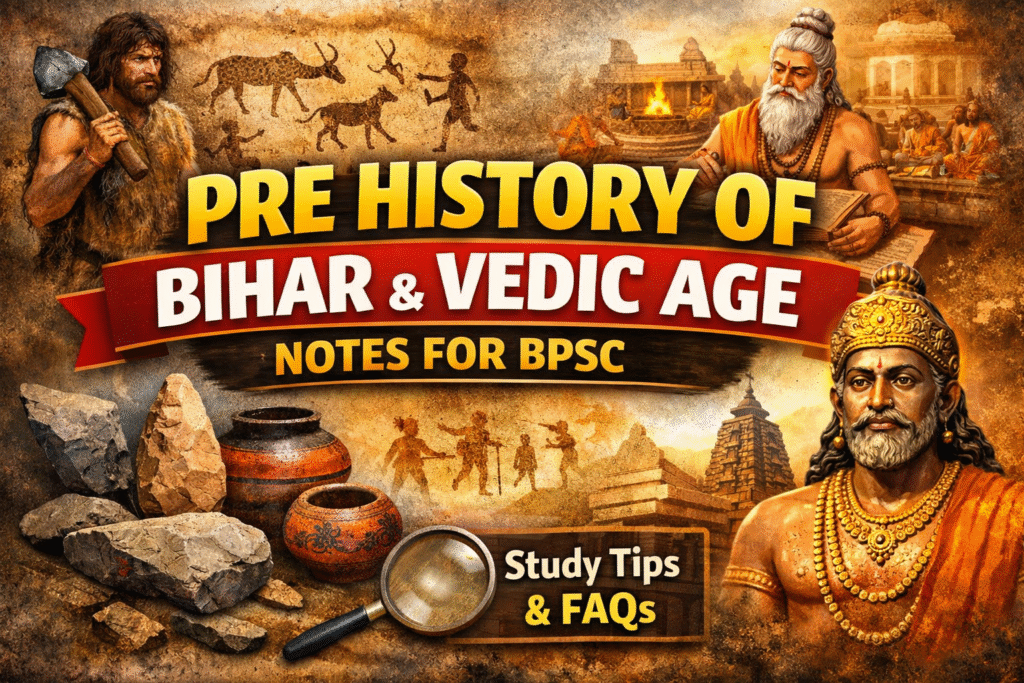
The Pre-History of Bihar and Vedic Age are among the most important and scoring topics for BPSC Prelims and Mains. In this blog, you’ll get exam-ready notes, important facts, and FAQs to boost your preparation.
🔍 What is Pre-History of Bihar?
Pre-history refers to the period before written records, known mainly through archaeological evidence like:
- Stone tools
- Pottery
- Rock paintings
It is divided into three main phases:
- Palaeolithic Age
- Mesolithic Age
- Neolithic Age
🪨 Palaeolithic Age in Bihar (Old Stone Age)
🔑 Key Features:
- Use of large, rough stone tools
- Humans were hunters and gatherers
📍 Important Sites:
- Munger
- Nalanda
👉 These regions provide evidence of the earliest human activity in Bihar.
🏹 Mesolithic Age (12000 BC – 6000 BC)
This phase shows gradual development in human lifestyle.
📍 Evidence Found In:
- Munger
- Hazaribagh
- Ranchi
- Singhbhum
- Santhal Pargana
🔎 Key Discoveries:
- Tools found at Paisra (Munger)
- Rock paintings in:
- Nawada
- Kaimur
- Jamui
👉 These paintings depict daily life, hunting scenes, and environment.
🌾 Neolithic Age in Bihar (2500 BC – 1345 BC)
This period marks the beginning of settled life.
🔑 Key Features:
- Agriculture started
- Animal domestication
- Permanent settlements
📍 Major Sites:
- Chirand (Saran)
- Chechar (Vaishali)
- Maner (Patna)
- Sanaur (Rohtas)
🔎 Findings:
- Bone tools (Chirand)
- Pottery:
- Black & Red Ware
- Ochre Painted Pottery
- Spotted vessels
🔶 Chalcolithic Age (2000 BC – 700 BC)
Also called the Copper Age.
🔑 Key Features:
- Use of copper + stone tools
- Beginning of metal usage
📍 Important Sites:
- Chirand (Saran)
- Maner (Patna)
- Champa (Bhagalpur)
- Chechar-Kutubpur (Vaishali)
- Sonpur (Saran)
- Taradih (Gaya)
👉 Evidence includes copper tools and pottery remains.
📜 Vedic Age in Bihar
🏛️ Kingdom of Videha
- Mentioned in Ramayana
- Ruled by King Janaka
- Capital: Mithila
🔹 Vedic Periods
📌 Early Vedic (1500–1000 BC)
- Aryans in North-West India
📌 Later Vedic (1000–600 BC)
- Aryans moved to Eastern India including Bihar
- Growth of agriculture and kingdoms
📚 Important Texts
- Rigveda
- Satapatha Brahmana
👉 These texts describe:
- Aryan expansion
- Political and social systems
🏙️ Rise of Janapadas
- Small states called Janapadas emerged
- Later formed Mahajanapadas
👉 Indicates early political organization in Bihar.
🎯 Why This Topic is Important for BPSC?
- Frequently asked in Prelims
- Useful in Mains answer writing
- Strong foundation for Bihar history
💡 Preparation Tips
- Focus on important sites (Chirand, Maner, Chechar)
- Revise pottery types and tools
- Practice previous year questions
- Make short notes
❓ Frequently Asked Questions (FAQs)
Q1. What is the Pre-History of Bihar?
👉 It refers to the period before written records, known through tools, pottery, and rock paintings found in regions like Munger and Nalanda.
Q2. Which are the important prehistoric sites in Bihar?
👉 Important sites include:
- Chirand
- Maner
- Chechar
- Taradih
- Sonpur
Q3. Why is Chirand important in Bihar history?
👉 Chirand is a major Neolithic site where bone tools and pottery were discovered, showing early human settlement.
Q4. What is the Chalcolithic Age in Bihar?
👉 It is the Copper Age (2000–700 BC) when humans started using copper along with stone tools.
Q5. Who was King Janaka?
👉 King Janaka was the ruler of Videha, with capital at Mithila, mentioned in the Ramayana.
Q6. Which Vedic text mentions Bihar?
👉 The Satapatha Brahmana mentions the spread of Aryans into Bihar.
Q7. Is Bihar history important for BPSC?
👉 Yes, Bihar-specific history is very important and scoring in BPSC exams.