
General Introduction
- The rotation of the earth exist in the continuity of rotation and revolution.
- The earth revolving around the sun and on its axis, for example, if the earth did not rotate on its axis, then it would always be day on one part and night on the other part.
- The seasons change only due to the rotation of the earth around the sun.
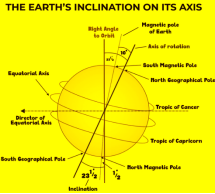
- Like other planets, the earth rotates continuously on its axis. The ‘axis’ is the imaginary line joining the north pole and the south pole, along which the earth rotates.
- The plane formed by the earth’s orbit and passing through the centre of the earth is called the ‘orbital plane’ or ‘orbital surface’.
- Due to the shape of the earth being geoid, sunlight falls on half of it, so it is day on half of it, while light does not reach the remaining half at that time, so it is night on the other half.
- The circle dividing the day and night on the earth is called the ‘circle of illumination’.
Earth is a planet of the solar system. It has two motions-
(1) Rotation or daily motion (2) Revolution or annual motion.
(1) Rotation or daily motion
- The earth always rotates on its axis from west to east like a top, which is called the rotation or revolution of the earth. Day and night occur due to the rotation of the earth. Hence, this motion is also called daily motion.
(2) Revolution or annual motion
- Along with rotating on its axis, the earth completes one revolution around the sun in an elliptical path in 365 days and 6 hours. This elliptical path of the earth is called the earth’s orbit. This motion of the earth is called revolution or annual motion.
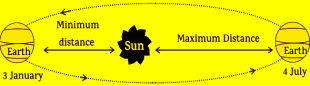
- Perihelion: When the earth is at the closest distance to the sun, it is called perihelion. This situation mostly occurs on 3 January.
- Aphelion: When the earth is at the maximum distance from the sun, it is called aphelion. This situation mostly occurs on 4 July.
Change Of Seasons
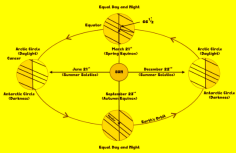
- The earth not only rotates on its axis but also revolves around the sun. So the position of the earth relative to the sun keeps changing. There are four main phases in the earth’s rotation and changes in these phases lead to change of seasons.
- Situation on 21 June :- On this time the Sun shines perpendicularly on the Tropic of Cancer. which is called summer solstice. During this period the days are long and nights are short in the Northern Hemisphere.
- Situation on 22 December :- At this time the sun shines perpendicularly on the Tropic of Capricorn. Which is called winter solstice. At this time the duration of days is long and nights are short in the Southern Hemisphere.
- Positions of 21 March and 23 September :- In both these positions the sun shines perpendicularly on the equator. Hence at this time half of all latitude lines receive sunlight. Hence the duration of day and night is equal everywhere. The position of 21 March is called spring equinox and the position of 23 September is called autumn equinox.
Solar Eclipse And Lunar Eclipse
- Both the Earth and the Moon receive light of the Sun. Only a part of the Moon is visible from the Earth because the rotation speed of the Earth and the Moon is the same. The entire illuminated part of the Moon is visible on Earth only once a month, i.e. on the full moon.
Lunar Eclipse-
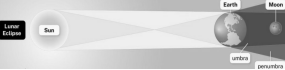
- When the Earth comes between the Sun and the Moon, the Sun’s light cannot reach the Moon and it becomes dark due to the Earth’s shadow which is called a lunar eclipse. A lunar eclipse always occurs on the night of a full moon.
Solar eclipse
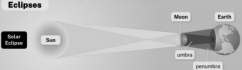
- A solar eclipse occurs when the moon comes between the sun and the earth and the earth receives the shadow of the moon instead of the sunlight. This situation is called a solar eclipse. A solar eclipse always occurs on the new moon day.
Supermoon
- The moon revolves around the earth in an elongated orbit, due to which the distance between the two keeps changing. Supermoon is a phenomena in which the moon is closest to the earth and in this moon appears 14% bigger and 30% brighter than even before. This phenomena is also called ‘Perigee Full Moon’.
Blue Moon
- When there are two full moons in a calendar month, the second full moon is called the ‘Blue Moon’. The time interval of two full moons gets balanced in 30 or 31 days only. this phenomenon has nothing to do with its blue colour. This type events recur after about 2.5 years.
- When a year has two or more Blue Moon months, it is called a ‘Blue Moon Year’, for example, the year 2018 was a Blue Moon Year.
Blood Moon
- The combination of four complete lunar eclipses is called blood moon, it is also called ‘tetrad’. However, as far as the moon being red in this event is concerned, the reason for this is the event of total lunar eclipse. Actually, in the event of a total lunar eclipse, when the Earth comes between the Sun and the Moon and its full shadow falls on the Moon, then in this situation the Moon appears completely red. Actually, the event of a total lunar eclipse is rare, which normally only one out of three lunar eclipses is a total lunar eclipse.
Tide
- The tides on the sea surface are generated by the effect of the gravitational force of the Sun and the Moon and the gravitational force and centrifugal force of the Earth.
- The rising of the sea level is called ‘tide’ and the falling of the sea level is called ‘ebb’.
- There is a variation in the height of the tide, the main reason is the difference in the depth of sea water, the nature of the sea coastline and the sea area (open or partially closed sea).
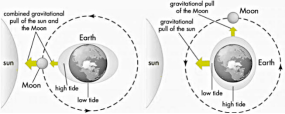
- The tide coming on the sea surface is more affected by the gravitational force of the Moon than the gravitational force of the Sun, because the Moon is closer to the Earth than the Sun.
- When the Sun, Earth, Moon are in a straight line (at the time of syzygy), then a high tide is generated, in which the height of the tide is more than the normal tide. Such tides come twice in a month (new moon and full moon).
- When the Sun, Moon and Earth are not in a straight line but at right angles, then the force of attraction of the Moon and the Sun works opposite to each other, in such a situation low tide is generated. In this, the height of the tide is less than the normal tide.
- Low tide is generated on the Saptami or Ashtami of Krishna Paksha and Shukla Paksha.
| Solar Time | Time taken by the Sun to reappear at the same position in the sky, as seen from a point on Earth, after one rotation of earth is known as Solar Time. |
| Solstice | During Solstice, the Sun shines directly over one of the tropics. Summer Solstice :- When one of the poles of the Earth has its maximum tilt towards the Sun Longest day.Northern Hemisphere : June 21 , Southern Hemisphere :- December 22.Winter Solstice: When one of the poles of the Earth has its maximum tilt away from the Sun Shortest day.Northern Hemisphere :- December 22 , Southern Hemisphere :- June 21. |
| Equinox | When the sun shines directly over the Equator then equal lengths of day and night at all points on Earth. i.e. 21 March & 23 September. |
| Asteroid | A small rocky body that orbits the Sun. Most asteroids are found in the asteroid belt, a region between Mars and Jupiter |
| Comets | Comets orbit the Sun, like asteroids, but comets are made of ice and dust ,not rock. Comets usually originate in the Kuiper belt which lies beyond the orbit of Neptune. |
| Meteoroids | A meteoroid is a small rocky or metallic body in outer space, usually formed from the collision of asteroids or comets |
| Meteors | If a meteoroid comes close enough to Earth and enters Earth’s atmosphere, it evaporates and turns into a meteor: a streak of light in the Sky.Because of their appearance, these streaks of light are sometimes called shooting stars. But meteors are not actually stars. |
| Meteorites | Sometimes meteoroids don’t evaporate completely in the atmosphere and land on the Earth’s surface.When they land on Earth, they are called meteorites. |
| Dwarf Planets | Celestial body that orbits the sun, has enough mass to assume a nearly round shape, has not cleared the neighbourhood around its orbit and is not a moon.Examples: Pluto, Ceres, Eris etc. |