
- The internal part is not visible to humans with naked eye , so it can be relied mostly from indirect sources only. Scientists have based the following sources for information about the internal structure of the earth –
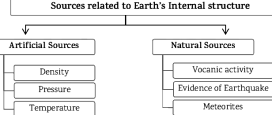
Unnatural Sources
1. Density–
- The average density of the entire earth is 5.51 g/cm3 while the density of the earth’s crust is about 3.0 g/cm3.
- The average density of the earth’s core (innermost) is more than 5.5 g/cm3.
- This density is considered to be 11 g/cm3, which is 7 to 8 times heavier than water. It is clear from this that the density will be higher in the inner parts.
2. Pressure
- The weight and pressure of the rocks can be referred to in relation to the higher density of the core. Although the density increases with increasing pressure, every rock has a limit beyond which its density cannot increase, no matter how the pressure is high .
3. Temperature
- Normally the temperature increases by 1oC for every 32 m depth, but the rate of increase of temperature decreases with increasing depth.
- In the first 100 km depth, there is an increase of 12oC for every km.
- In the next 300 km depth, there is an increase of 2oC for every km and thereafter an increase of 1oC for every km depth.
Natural Sources
1. volcanic activity:- On the basis of the elements and liquid magma released from volcanic eruptions, it is clear that somewhere deep inside the Earth there is definitely a layer that is in liquid or semi-liquid state.
2. Evidence of seismology :– Seismology is the science in which the internal structure of the earth is studied by marking the seismic waves with the help of seismograph.
3. Meteorites :- They are solid structures which are floating freely in space. Sometimes these bodies collide with the earth when they come in the gravitational effect zone of the earth.
Chemical composition of the earth and various layers
- Broadly three layers can be identified:- 1. Crust 2. Mantle 3. Core
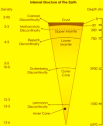
| Crust | Outermost solid part Crust + upper most layer of mantle = lithosphere (10 to 200 km) Continental Crust: Mean thickness = 30 km & density = 2.7g/cm3 Rock Type: Granite Minerals Silica + Aluminum = SiAL Oceanic Crust: Mean thickness = 5km & density = 3g/cm3 Rock type: Basalt Minerals = Silica + Iron + Magnesium = SiMA |
| Mantle | The mantle extends from Moho’s discontinuity to a depth of 2,900 km. The upper portion of the mantle is called the asthenosphere. (~400KM). The material in the upper mantle portion is called magma. Once it starts moving towards the crust or it reaches the surface, it is referred to as lava. Density = 3.4g/cm3. The lower mantle extends beyond the asthenosphere. It is in solid state |
| Core | Core mantle boundary is located at a depth of 2,900 km referred as Gutenberg discontinuity.Outer Layer: Liquid state Inner Layer: Solid State Major Minerals: Iron + Nickel (NiFe) |
2 SOURCES OF NFORMATION ABOUT INTERIOR OF EARTH
SOURCES OF INFORMATION ABOUT INTERIOR OF EARTH
| Direct Sources | Indirect Sources |
| Mponeng gold mine (deepest mine in the world) and TauTona gold mine (second deepest mine in the world) in South Africa.Volcanic eruption. Integrated ocean drilling project Deep ocean drilling project | Increase in pressure and temperature with depth.Seismic waves Meteorites Gravitation Magnetic sources |
CHEMICAL COMPOSITION OF EARTH
- Only the crust, then oxygen is the most abundant element in the crust followed by Silicon, Aluminium, Iron and so on.
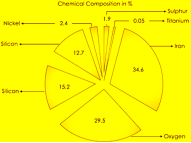
- Iron is the most abundant element in the Earth followed by Oxygen, Silicon and Magnesium and so on.
| Element in crust | Chemical composition (%) |
| Oxygen | 46.60 |
| Silicon | 27.72 |
| Aluminum | 8.13 |
| Iron | 5.0 |
| Calcium | 3.63 |
| Sodium | 2.83 |
| Potassium | 2.59 |
| Magnesium | 2.09 |