
Various geologists have various convictions about the beginning of the Earth. It grouped into two sorts.
- Monistic concept :- Kant’s concept of space and Laplace’s nebular hypothesis
- Dualistic concept :- Chamberlin and Moulton’s planet hypothesis , Tidal hypothesis of james jeans, Russell’s concept of dialectics , Otto-Schmidt’s interstellar dust hypothesis.
Monistic Concept
1. (Kant’s Gaseous Hypothesis)
- It was propounded by Kant (German savant) in 1755 based on Newton’s laws of gravity.
- As per this hypothesis, there were little particles of supernaturally made substances in the universe which were very hard, cold and unmoving. Because of the power of gravity, these particles began crashing into one another, which brought about the age of intensity and rotational movement.
- Little particles changed into greater bodies by consolidating and greater bodies changed intohuge bodies. In the long run a tremendous vaporous body (cloud) was shaped.
- Due to the excessive rotation speed of the nebula, the heat increased, due to which the centrifugal force became more than the centripetal force. From this hot and rotating nebula, many rings of round shape came out, which cooled down and got transformed into planets.
- Thus, according to Kant, the earth originated when the material of the rings separated from the nebula by the centrifugal force solidified in the form of a knot at one place. The part of the original nebula which remained, got transformed into the Sun. With time, due to the repetition of the above process, the planets and their satellites were formed.
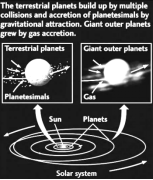
2.Nebular Hypothesis of Laplace
- French scholar Laplace described the nebula hypothesis in his book ‘Exposition du système du monde’ (The System of the World) in 1796. Laplace expressed his revised views by removing the shortcomings of Kant’s hypothesis.
- According to Laplace, in the past there was a dynamic and hot giant body in the universe which was rotating at a slow speed. This hot and slowly rotating gas cloud was called ‘nebula’ (nebula). On this basis, this hypothesis was named ‘nebula hypothesis’.
- With the passage of time, due to the loss of radiation and heat along with the speed of the nebula, its outer part started cooling. Thus, due to continuous cooling in the nebula, its size and volume started decreasing due to contraction and thus due to the decrease in volume, the speed of the nebula started increasing continuously.
- The increase in rotation speed increased the centrifugal force. When the centrifugal force became more than the gravitational force, a ring separated from the nebula and broke into many rings. Those rings cooled down and became planets and satellites and the remaining part of the nebula is our Sun.
- Later, French scholar Ross amended La Place’s hypothesis. According to Ross, many thin rings gradually separated from the nebula and each ring condensed and became a planet. In this sequence, due to continuous movement, all the planets were formed.
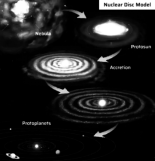
❖ Dualistic Concept
1. Chamberlin and Moulton’s planet hypothesis
- The planetesimal hypothesis was propounded by Chamberlin and Moulton in 1905 (1900 in other sources). According to this, planets are formed from two giant stars, the Sun and its companion star.
- According to them, when the companion star passed near the Sun, due to its gravitational force, innumerable small particles came out from the surface of the Sun and separated, which were called ‘planetesimals’. When this star moved away from the Sun, these substances that came out of the Sun’s surface started revolving around the Sun and these slowly condensed and transformed into planets. This is a dualistic concept, which was propounded by Chamberlin and Moulton in 1905. According to them, planets are not formed from hot gaseous nebula but from solid bodies. In the beginning, there were two giant stars in the universe – one was the Sun and the other was another traveling star. When this other giant star separated, innumerable particles got separated from the surface of the Sun. These particles got mixed together and became the reason for the formation of the Earth and other planets. An attempt has also been made to explain the origin of the Earth, its structure, the origin of the atmosphere, the origin of the oceans and continents, the formation of mountains etc. through this theory.
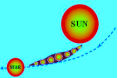
2. Tidal hypothesis of James Jeans and Jeffreys
- According to this, the solar system was formed by the combination of the Sun and another star. Due to the arrival of this star near the Sun, some part of the Sun got pulled in the form of a filament due to tidal eruption and later broke and started revolving around the Sun. This filament became the reason for the origin of various planets of the solar system, including Earth.
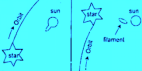
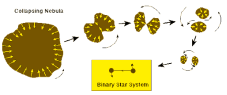
3. Russell’s binary star hypothesis
- Russell propounded this theory to solve the problems like the current distance between the Sun and the planets and the excess of the current angular momentum of the planets.
4. Otto-Schmidt’s interstellar dust hypothesis
- The origin of planets is believed to be formed from gas and dust particles.
Modern Theory
Big Bang and Inflation Theory
- This theory was propounded by George Lemantier for the origin of the universe, galaxies and the solar system. On the basis of the Big Bang theory, it has been said that the universe originated about 15 billion years ago from a sudden powerful explosion and the radiation generated by it.
- But American scientist Allen Guth found the Big Bang theory incapable of solving the problem of the origin of the universe and introduced the inflation theory. According to this theory, the actual density of the universe is much higher than the density of its visible matter. This makes it clear that invisible black matter exists in the universe. Galaxies have been formed from the agglomeration of these black matter.