
Geology
| Relative duration of Eons | ERA | (Period) | EPOCH | (Age)(millions of years ago) | Some important events in the history of life |
| Phanerozoic | Cenozoic | Quaternary | Holocene | 0.01 | Historical time |
| Phanerozoic | Cenozoic | Pleistocene | 1.8 | Ice Age: Origin of the Homogenus | |
| Phanerozoic | Cenozoic | Neogene | Pliocene | 5.3 | The appearance of bipedal human ancestors |
| Phanerozoic | Cenozoic | Miocene | 23 | Continuing radiation of mammals and angiosperms; earliest direct human ancestor | |
| Phanerozoic | Cenozoic | Paleogene | Oligocene | 33.9 | Origin of many primate groups |
| Phanerozoic | Cenozoic | Eocene | 55.8 | Angiosperms grow to dominance; continuing radiation of most modern mammalian orders | |
| Phanerozoic | Cenozoic | Paleocene | 65.5 | Major radiations of mammals, birds and pollinating insects | |
| Proterozoic | Mesozoic | Cretaceous | 145.5 | Flowering plants (angiosperms) appear, many groups of organisms, including most dinosaurs, become extinct at the end of the period | |
| Proterozoic | Mesozoic | Jurassic | 199.6 | Gymnosperms continue as dominant plants; dinosaurs abundant and diverse | |
| Proterozoic | Mesozoic | Triassic | 251 | Coniferous plants gymnosperms) dominate the landscape; radiation of dinosaurs; origin of mammals | |
| Archaean | Paleozoic | Permian | 299 | Radiation of reptiles; origin of most extant groups of insects; extinction of many marine and terrestrial organisms at the end of the period | |
| Archaean | Paleozoic | Carbonaceous | 359.2 | Vascular plants develop forests; first seed plants appear; reptiles emerge; amphibians become Prominent | |
| Archaean | Paleozoic | Devonian | 416 | Diversification of bony fishes; first tetrapods and insects appear | |
| Archaean | Paleozoic | Silurian | 443.7 | Diversification of early vascular Plants | |
| Archaean | Paleozoic | Ordovicin | 488.3 | Seaweeds abundant;colonization of land by diverse fungi, plants, and arthropods | |
| Archaean | Paleozoic | Cambrian | 542 | Sudden increase in diversity of many animal phyla (Cambrian explosion) | |
| Archaean | Paleozoic | Ediacaran | 600 | Diverse algae and soft-bodied Invertebrates | |
| Archaean | Paleozoic | Ediacaran | 2,100-2,500 | The oldest fossils of eukaryotic Cells | |
| Archaean | Paleozoic | Ediacaran | 2,700 | Atmospheric oxygen concentration begins to rise | |
| Archaean | Paleozoic | Ediacaran | 3,500 | The oldest fossils of cells (prokaryotes) appeared | |
| Archaean | Paleozoic | Ediacaran | 3,800 | The oldest known rock on the Earth’s surface | |
| Archaean | Paleozoic | Ediacaran | About 4,600 | The origin of the Earth |
Rock
- Rocks are aggregates of one or more minerals.
- They may be hard or soft in varied colours.
- They do not have definite chemical composition.
- Petrology is the science of rocks. Petrologist who studies the scientific methods of rocks.
- There are at least six mineral groups which form rocks in the crust.
ROCK CYCLE
- Rock cycle is a continuous process through which old rocks are transformed into new ones.
- Igneous rocks can be changed into metamorphicrocks. The fragments derived out of igneous and metamorphic rocks form into sedimentary rocks.
- Sedimentary rocks turns into fragments and may be a source for formation of sedimentary rocks.
- The crustal rocks once formed may be carried down into the mantle through the subduction process and may turn into molten magma.
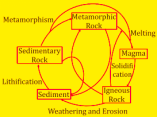
Classification of rocks
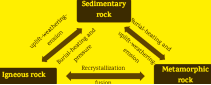
1. Igneous Rocks
- It is formed by the cooling of hot and liquid magma present beneath the crust.
- Igneous rocks are crystalline. They are also called primary rocks because they were the first to be formed after the origin of the Earth.
- The upper 16 kilometers of the Earth’s crust is made up of 95% Igneous rock, with a thin covering of sedimentary and metamorphic rocks.
- Layers and fossils are not found in them.
Features of Igneous Rocks
- hard, granular and crystalline
- not contain fossils
- not allow water to percolate through them
- Less affected by chemical weathering.
- No layers like sedimentary rocks.
Magma as Source of Igneous Rocks
- The mixture of the molten rocks, volatiles (gas) and other solids (originated from partial melting of lower crust and upper mantle) which makes the Igneous rocks is called Magma.
Intrusive Igneous Rocks
- Magma that solidifies below the Earth’s surface and remains surrounded by older, pre-existing rock.
- Examples of intrusive igneous rocks:
- Granite: (batholith generally), Felsic, igneous rock.
- Diorite: intermediate.
- Gabbro: Mafic igneous rocks equivalent to basalt.
- Peridotite, Rhyolite, Andesite, Basalt, Komatiite, Diabase etc.
Extrusive Igneous Rocks
- If the magma reaches the surface and emerges as lava, it forms extrusive igneous rock.
- Examples of extrusive igneous rocks: Basalt, Andesite, Rhyolite.
Classification Based on Chemical Composition
- Those with a high proportion of silica are known as acidic rocks.
- Those with a high proportion of basic oxides are denser and darker in appearance are known as basic rocks.
2. Sedimentary Rocks
- The rocks formed as a result of erosion and deposition of igneous and metamorphic rocks are called sedimentary rocks. Due to the development of layers in these reworked rocks, they are also called stratified or layered rocks.
- Fossils are found in large quantities in these rocks. Due to which there is a high probability of finding natural gas, coal reserves and mineral oil reserves here.
- Sedimentary rocks are spread over about 75% of the entire crust, but its contribution in the formation of the crust is only 5%.
Features of Sedimentary Rocks
- Forms at the earth’s surface by the hydrological system.
- Contains of layers
- Consist fossils
- The process of sedimentary rock formation is called lithification.
- Most of the sedimentary rocks are permeable and porous.
Types and Examples of Sedimentary Rocks
| Mechanical | Sandstone {cemented sand grains}. Siltstone {Cemented silt particles}. Conglomerate {sandstone containing pebbles of hard rocks}.Mudstone {mainly silt and clay}. Claystone {mainly clay} and shale {clay and mud rock}. |
| Organic | Calcareous types like limestone, chalk. Carbonaceous like peat, lignite, coal. |
| Chemical | Dolomite, rock salt, gypsum. |
3. Metamorphic Rocks
- When the composition and form of igneous and sedimentary rocks change or get transformed due to heat and pressure, then metamorphic rocks are formed.
- These rocks are the hardest and fossil-free.
Features of Metamorphic Rocks
- Forms due to recrystallization.
- Forms due to pressure and temperature.
- Very smooth in texture Consists of layers sometimes.
- Exhibit a wide range of colours.
- Rarely contain fossils React with acids.
Types of Metamorphic Rocks
- Foliated metamorphic rocks :- such as gneiss, phyllite, schist and slate which have a layered or banded appearance that is produced by exposure to heat and directed pressure.
- Non-foliated metamorphic rocks :- such as marble and quartzite which do not have a layered or banded appearance.
| Metamorphic Rocks | Metamorphic Rocks Of Igneous Rocks | Rocks Formed By Re-Metamorphism Of Metamorphic Rocks |
| (i) Shale – Slate(ii) Limestone and dolomite – Marble(iii) Chalk and dolomite – Marble(iv) Sandstone – Quartzite(v) Conglomerate and large grained igneous rock – Quartzite | (i) Granite – Gneiss(ii) Basalt – Amphibolite/Schist | (i) Slate – Phyllite(ii) Phyllite – Schist(iii) Gabbro – Serpentine |
MINERALS
- Minerals are naturally occurring substances that have an orderly atomic structure and a definite chemical composition & physical properties.
- Minerals can be identified on the basis of their physical properties such as colour, density, hardness and chemical properties such as solubility.
- Basic source of all minerals is the hot magma present in the interior of the earth.
- On the basis of composition, minerals are classified into metallic and non-metallic types.
- Metallic :- ferrous (iron) , non-ferrous (copper) and precious (gold)
- Non-Metallic :- Organic (coal) and Inorganic (sulphur rocks)
Distribution of minerals
- Outer layer :- crust ( minerals in solid form) & 98% of crust consist of 8 elements (Oxygen,silicon, Aluminium, Iron, Calcium, sodium, Potassium,Magnesium)
- Inner layers :- Liquid
| Important minerals of the earth’s crust | |
| Feldspar | Silicon and oxygen are common elements.Half of the Earth’s crust is made up of feldspar.It ranges in colour from light cream to salmon pink and is used to make ceramics and glass. |
| Quartz | Silica is a hard mineral which is an important constituent of sand granite.It is insoluble in water. It is white or colourless and is used in radio, radar etc. |
| Pyroxene | It constitutes 10% of the Earth’s crust, and consists of calcium, aluminum, magnesium, iron, and silicon.Found in meteorites, usually green or black in colour. |
| Olivine | Magnesium, iron, silica are the major elements. |
| Amphibole | Constitute 7% of the earth’s crust, contains aluminium, calcium, silicon, iron, magnesium.They are green or black in colour.Hornblende used in the asbestos industry is another form of amphibole. |
| Asbestos | Consists of potassium, aluminium, magnesium, iron, silica and makes up 4% of the earth’s crust. Found in igneous and metamorphic rocks. |