
INTRODUCTION
- 3/4th or 71% of the globe is covered by hydrosphere and remaining 29% by lithosphere.
- Only 2.05% of water on the surface is fresh; the remaining 97% resides in the ocean.
| Reservoir | Volume (Million Cubic km) | Percentage of the Total |
| Oceans | 1.370 | 97.25% |
| Ice Caps and Glaciers | 29 | 2.05% |
| Groundwater | 9.5 | 0.68% |
| Lakes | 0.125 | 0.01% |
| Soil Moisture | 0.065 | 0.005% |
| Atmosphere | 0.013 | 0.001% |
| Streams and Rivers | 0.0017 | 0.0001% |
| Biosphere | 0.0006 | 0.00004% |
HYDROLOGICAL CYCLE
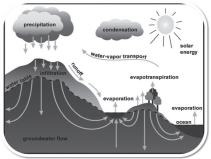
- There is a continuous exchange of water between the atmosphere, the oceans and the continents through the processes of evaporation, transpiration, condensation and precipitation.
| Evaporation | When the sun heats up water in rivers or lakes or the ocean and turns it into vapour or steam |
| Transpiration | Process of water movement through a plant and its evaporation from aerial parts, such as leaves, stems and flowers. |
| Condensation | Process by which water vapour in the air is changed into liquid water.Responsible for the formation of clouds. |
| Precipitation | Occurs when so much water has condensed that the air cannot hold it anymore. The clouds get heavy and water falls back to the earth in the form of rain, hail, sleet or snow. |
| Gulf | A gulf is a portion of the ocean that penetrates land. Gulfs vary greatly in size, shape and depth. Generally larger and more deeply indented than bays.Make excellent harbours. Many important trading centres are located on gulfs |
| Bay | A bay is a body of water partially surrounded by land.Usually smaller and less enclosed than a gulf. |
| Cape | A cape is a high point of land that extends into a river, lake, or ocean.Some capes, such as the Cape of Good Hope in South Africa, are parts of large landmasses. |
| Strait | A strait is a narrow body of water that connects two larger bodies of water. |
| Isthmus | A narrow strip of land, bordered on both sides by water, connecting two larger bodies of land. |
| Estuary | Partly enclosed coastal body of water in which river water is mixed with sea water. |
RELIEF OF THE OCEAN BASIN
- The ocean floor can be divided into four main categories. Continental submerged coast, continental slope, continental rise and oceanic deep floor plain. Apart from these, other major submerged features are ridges, hills, seamounts, guyots (flat-topped seamounts), trenches, canyons, troughs, rift zones. Numerous islands, coral reefs, coral reefs, submerged volcanic mountains etc. further increase the diversity of submerged features.
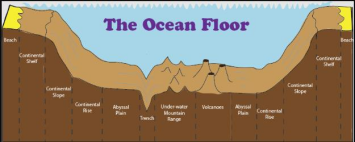
Continental Shelf
- The shallow part near the coast is called continental deep coast.
- It mainly consists of terrestrial deposits brought by rivers.
- Its average width is 70 km. But it has different widths in different areas.
- Extends from the coast to depths of 100–200 metres .
- Shallowest part of the ocean with average slope of 1° or even less.
- Depending on the nature of the relief of coastal land, the width of continental shelf varies. The Siberian shelf in the Arctic Ocean, the largest in the world, stretches to 1,500 km in width.
- Entirely absent: where coasts are extremely mountainous, such as the Rocky Mountain and Andean coasts.
- The shelves are almost absent or very narrow along some of the margins of Ocean– Continent Convergence and Ocean– Ocean Convergence.
- Covers 7.5% of the total area of the oceans.
- According to the UNCLOS, every nation has a continental shelf extending no more than 200 NM from the nation’s coastline.
- Continental Shelves of India: Compared to the western continental margin of India, the shelf in the eastern continental margin of India is found to be irregular and narrower, with a variable width.
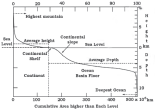
Reasons for Shelf Formation:
- Tilting of land
- Marine erosion
- Submergence of a part of continental margin
- Relative rise in sea level.
- Sedimentary deposits brought down by rivers
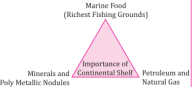
Continental Slope
- The continental slope is actually the submerged last boundary of the continents.
- It has a steep slope (average 2o to 5o) which connects the continental shelf and the oceanic plain.
- The depth of the continental slope varies from 200 to 2,000 m but sometimes it goes up to a depth of more than 3,600 m.
- It is spread over 8.5% of the total ocean area.
Continental Rise
- Where the continental slope ends, the gently sloping uplift begins.
- Their slope is 0.5o to 1o and the general elevation is very low.
- With increasing depth, it becomes almost flat and merges into the ocean floor plain.
Deep Sea Plain or Abyssal Plain
- Deep sea plains are gently sloping areas of the ocean basins.
- Flattest and smoothest regions of the world.
- The depths vary between 3,000 and 6,000m.
- Covered with fine-grained sediments like clay and silt.
- The large supply of terrigenous and shallow water sediments buries the irregular topography to form a generally flat relief.
- It covers nearly 40% of the ocean floor.
- With increasing depth the rise becomes virtually flat and merges with the abyssal plain.
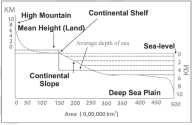
- The deep ocean floor similar to a plain after continental uplift is called benthic plain.
- Its depth ranges from 3,000 to 6,000 m.
- These are spread over about 75.9% of the oceanic area.
- These plains are almost flat and their slope gradient is less than 1 : 100. Both landborne sediments and skeletons of marine organisms are found on them.
Submarine Ridges
- The ocean floor is covered with mountain ranges which is hundreds of km wide and hundreds to thousands of km long and forms the longest mountain system on Earth.
- These worldwide oceanic ridges can be explained by the plate tectonics theory. These oceanic ridges are formed due to the release of magma from the asthenosphere due to the divergence of two plates.
Abyssal Hills
- There are thousands of isolated flat hills, seamounts and guyots on the ocean floor.
- A submerged mountain whose peak is more than 1,000 m above the floor is called a seamount.
Submerged Trenches And Depressions
- These trenches are the deepest parts of the oceans.
- They are usually found along destructive plate margins parallel to folded mountains or island chains. They are most commonly found in the Pacific Ocean.
Submarine Canyons
- Deep gorges located on the ocean floor are called submerged canyons. These are mainly confined to the continental submerged coasts, slopes and elevations.
Mid Oceanic Ridges
- These oceanic ridge systems are of tectonic origin and provide evidence in support of the theory of Plate Tectonics.
- It is composed of two chains of mountains separated by a large depression.
- The mountain ranges can have peaks as high as 2,500 m and some even reach above the ocean’s surface.
- Iceland, a part of the mid-Atlantic Ridge, is an example.
- These ridges are either broad, like a plateau, gently sloping or in the form of steep-sided narrow mountains.
Seamount
- A submarine mountain or peak rising more than 1,000 metres above the ocean floor is known as a seamount. For e.g. The Emperor seamount, an extension of the Hawaiian Islands in the Pacific Ocean, is a good example.
- The flat topped seamounts are known as guyots. They show evidence of gradual subsidence.
Atoll
- An atoll is created as a ring of coral surrounds an undersea volcano that has risen above the water’s surface.
- Atoll encloses a lagoon. Thus, It may be a part of the sea (lagoon), or sometimes form enclosing a body of fresh, brackish, or highly saline water.
- A lagoon is a shallow body of water protected from a larger body of water (usually the ocean) by sandbars, barrier islands, or coral reefs.
Coast, Shoal, Reefs
- These are formed by erosion, deposition and biological processes respectively. Beaches are flat-topped elevations and are located along the edge of continents. These are major fishing areas e.g. Grand Banks, Dogger Bank.
- Shoal is the detached part of the submerged elevation. Here the depth of water is less, hence they are dangerous for navigation. The formation of reef is associated with biological deposits. Coral reefs are mainly a feature of the Pacific Ocean. Theworld’s largest coral reef is found near Queensland, Australia. It is famous as the Great Barrier Reef.
Indian Ocean Bottom Elevation
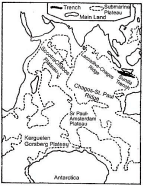
- Its northern shore is very fragmented, whose average depth is about 4,000 m. And the unevenness on the floor is also less. It is noteworthy that generally trenches are not found here, Sunda Trench and Diamantina Trench are exceptions to this.
- There are many wide submerged ridges on the floor of the Indian Ocean.
- Like the Atlantic Ocean, it also has a continuous submerged ridge from Kanyakumari to Antarctica, which divides this ocean into two almost equal basins.
- Various ridges divide the Indian Ocean into many basins. Most of the islands located in the Indian Ocean are parts that have broken off from continental fragments, for example, Andaman-Nicobar Islands, Sri Lanka, Madagascar and Zanzibar etc.
- Lakshadweep and Maldives near the south-west coast of India are examples of coral islands. Mauritius and Reunion islands are examples of volcanic process. There are relatively fewer islands in the eastern part of the Indian Ocean.
Important facts related to the Indian Ocean
1. Marginal Seas: Persian Gulf, Red Sea, Gulf of Aden, Mozambique Channel, Oman, Gulf of Kutch and Khambhat.
2. Major Islands: Madagascar, Sri Lanka, Java, Sumatra, Andaman-Nicobar, Reunion,
Zanzibar, Mauritius, Comoro, Maldives, Seychelles, Diego Garcia, Cocos etc.
3. Major Ridges: Lakshadweep-Chagos Ridge, Chagos St. Paul Ridge, Amsterdam Ridge,
Carlsberg Ridge, Sokotra-Chagos Ridge, Seychelles Ridge, South Madagascar Ridge,
Prince Edward Ridge, Crozet Ridge, Andaman-Nicobar Ridge.
4. Major Trenches: Sunda or Java Trench, Mauritius Trench, Ob Trench, Diamantina
Trench, Amirante Trench etc.