
General Introduction
- The average of weather conditions and variations over a long period of time (generally 35 years) in a large area is called ‘climate’.
- On one hand, the essential elements of climate include temperature, atmospheric pressure, wind, humidity and rainfall etc., on the other hand, latitude or distance from the equator, height from sea level, continentality or distance from the sea, nature of prevailing winds, cloud cover, sea currents, position of mountain ranges, slope and orientation of the land and nature of soil and vegetation cover etc. are also factors affecting the climate.
- German scientist Koppen made the five vegetation zones of the world presented by Candolle the basis for division of the world’s climate.
- Koppen started using capital and small letters to identify climate groups and types.
| Climatic Zone | Latitude | Climatic Type (Approximate) | Rainfall Regime(with approx. total) | Natural Vegetation |
| Equatorial Zone | 0°-10° N and S | Hot, wet equatorial | Rainfall all year round: 80 inches | Equatorial rain forests |
| Hot Zone | 10°-30° N and S | (a) Tropical monsoon (b) Tropical marineSudan TypeDesert : Saharan type, Mid-latitude type | Heavy summer rain: 80 inches Much summer rain:70 inchesRain mainly in summer: 30 inchesLittle rain: 5 inches | Monsoon forests, Monsoon forest,Savanna (tropical grassland),Desert vegetation and scrub |
| Warm Temperate Zone | 30°-40° N and S | Western Margin. (Mediterranean type)Central continental (Steppe type)Eastern Margin:- China type, Gulf type, Natal type | Winter rain: 35 inches Light summer rain:-20 inches,Heavier summer rain: 20 inches | Mediterranean forests and shrubSteppe or temperate grassland,Warm, wet forests and bamboo. |
| Cool Temperate | 45°-65° N and S | Western Margin (British type)Central Continental (Siberian type)Eastern Margin Laurentian type | More rain in autumn & winter: 30 inches Light summer rain:25 inchesModerate summer rain:40 inches | Deciduous forest Evergreen coniferous forestsMixed forests and coniferous |
| Cold Zone | 65°-90° N and S | Arctic or Polar | Very light summer rain: 10 inches | Tundra, mosses, Lichens |
| Alpine Zone | Mountain climate | Heavy rainfall conifers, fern, snow | Alpine pastures, |
- THE HOT, WET EQUATORIAL CLIMATE
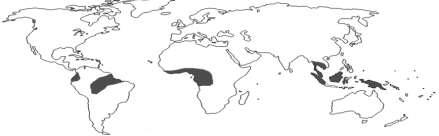
- Found between 5° and 10° north and south of the equator.
- Its greatest extent is found in lowlands of Amazon, the Congo, Malaysia and the East Indies.
Climate
- Dominated by Maritime tropical air masses.
- Temperature is uniform throughout the year, with Average monthly temperatures above 18°C, but the highest temperature can reach as high as 45°C.
- There is no winter.
- The diurnal range of temperature and annual range is small.
Precipitation
- Cloudiness and heavy precipitation help to moderate the daily temperature.
- Annual average precipitation is above 150 cm.
- No distinct dry season.
- There are two periods of maximum rainfall, in April and October, which occur shortly after the Equinoxes. (Double rainfall peaks are the characteristic feature of equatorial climates, & not found in other climate types.)
- Least rain falls at the June and December solstices.
- There is much evaporation and conventional air currents are set up, followed by heavy downpours of conventional rain in afternoons.
- Relative Humidity is constantly high (over 80%) making one feel sticky and uncomfortable.
Vegetation
- Equatorial regions support Tropical evergreen forests with dense canopy cover (called ‘Selvas’ in Amazon).
- The vegetation comprises a multitude of evergreen trees e.g., mahogany, ebony, cabinet woods and dyewoods.
- Other plants like small palm trees, climbing plants like lianas and epiphytes and parasitic plants found here.
Life and Economy
- Equatorial regions are sparsely populated with primitive people who live as hunters and collectors and the most advanced ones practise the Shifting cultivation.
- After shifting cultivation, a less luxuriant secondary forest.
- Secondary Forest, called Belukar (in Malaysia).
- Natural Rubber and cocoa industry thriving here. Other important crops like coconuts, sugar, coffee, tea, tobacco, spices, and sago are cultivated here.
- TROPICAL MONSOON CLIMATE
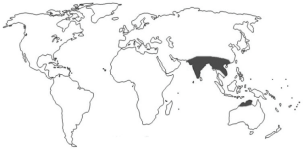
- Occur within 5° to 30° north and south of the Equator.
- Best developed in the Indian subcontinent, Myanmar, Thailand, Laos, Cambodia, parts of Vietnam and south China and northern Australia.
Climate
- The basic cause of monsoon climates is the difference in the rate of heating and cooling of land and sea.
- In the summer, when the sun is overhead at the Tropic of Cancer, low pressure is created in Central Asia.
- Winds blow outwards as the South-East Monsoon, to Java, and after crossing the equator are drawn towards the continental low-pressure area reaching the Indian sub- continent as the South-West Monsoon.
- In winter, the conditions are reversed.
Temperature
- Average monthly temperature is above 18°C, maximum temperature can reach 45°C.
- The average temperature in the summer is around 30°C and during winters is around 25°C.
Vegetation
- Dry deciduous forests, with broad-leaved hardwood trees.
- Less luxuriant than tropical forests with fewer species.
Life and Economy
- Supports high- population density.
- Subsistence farming is the main occupation.
- Intensive cultivation in regions with irrigational facilities.
- Shifting cultivation is followed in North-East India and South-East countries.
- Major crops include rice, sugar, cotton, jute, spices, etc.
- Cattle and sheep rearing for domestic and commercial purposes.
Tropical Monsoon Seasons: Three Distinct Seasons
- The cool, dry season (October to February) :- Out Blowing dry winds, the North- East Monsoon brings little or no rain to the Indian subcontinent. However, a small amount of rain falls in Punjab from cyclonic sources (Western Disturbances).
- The hot dry season (March to mid-June) :- The sun’s northward shift to the Tropic of Cancer causes a sharp temperature rise. Coastal districts are a little relieved by sea breezes and little rain.
- The rainy season (mid-June to September) :- ‘Burst’ of the South-West Monsoon in mid-June, torrential downpours sweep across the country. Almost all the rain for the year falls within this rainy season. Concentrated Heavy rainfall in summer is a characteristic feature of the Tropical Monsoon Climate.
- TROPICAL MARINE CLIMATE
- The climate is under influence of the on-shore Trade Winds all the year-round.
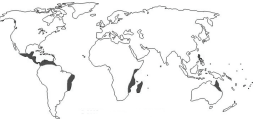
- Found in Central America, West Indies, northeastern Australia, the Philippines, parts of East Africa, Madagascar, the Guinea Coast and eastern Brazil.
- Rainfall (both orographic and convectional) is maximum in summer, but without any distinct dry period.
- Favourable for habitation, but prone to severe tropical cyclones, hurricanes or typhoons.
- THE SAVANNA OR SUDAN TYPE CLIMATE
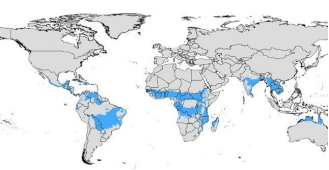
- Transitional type of climate found between the equatorial rainforests and hot deserts.
- Characterised by distinct wet and dry seasons.
- Also known as llanos in Orinoco basin and compos in the Brazilian Highlands.
Climate
- Characterised by an alternate hot, rainy season and cool, dry season.
Rainfall
- In the Northern Hemisphere, Rainy season is from May to September.
- In the Southern Hemisphere, Rainy Season from October to March.
- The amount of rainfall and the length of the rainy season decreases from equator to pole-wards towards the desert fringes.
- Trade winds bring rains to the eastern coasts but become dry by the time they reach the interiors of the continents.
Temperature
- Mean annual temperature is greater than 18°C.
- Highest temperatures do not coincide with the period of the highest sun but fall just below the onset of rains.
- Extreme diurnal range of temperatures.
Winds
- The prevailing winds (the Trade Winds) bring rain to the coastal districts.
- They are strongest in the summer but are relatively dry in continental interiors or the western coasts.
- Harmattan meaning the doctor are the north east trades which blow from interior Africa to the Atlantic coast in Guinea gives relief from moist sea winds by increasing the rate of evaporation with resultant cooling effect.
Vegetation
- The savanna landscape is typified by tall grass and short trees.
- The grasslands are called bush-veld or parkland.
- The trees are deciduous, usually have broad trunks, with water-storing devices to survive (like acacia tree).
- Many trees are umbrella shaped, exposing only a narrow edge to the strong winds.
- Tall Savanna grasses (elephant grass) have deep roots. It lays dormant during the cool, dry season.
- Trees decrease in height and density polewards.
Animal Life of the Savanna
- The savanna is known as the big game country as thousands of animals are trapped or killed each year.
- There are two main groups of animals in the savanna, the grass-eating herbivorous animals and the fleshing eating carnivorous animals.
Life and Economy
- Masai tribes of the East African plateau are pastoralists whereas Hausa of northern Nigeria are settled cultivators.
- The old grazing grounds of Masai tribes in the Kenyan Highlands were taken over by the immigrant white settlers for plantation agriculture (coffee, tea, cotton) and dairy farming
- DESERT CLIMATE
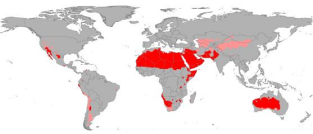
- Deserts are regions of scanty rainfall which may be Hot like the hot deserts of the Saharan type or Temperate as are the mid-latitude deserts like the Gobi.
Hot Deserts
- Also called the Trade Wind Deserts because the aridity of the hot deserts is mainly due to the effects of off-shore Trade Winds.
- The major hot deserts of the world are located on the western coasts of continents between 15°-30° north and south latitudes.
Mid Latitude Deserts
- The temperate deserts are rainless because of either continentality (Ex: Gobi Desert) or rain-shadow effect (Ex: Patagonian Desert).
- The Patagonian Desert is drier due to its rain-shadow position on the leeward side of the lofty Andes than to continentality.
Precipitation
- Annual precipitation of less than 25 cm.
- The hot deserts lie astride the Horse Latitudes or the Sub- Tropical High-Pressure Belts where the air is descending, a condition least favourable for any precipitation.
Temperature
- Hottest regions on earth with no cold season.
- The average summer temperature is around 30°C.
- The diurnal range of temperature in the deserts is very great.
Natural Vegetation
- Xerophytic or drought-resistant.
- Grass, scrub, herbs, weeds, roots or bulbs.
- Leaves are waxy and leathery, needle-shaped – reduce transpiration.
Life in the Deserts
- Despite its inhospitality, the desert has always been populated by different groups of inhabitants.
- Example: The primitive hunters and collectors(The Bushmen and The Bindibu).
- The nomadic herdsmen (The Tuaregs of the Sahara, the Gobi Mongols and The Bedouin of Arabia).
- The caravan traders, the settled cultivators and the mining settlers.
- THE WARM TEMPERATE WESTERN MARGIN (MEDITERRANEAN) CLIMATE
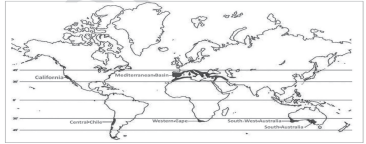
- Distribution: around the Mediterranean Sea, along the west coast of continents in subtropical latitudes between 30°-40° latitudes.
- Example: Central California, Central Chile, along the coast in southeastern and south-western Australia.
- The basic cause of this type of climate is the shifting of the wind belts.
- These areas come under the influence of a subtropical high in summer and westerly wind in winter.
- Hence, the climate is characterised by hot, dry summers and mild, rainy winters.
- Temperature: Monthly average in summer is around 25°C and in winter below 10°C.
- The annual precipitation ranges between 35-90 cm.
- Climate is not extreme because of cooling from water bodies.
Natural Vegetation
- Land of Orchids.
- Trees with small broad leaves are widely spaced and never very tall.
- The absence of shade is a distinct feature of Mediterranean lands.
- A wide range of citrus fruits such as oranges, lemons, limes, citrons and grapefruit are grown.
Local Winds
- Sirocco: hot & dry dusty (blood rain) wind originates in the Sahara Desert.
- Brings a warming effect to the colder Mediterranean region.
- Mistral: is a cold wind.
- The velocity of the Mistral is intensified by the funneling effect in the valley between the Alps and the Central Massif [Plateau in France].
Economic Activities
- The area is important for fruit cultivation, cereal growing, Wine-making and agricultural industries as well as engineering and mining.
- THE TEMPERATE CONTINENTAL (STEPPE) CLIMATE
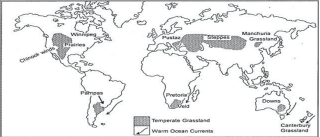
- Distribution: Bordering the deserts, away from the Mediterranean regions and in the interior continents are the temperate-grasslands.
Climatic Conditions
- The grasslands are practically treeless.
- The grasses are not only shorter but also wiry and sparse.
- Climate is continental with extremes of temperature.
- This type of climate in the southern hemisphere is never severe due to maritime influence.
- The summers are hot and the winters are cold.
- The heaviest rain comes in June and July.
- Wheat and Maize cultivation is predominant.
- Due to extensive, mechanised wheat cultivation and are now the ‘granaries of the world’.
Local Wind
- Chinook: is a hot wind, also called ‘snow eater’. It melts the snow-covered pastures and animals can be driven out of doors to graze in the open fields.
- THE WARM TEMPERATE EASTERN MARGIN (CHINA TYPE) CLIMATE
- A modified form of monsoonal climate.
- Found on the eastern margins of continents in warm temperate latitudes, just outside the tropics.
- Characterised by a warm moist summer and a cool, dry winter.
- Annual rainfall is around 60 to 150 cm.
- In summer, the regions are under the influence of moist, maritime airflow from the subtropical anticyclonic cells.
- Local storms :- Typhoons (tropical cyclones), and Hurricanes, also occur.
It Can be Subdivided into Three Main Types
- The China type: Central and north China (including southern Japan (temperate monsoonal).
- The Gulf type: Minimal monsoonal characteristics.
- There is no complete seasonal wind reversal.
- Areas: south-eastern United States, (slightmonsoonal).
- The Natal type: Absence of the monsoonal characteristics.
- The entire warm temperate eastern margin (nonmonsoonal areas) of the southern hemisphere.
Economy
- The warm temperate eastern margins are the most productive parts of the middle latitudes.
- World’s greatest rice-growing areas, warm wet and lowland favour rice cultivation.
- Sugarcane , cotton, tobacco, maize, dairy products etc.
- THE COOL TEMPERATE WESTERN MARGIN (BRITISH TYPE) CLIMATE
- These are under the permanent influence of the Westerlies all-round the year.
- Regions of frontal cyclonic activity, typical of Britain, and are thus said to experience the British type of climate.
- The seasons are very distinct.
- Mean annual temperature :- 5 to 15°C
- The warming effect of North Atlantic Drift makes winter milder.
Distribution
- Around Britain in Europe.
- In the Southern Hemisphere: Southern Chile, Southern Australia, Tasmania and most parts of New Zealand.
- Parts of North America.
Natural Vegetation
- Deciduous forest: Shed leaves in winters to protect against snow and frost.
- Valuable temperate hardwood: oak, elm, birch, beech, poplar, Willows, Alder, Asp.