
- The general movement of ocean water flowing in a certain direction is called ocean current.
- Due to the effect of Coriolis force, the currents of the northern hemisphere flow towards their right and the currents of the southern hemisphere flow towards their left.
- They are the continuous, predictable, directional movement of seawater driven by gravity, wind (Coriolis Effect) and water density.
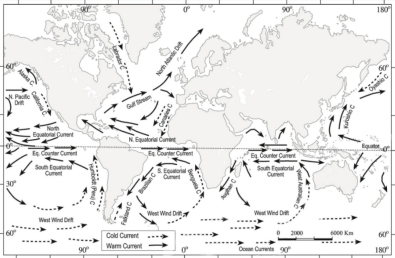
14.4.1 Types of Ocean Currents
| Based of Depth | Surface Current :- Constitute about 10 percent of all the water in the ocean, these waters are the upper 400 m of the ocean. Deep Water CurrentThese waters move around the ocean basins due to variations in the density and gravity.Deep waters sink into the deep ocean basins at high latitudes, where the temperatures are cold enough to cause the density to increase. |
| Based on Temperature | Cold CurrentsBring cold water into warm water areas. Found on the west coast of the continents in the low and middle latitudes(true in both hemispheres) and on the east coast in the higher latitudes in the Hemisphere. Warm CurrentsBring warm water into cold water areas and be observed on the east coast of continents in the low and middle latitudes (true in both hemispheres). In the northern hemisphere they are found on the west coasts of continentsin high latitudes. |
Factors of origin of ocean currents
The following factors are considered responsible for influencing the origin of currents and their speed:
1. Earth’s rotation and gravity
2. Oceanic factors: Temperature, salinity, density and melting of ice.
3. External oceanic factors: Atmospheric pressure, wind, rainfall, evaporation and insolation.
4. Factors that bring about changes or modifications in currents: Direction and shape of the coast, changes in weather and topography of the bottom.
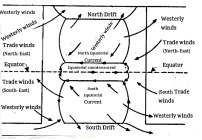
Effect and importance of currents
1. The continuous flow of currents is nature’s effort towards establishing the horizontal heat balance of the earth.
2. Warm currents bring with them moist winds that cause rainfall. For example, the North Atlantic Current causes rainfall in the western European parts, which has created a climatic region similar to that of western Europe where rainfall is received throughout the year, while cold currents create high air pressure on the coast.
3. Cold currents bring with them floating icebergs, which are a huge storehouse of fresh water. But these icebergs also pose a danger to ships.
4. These currents also bring with them planktons, which are the main food of fish. The favourable conditions for production of planktons takes place where cold and warm sea currents meet.
5. When warm and cold currents meet, conditions of temperature inversion are created and dense fog is formed, which hinders the traffic of ships.
6. Ocean currents are like a huge highway in the ocean, which ships generally follow.
7. Due to warm currents, the ports in the polar region do not get frozen and they remain open throughout the year.
| Indian ocean current | Nature |
| 1. South Equatorial Current | hot and steady |
| 2. Mozambique Current | hot and steady |
| 3. Agulhas Current | hot and steady |
| 4. Western Australia Current | cold and steady |
| 5. Summer Monsoon Current | hot and variable |
| 6. Winter Monsoon Current | cold and variable |
| 7. Somali Current | Cold |
| 8. South Indian Ocean Current | cold |
| Pacific ocean currents | Nature |
| Oyashio | Cold |
| Alashka | Cold |
| California | Cold |
| Peru/humbolt | Cold |
| Okhotsk | Cold |
| North & south equatorial | Warm |
| Counter equatorial | Warm |
| Kuroshio | Warm |
| North pacific | Warm |
| East australian | warm |
| Atlantic ocean currents | Nature |
| Labrador | Cold |
| Greenland | Cold |
| Canary | Cold |
| benguela | Cold |
| Falkland | Cold |
| North & south equatorial | Warm |
| Counter equatorial | Warm |
| Antilles | Warm |
| Gulf | Warm |
| North atlantic drift | Warm |
| Norwegian | Warm |
| Brazil | warm |
OSITS Oceanic Deposits
- The unconsolidated sediments, derived from various sources, deposited on the sea floors are known as oceanic deposits.
- Murray and Renard have given important information about them.
- The sediments deposited in the oceans and the seas are derived from three major sources:
Terrigenous Sources
- These sediments are continental in origin and formed due to disintegration and decomposition of continental rocks.
- The size of these sediments decreases towards the sea.
- Examples: Gravel, Sand, Clay and Mud. Mud is further divided into three types on the basis of colour – Blue Mud (Iron sulphide and iron-oxide), Red Mud (rich in iron oxide) and Green Mud ( rich in iron silicate).
Volcanic Materials
- These are the brown or black materials, deposited as a result of volcanic eruption.
Organic Materials
- These are also called carbonic materials as they include skeletons of marine organisms and plant remains.
Inorganic Materials
- The most important among them is the red clay (Aluminium Silicate and Iron Oxide).
- Widely distributed to the greatest depth in all the oceans.
- It covers about 38% of the oceans and more than half of the bottom of the Pacific Ocean.