Temperature of ocean water
- The temperature of the oceanic water is important for marine organisms including plants (phytoplankton) and animals (zooplanktons).
- Factors Affecting Temperature Distribution:
- Latitude: The temperature of surface water decreases from the equator towards the poles because the amount of insolation decreases pole ward.
- Unequal distribution of land and water: Water warms up and cools down much more slowlythan land.
- Winds: Winds also affect the temperature distribution of the oceans. In the areas of trade and counter-trade winds, the effect of winds is comparatively less as compared to calm atmosphere areas.
- In those parts of the oceans where there are more clouds, the temperature is low.
- The salinity found in the ocean water also affects the distribution of temperature. In those parts of the oceans where salinity is high, the temperature is also high.
- Currents also affect the temperature distribution of the oceans. Currents of warm water flow towards cold regions and cold currents flow from the poles towards warm regions, which affects the horizontal temperature of the oceans.
- Sea ridges, evaporation process, fog etc. also affect the temperature distribution.
HORIZONTAL DISTRIBUTION OF TEMPERATURE
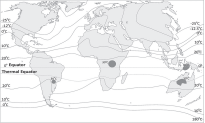
- From the equator towards the pole temperature decreases.
- Northern hemisphere records a relatively higher average temperature than in the southern hemisphere due to unequal distribution of land and water.
- Highest temperature not recorded at equatorrather a bit north of it. Sunlight falling on the Equator generates rising air currents that help in the formation of clouds over equatorial regions, which then cause rains and thunderstorms.
- Warm and cold currents affect the rate of change of temperature with latitude.
Vertical distribution of ocean temperature
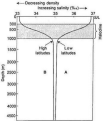
1. Surface or Photic Zone : The depth of the upper layer of the ocean is about 100 meters, and only 2 percent of the total water of the ocean is found in this layer. The temperature and salinity remain almost the same in this layer of the ocean.
2. Thermocline or Pycnocline : The thermocline layer is present in the ocean from a depth of 100 meters to 1000 meters. The temperature of this layer decreases rapidly. As we go deeper, the salinity increases.
3. Deep Zone: The deepest layer is from one kilometer to the bottom of the ocean. The temperature decreases slowly as we go deeper into it, but the temperature of the deepest part of the ocean – the bottom –remains above zero. If the temperature goes below zero, the water will turn into ice and ice is lighter than water, so it will float on top.
Salinity of ocean waters
- Salinity is defined as the ratio between the weight of the dissolved materials (salt in grams) and the weight of the sample sea water (litre).
- The average salinity of the ocean is 35 grams of dissolved salts in each litre.
- The oceans contain 96.5 percent water and 3.5 percent salt.
- Density of highly saline Lake Van and Dead Sea is so high that it is almost impossible to sink.
Sources of Salinity
- Most of the salt found in the ocean comes from the land surface. Flowing rainwater, moving wind, glaciers and sea waves add salinity from the land to the ocean. Apart from these, volcanoes originating in the oceans and the animals and grass that die in the ocean also increase salinity.
| Composition Of Sea Water | |
| Salts | Percentage |
| Sodium Chloride | 77.8 |
| Magnesium Chloride | 10.8 |
| Magnesium sulphate | 4.7 |
| Calcium sulphate | 3.6 |
| Potassium sulphate | 2.5 |
| Calcium carbonate | 0.3 |
| Magnesium bromide | 0.2 |
1. Evaporation: There is a direct relationship between evaporation and salinity. In those parts of the ocean where evaporation is more, the salinity there is also more.
2. Temperature : The seas which have high temperature, their salinity is also high.
3. Precipitation: There is an inverse relationship between the amount of rainfall and the salinity of the ocean. The parts of the oceans where there is more rainfall have less salinity.
4. Ocean Currents : Water currents carry water from areas of high salinity to areas of low salinity.
5. River Deltas : The salinity level is less in front of the river deltas. The water coming from the rivers reduces the salinity level of the ocean. The salinity level of the oceans is comparatively less in the Sundarban delta and Amazon rivers.
VERTICAL DISTRIBUTION OF SALINITY
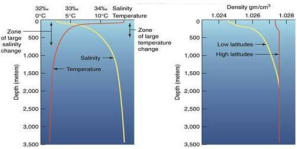
- Salinity, generally, increases with depth and there is a distinct zone called the halocline (compare this with thermocline), where salinity increases sharply.
- Salinity at the surface increases by the loss of water to ice or evaporation, or decreased by the input of fresh waters, such as from the rivers.
- Salinity at depth is very much fixed, because there is no way that water is lost, or the salt is added.
- Salinity changes with depth, but the way it changes depends upon the location of the sea.
- High latitudes: Increases with depth.
- Middle latitudes: Increases up to 35 metres and then it decreases.
- Equator: Surface salinity is lower.
HORIZONTAL DISTRIBUTION OF SALINITY
- Arctic Ocean
- The salinity fluctuates from 30-35 ppm seasonally.
- In hot and dry regions, where evaporation is high, the salinity sometimes reaches 70%.
2.Pacific Ocean
- Variation is mainly due to its shape and larger areal extent.
- Salinity decreases from 35-31 ppm in the western parts of the northern hemisphere because of the influx of melted water from the Arctic region.
3.Atlantic Ocean
- The average salinity of the Atlantic Ocean isaround 36 ppm.
- The highest salinity is recorded between 15° and20° latitudes.
4.Marginal Seas
- The North Sea, in spite of its location in higher latitudes, records higher salinity due to more saline water brought by the North Atlantic Drift.
- The Baltic Sea records low salinity due to the influx of river waters in large quantities
- The Mediterranean Sea records higher salinity due to high evaporation.
- Salinity is, however, very low in Black Sea due to enormous freshwater influx by rivers.
- The low salinity trend is observed in the Bay of Bengal due to influx of river water.
- On the contrary, the Arabian Sea shows higher salinity due to high evaporation and low influx of fresh water.