
INTRODUCTION
- The horizontal and vertical motions are common in ocean water bodies.
1. Horizontal movement: Currents & waves.
2. Vertical movement: Tides.
WAVES
- Waves are actually the energy, which moves across the ocean surface.
- Most of the waves are caused by the wind driving against water.
- Water particles only travel in a small circle as a wave passes.
Origin
- A wave’s size and shape reveal its origin.
- Steep waves are young and formed by local winds whereas slow and steady waves are older originating from far away places.
Source of Energy
- Wind causes waves to travel in the ocean and the energy is released on shorelines.
- The motion of the surface water seldom affects the stagnant deep bottom water of the oceans.
- The maximum wave height is determined by the strength of the wind, i.e. how long it blows and the area over which it blows in a single direction
- Movement of water caused by meteorological effects(winds and atmospheric pressure changes) is called surges. Surges are not regular like tides.
TIDES
- The periodical rise and fall of the sea level, once or twice a day, mainly due to the attraction of the sun and the moon, is called a tide.
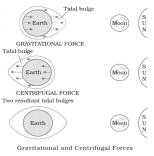
- Major cause for tide: The gravitational pull and the centrifugal force are responsible for creating the two major tidal bulges on the earth.
- On the side of the earth facing the moon, a tidal bulge occurs while on the opposite side though the gravitational attraction of the moon is less as it is farther away, the centrifugal force causes tidal bulge on the other side.
- When the tide is channeled between islands or into bays and estuaries they are called tidal currents.
- The vertical distance between high tide and low tide is the tidal range.
Types of Tides
- based on frequency
- Based on positions of Sun, Earth and Moon
| Based on frequency | |
| Semi Diurnal tides | Most common2 high and 2 low tides each day Successive high or low tides of same height |
| Diurnal tides | Only 1 high and low tide each daySuccessive high or low tides of same height |
| Mixed tides | Variation in height of tidesWest coat of north america and islands of pacific ocean |
| Based on positions of Sun, Earth and Moon | |
| Spring Tide | Neap Tide |
| When the sun, the moon and the earth are in a straight line, the height of the tide will be higher. These are called spring tides. Occurs twice a month, one during the full moonperiod and another during the new moon. | At this time the sun and moon are at right angles to each other and the forces of the sun and moon tend to counteract one another. The Moon’s attraction, though more than twice as strong as the sun’s, is diminished by the counteracting force of the sun’s gravitational pull. |
| Period | Normally, there is a seven day interval between the spring tides and neap tides | |
| Perigee | Moon’s orbit is closest to the earth | High and low tides occur. During this time the tidal range is greater than normal. |
| Apogee | When the moon is farthest from Earth | The moon’s gravitational force is limited and the tidal ranges are less than their average heights. |
| Perihelion | Earth is closest to the sun. | Around 3rd January each year, tidal ranges are also much greater, with unusually high and unusually low tides |
| Aphelion | Earth is farthest from the sun. | Around 4th July each year, tidal ranges are much less than average. |
| Ebb | The time between the high tide and low tide, when the water level is falling. | |
| Flow | The time between the low tide and high tide, when the tide is rising | |