
Ocean Deposits
Different types of sediments get deposited in the oceans. They are called marine deposits.
The main sources of marine deposits are as follows:
(i) Terrigenous Sediments : Most of the deposits in the oceans are deposited from land. Sand, clay, silt etc. are such types of sediments.
(ii) Volcanic Deposits : Volcanoes keep erupting in the oceans, the ash, pebbles, stones etc. coming out, which get deposited on the bottom of the ocean.
(iii) Biotic Deposits : In the oceans, various kinds of living creatures, animals, birds, algae, grass, etc. and take the form of deposits on the bottom of the ocean.
(iv) Cosmogenous Deposits : Ashes and tektites falling from space turn into marine deposits. The thickness of the deposits varies in different oceans. The layer of deposits is thick in the Atlantic Ocean and half a kilometer thick in the Pacific Ocean.
Coral Reef
- These are highly biodiversity underwater topographies formed by the skeletons of marine organisms called coral polyps. These are lime-based rocks. Coral reefs are formed in tropical oceans (25oN-25oS) on underwater platforms located at a depth of 200 to 300 feet along an island or coast, where sunlight reaches in sufficient quantity. High salinity and completely clean water both are harmful for their growth. For proper growth of corals, normal ocean salinity (25% to 30%), sediment-free water and 20oC-25oC average temperature are required. Ocean waves and currents are beneficial for the growth of corals.
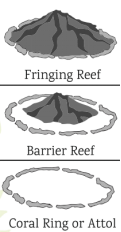
Coral reefs are of three types :-
(i) Fringing Reef : These are coral reefs formed along the coast. For example, Gulf of Mannar in India, South Florida in USA etc.
(ii) Barrier Reef : These are coral reefs found some distance away from the coast. Lagoon lakes are found in the middle parts of these.
(iii) Coral Ring or Attol : It is an island or coast surrounded by coral reefs. For example- Fiji Atoll, Funafati Atoll etc.
Coral Bleaching
- Corals have a symbiotic relationship with microscopic algae called zooxanthellae. These algae carry out photosynthesis and the nutrients obtained from them help in the growth of corals. But when zooxanthellae algae start dying out or their photosynthesis is obstructed due to increase in temperature, El Niño phenomenon, accumulation of sediments and silt, marine pollution and infectious diseases in corals, the colour of the algae turns white which is called coral bleaching.
- Global warming has been identified as the main cause of coral bleaching. Coral reef bleaching is caused by man-made and natural changes in the coral environment including sea surface temperature rise, solar radiation, siltation, black band disease and coral plague in corals, xenobiotic exposure (subaerial), inorganic nutrients, low water concentration due to freshwater exposure, epizootics. Control of temperature rise and marine pollution is extremely important to prevent coral destruction.