GEOLOGICAL STRUCTURE
- It includes arrangement and deposition of rocks in earth’s crust.
- Plays a dominant role in determining relief of landand nature of the soil.
- Helps in knowing mineral wealth, harnessing agricultural and industrial growth and in economic prosperity.
GEOLOGICAL REGIONS OF INDIA
Triple Tectonic Division (generally accepted by most geologists)
1. Peninsular Region which also includes:
- Meghalaya Plateau
- Kutch-Kathiawar plateau
2. Extra-Peninsular Region which includes:
- Himalayas
- Eastern Extension- Andaman & Nicobar Islands
3. Indo-Gangetic Plains
Some Scholars Recognise Only Two Divisions
1. Peninsular region
- One of the oldest landmasses on earth
- Open senile topography dominates.
- Not undergone marine submergence since Cambrian times.
- Not much tectonic activity happens.
2. Extra-Peninsular or Himalayas and Indo-Gangetic Plains
- Dominated by youthful reliefs like the Himalayas.
- Indo Gangetic plains have flat featureless and monotonous topography.
- It has its origin in Tethys sea and is prone to tectonic forces.
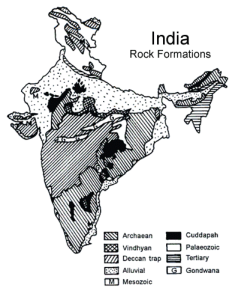
Geological history of India
- Sir T. Holland who was the Director of the Geological Survey of India, classified the rock systems of the country into the following four major divisions :-
1. The Archaean Rock system
2. The Purana rock system
3. The Aryan rock system
4. The Dravidian rock system
| Rock systems of India | |
| Archaean rock system | Gneiss and Schist (4000 million years ago) Oldest and formed when the earth’s surface cooled and solidified. Azoic or unfossiliferous, completely crystalline and has a well defined foliated structure. Also known as “basement complex” or “fundamental complex”. Distribution: Central and peninsular India, Odisha, Meghalaya, Madhya Pradesh, Chhattisgarh, Chota Nagpur Plateau, Bundelkhand Plateau and along the Aravallis north of Vadodara. Dharwad system (4000 – 1000 Million Years Ago) Oldest and highly metamorphosed rocks of sedimentary and igneous origin. Reserve of precious minerals like high grade iron ore, manganese, copper, lead, gold etc. Distribution: Aravallis, Tamil Nadu, Chota Nagpur Plateau, Meghalaya, Delhi, Himalayas. |
| Purana RockSystem | Kuddapah systemThey were formed when sedimentary rocks like sandstone, limestone etc. and soil were deposited in the synclinal basins(Depression between two folds. Ie, ).They are famous for deposits of iron ore, manganese, copper, cobalt, nickel, cement grade limestone.Found in Andhra Pradesh, Delhi, Rajasthan, Chhattisgarh and Kuddapah region of Lesser Himalayas. Vindhyan systemAssimilation of ancient sedimentary rocks superimposed on Archaean bedrock or base.Large stratified (layered) formations of sandstone, shale and limestone.Upper Vindhyan belt encloses the diamond producing belts of Panna and Golconda.Devoid of metallic minerals but provides excellent ornamental stones, sandstone, glass making sand and some coal. |
| Aryan rock System | Gondwana System Consists of sandstones with some shales and clays. Continental origin, fluvial and lacustrine deposits. Contains about 98% of coal reserves, iron ore, copper, uranium. Distribution: Peninsular region along Damodar valley in Jharkhand, Mahanadi river valley in Chhattisgarh and Odisha and also in southern part of Madhya Pradesh. Triassic System (280–225 MY old) It is almost absent in the Peninsula but is found extensively from Hazara to Nepal. The Deccan Traps From the end of the Cretaceous to the beginning of the Eocene volcanic eruptions undermined a large part of peninsular India. The volcanic deposits have flat summits and steep sides, making them appear as giant staircases from a distance. It is thickest along the west coast (3000m) and thinnest around the eastern limit(150m). Distribution: Kutch, Saurashtra, Maharashtra, Malwa Plateau, North Karnataka, parts of Telangana, Tamil Nadu, UP and Jharkhand. |
| Dravidian rock System | Cambrian rocks (600 million year ago) Consists of slate, clay, quartzite and limestone. Best developed in north-western Himalayan region. Carboniferous rocks (350) It consists mainly of limestone, shale and quartzite. These rocks are divided into: a. Upper Carboniferous is composed of limestone and dolomite. E.g.:- Mount Everest is composed of Upper Carboniferous limestone.b. Middle Carboniferous has been an age of great upheaval. These rocks are found in Shimla, Kashmir and Eastern Himalayas. c. Lower Carboniferous consists of various types of slates and is found in Pir Panjal and Kumaon region. Coal formation began in the Carboniferous era. Ordovician (500) Consists of quartzites, sandstones and limestones. They are located in the spoti valley region of Himachal and are present in Kashmir and Kumaon. Devonian (400) They are devoid of any fossil remains and are identified in the Muth Quartzite of Spiti and Kumaon and Haridwar of Uttarakhand. Silurian (400) Found in Spiti valley along with Ordivician. Lahaul and Kullu valleys also have these. Limestone and shale of Kumaon belong to Silurian period. |