
- The gaseous envelope around the earth is called atmosphere. The gases found in the earth’s atmosphere originate from within the earth. The modern form of our atmosphere developed in the pre-Cambrian era.
- The atmosphere allows short waves of solar radiation to reach the earth’s surface but acts as a barrier for long waves of terrestrial radiation. This temperature (15oC) is the basis for the development of biosphere on earth.
Atmosphere :- mixture of various gases, water vapor and dust
Climate :- the average weather in an area over a long period of time.
Weather ;- the condition of the atmosphere at a specific time (short term) and place.
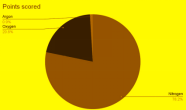
| Physical | Chemical(Gas) | In Percentage By Volume |
| Odorless | Nitrogen (N2) | 78.084 |
| Colorless | Oxygen (O2) | 20.946 |
| Tasteless | Argon (Ar) | 00.934 |
| Shapeless | Carbon dioxide (CO2) | 00.0314 |
| Completely Mixed | Neon (Ne) | 00.0018 |
| Helium (He) | 00.0005 | |
| Methane (CH4) | 00.0002 | |
| Krypton (Kr) | 00.00011 | |
| Hydrogen (H2) | 00.00005 | |
| Xenon (Xe) | 00.0000087 |
- Nitrogen (N2) – It is the most important atmospheric gas. Leguminous plants supply atmospheric nitrogenous nutrients.
- Oxygen (O2) – It is a life-giving gas for humans and animals. Plants release it (oxygen) into the atmosphere through photosynthesis.
- Argon (Ar) – It is an inert gas. Apart from this, inert gases like helium, neon, krypton, xenon are also found in small quantities in the atmosphere.
| Carbon Dioxide | CO2 is transparent to the incoming solar radiation but opaque to the outgoing terrestrial radiation.It also absorbs a part of terrestrial radiation & reflects some part of it towards the earth’s surface. It is largely responsible for the GreenHouse Effect. |
| Ozone | Found between 10 and 50 km above the earth’s surface. Acts as a filter & absorbs the ultraviolet rays radiating from the sun and prevents them from reaching the surface of the earth |
| Water Vapour | Water vapour is a variable gas in the atmosphere, which decreases with :- AltitudeAnd From Equator Towards Poles.Also absorbs parts of the insolation from the sun & preserves the earth’s radiated heat. Thus, it acts like a Blanket. |
| Dust Particles | Dust particles include sea salt, fine soil particles, smoke soot, ash, pollen, dust and meteorite particles. They are mainly found in the lower level of the atmosphere i.e. troposphere. These dust particles act as hygroscopic nuclei or condensation centers, where the atmospheric water vapor condenses to form various forms of precipitation. They also create red and orange hues in the sky by scattering light at sunrise and sunset. Dust fog is also a dense mist formed in the presence of dust particles. |
(Structure of Atmosphere)
- The atmosphere consists of different layers with varying density and temperature.
- Highest near the surface of the earth and decreases with increasing altitude.
- In terms of chemical composition, the atmosphere is divided into two layers. In the thickness of 80 km of the atmosphere, the mixture of gases remains almost the same. Hence, it is called the homosphere. different molecular layers of nitrogen, oxygen, helium and hydrogen also called the heterosphere.
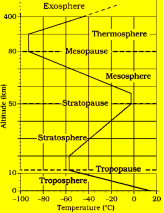
- The atmosphere is divided into five different layers depending upon the temperature condition as:
| Layers | Characteristics |
| Troposphere | Lowest layer of the atmosphere.Average height is 13 km (8 km near the poles & 18 km near the equator).All changes in climate and weather take place in this layer.Contains 99% of the water vapour in the atmosphere.The temperature in this layer decreases at the rate of 1°C for every 165 m of height (called the Normal Lapse Rate).Tropopause: the zone separating the troposphere from the stratosphere. |
| Stratosphere | Found above the tropopause and extends up to a height of 50 km.Contains the ozone layer.Temperature increases with increasing height.The air blows horizontally here, therefore, considered ideal for flying of aircrafts.The lower portion of the stratosphere is also influenced by the polar jet stream and subtropical jet stream. |
| Mesosphere | Lies above the stratosphere, which extends up to 80 km.Temperature starts decreasing with the increase in altitude.Absence of GreenHouse Gases. Meteors or falling stars occur in this layer.The upper limit of the mesosphere is known as the mesopause. |
| Thermosphere | The part of the atmosphere situated just above the mesosphere is called the ‘thermosphere’, in which the temperature increases rapidly with increasing height and the air pressure is minimum due to low atmospheric density.Based on the characteristics of the thermosphere, it is classified into two parts-IonosphereExosphere |
| Ionosphere | The ionosphere extends from 80 to 640 km above the sea level above the mesosphere. (Although, in many standard sources, its extension is considered to be up to 400 km only.)The ionosphere is dominated by ions i.e. electrically charged particles, so the ionosphere makes the ‘communication system’ possible by reflecting radio waves to the earth.In this sphere, phenomena like Aurora Australis and Aurora Borealis occur, which are electron waves expelled from a type of solar storm.In this sphere, several layers develop with height: D, E, F and G layers.D layer – Its extension is approximately between 80 to 99 km. This layer reflects low frequency waves, but absorbs high and medium frequency radio wave signals. This layer is related to solar radiation, so it disappears with the sunset.E layer – This layer is also called ‘Kenley Heaviside layer’. Its extension is approximately between 99 to 150 km. This layer reflects medium and high frequency radio waves. This layer is formed by the reaction of solar ultraviolet photons with nitrogen and oxygen molecules. This layer also disappears with the sunset.F layer :- This layer is formed by two sub-layers, F1 layer and F2 layer. It is also called ‘Apliton layer’. Its extension is found between 150 to 380 km. This layer reflects medium and high frequency radio waves towards the earthG layer – Its extension is found above 400 km. It is present between 400 to 640 km. |
| volume or Exosphere | This layer is the uppermost layer of the atmosphere, which extends in the atmospheric part above the ionosphere.The density of air becomes very low here, due to which it appears like a nebula.The temperature here goes above 5,000oC, but it cannot be felt.The atmosphere above the ionosphere is also called ‘outer atmosphere’, it includes the thermosphere and the magnetosphere. |
Classification based on chemical properties
(Homosphere)
- It represents the lower atmosphere and its height is up to 90 km from the sea level.
- The main basis for calling this sphere the homosphere is that the proportion of all gases in it is almost the same (with respect to height).
- The homosphere has been most affected by human activities, because the proportion of atmospheric gases is changing.
- The homosphere is divided into three parts :- troposphere, stratosphere and mesosphere.
Heterosphere-
- Its extension is about 10,000 km from the homosphere.
- There is a difference in the chemical and physical properties of the various layers of this sphere, due to which it is called the ‘heterosphere’.
- There are four layers found in it-
- Molecular nitrogen layer (90-200 km) – Nitrogen molecules predominate.
- Molecular oxygen layer (200-1,100 km) – Oxygen molecules predominate.
- Helium layer (1,100-3,500 km) – Helium molecules predominate.
- Molecular hydrogen layer (upper limit of 3,500 atmospheres) – Hydrogen molecules predominate.