
- Temperature is the measurement in degrees of how hot (or cold) a thing (or a place).
Atmospheric Temperature – The distribution of temperature in the atmosphere is not uniform. It is affected by various factors such as latitude, altitude, continentality and seasonal variability.
Determinants of Temperature
- The average temperature of the Earth is about 15oC, but there is great variation in local average temperatures. The horizontal distribution of temperature on maps is usually shown by isotherms. The following influences the horizontal temperature distribution:
1. Latitude :– The latitudinal position of a place has a profound effect on the amount of insolation it receives. In other words, high temperatures are recorded in equatorial regions while temperatures remain low in polar regions.
2. Altitude :- The temperature decreases at the rate of 6-4oC per kilometer as we go higher in the troposphere, hence the highest temperatures are recorded at sea level at any latitude. This is why Libreville (Gabon), located near the equator at a height of only 15meters above sea level, has an annual average temperature of 28oC, while Quito (Ecuador), which is located at a height of 3000 meters near the equator, has an annual average temperature of 13oC.
3. Cloud Cover :– Clouds also affect the distribution of temperature. According to an estimate, at any given time, 50 percent of the sky is always covered with clouds. Generally, if there are clouds during the day, the temperature remains low, but if there are clouds during the night, the night temperature increases. This is the reason why the highest temperatures are not recorded on the Equator, where the sun rays fall perpendicularly. On the contrary, the highest temperatures are recorded in the deserts located on the western part of every continent on the Tropic of Cancer, where there are fewer clouds.
4. Distance from the Sea/Ocean :– The location of a place in relation to the sea or oceans also affects the temperature distribution. In fact, there is differential heating of land and sea at the same latitude. Sea water can move its heat downward, or evaporation and ocean currents can lower the surface temperature, but land is opaque and the sun’s rays can penetrate only to a depth of about a meter on land, while in water (seas) they can penetrate much deeper.
5. Wind :– The velocity and direction of the wind also affect the horizontal distribution of temperature. The wind coming from the sea helps in reducing the temperature while the wind coming from the warm parts of the land increases the temperature.
6. Topography and Slope :– The distribution of temperature is also affected by geographical features. The slope of the land facing the sun receives more solar radiation (temperature) than the slope facing the wind.
7. Ocean Currents :– The flowing water in the oceans is called currents. Currents carry warm water towards cold regions and cold water towards warm regions. In this way, the temperature of water affects the neighbouring regions.
Normal Lapse Rate-
- The rate of decrease of temperature with increase in altitude is called ‘normal lapse rate’.
- Normal lapse rate is 6.5oC per 1,000 m increase in altitude.
Albedo
- Albedo is the amount of sunlight (solar radiation) reflected by a surface.
- The scale is measured from 0 to 1 (perfect reflectance).
- Fresh snow (0.80) > sea ice > sand > green matter > soil > forests > open ocean (0.06) > charcoal (0.04).
Temperature inversion-
- Temperature inversion is a reversal of the normal pattern of temperature in the troposphere, in which a layer of cold air at the surface is overlain by a layer of warm air.
- Favourable conditions for temperature inversion:-
- A long winter night, so that outgoing radiation exceeds incoming radiation.
- A clear and cloudless sky.
- Calm air (no/slow horizontal movement of air) which avoids mixing of air.
- Dry air near the ground surface.
| Types of Temperature Inversions | |
| Surface Temperature Inversion | The process of conduction takes place in layers in contact with the surface.If the surface air temperature drops below the dew point, fog may result.This type of temperature inversion is very common in high latitudes.In lower and middle latitudes it occurs on cold nights and dissipates during the day. |
| Valley Inversion | Caused by air flow in hills and mountains.Cold air (heavy and dense) formed during the night over hills and mountains flows under the influence of gravity almost acts like water and is carried down the slope to accumulate deep in pockets and valley bottoms with warmer air above.This is called air drainage.Protects plants from frost damage. |
| frontal Inversion | Occurs when a cold air mass intersects a warm air mass and lifts it.This type of inversion is unstable and dissipates with a change in weather. |
Consequences of Temperature Inversion
- Determines precipitation, cloud formation.
- Affects diurnal variations.
- Air drainage system protects plants from frost damage.
- Limits the diffusion of air pollutants that aid Fog or Smog formation.
- Atmospheric stability: Discourages the vertical movement of air which brings stability in the atmosphere.
- Intense thunderstorms and tornadoes are also associated with inversion of temperature.
SOLAR RADIATION
- Solar radiation is radiant energy emitted by the Sun from a nuclear fusion reaction that creates electromagnetic energy.
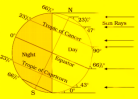
- The earth’s surface receives most of its energy from the Sun (in short-wavelength) called the Insolation (or Incoming Solar Radiation).
- The amount and the intensity of insolation varyduring a day, in a season and a year.
- Factors causing variations in insolation:
- Rotation of the earth on its axis;
- Angle of inclination of the sun’s rays;
- Length of the day;
- Transparency of the atmosphere and;
- Land topography.
- The maximum insolation is received over subtropical deserts, where the cloudiness is least.
- The Equator receives comparatively less insolation than the tropics.
- The area covered by vertical rays is always less than the slant rays. More slanting results in more absorption, cattering & diffusion.
Heating and Cooling of Atmosphere
- The four different ways of heating and cooling of the atmosphere are:
1. Conduction: Process in which heat flows from objects with higher temperature to objects with lower temperature though molecular movement.
2. Radiation: Heat transfer from one body to another without actual contact or movement.
3. Advection: Transfer of heat through the horizontal movement of the air. In middle latitudes, most of
diurnal (day & night) variation in daily weather is caused by advection alone.
4. Convection: Transfer of heat by the movement of a fluid (liquid or gas) between areas of different
temperature.