
- Vegetation refers to a group of trees, bushes, grasses, vines and creepers etc. or different species of plants, which are found in a particular environment.
- When vegetation develops or grows on its own by adapting itself to the soil and climatic conditions found there for a long time without any external human intervention, then it is called ‘natural vegetation’
- Factors Determining Vegetation:-
- Relief :- Land & Soil.
- Climate :- Temperature, Photoperiod & Precipitation.
Types of vegetation
- Tropical evergreen forests
- Tropical deciduous forests
- Tropical thorn forests and scrubs
- Montane forests
- Mangrove forests
Distribution of Vegetation
- On the basis of receipt of rain water and temperature, the natural vegetation of India can be mainly classified in two ways :-
- Horizontal distribution or distribution based on rainfall.
- Vertical distribution or distribution based on temperature.
- Horizontal Distribution
- With the decrease in the amount of rainfall, the density of vegetation, biomass and biodiversity also decreases. Hence, in India, when moving from areas with more than average rainfall to areas with less rainfall, the tropical vegetation has developed intoevergreen forests, deciduous forests, dry and moist, thorny forests, savannahs and desert vegetation respectively.
| Amount of rainfall (annual) | Types of Vegetation | Major trees |
| More than 250 cm | Tropical evergreen plants | Ebony, Mahogany, Rosewood, Rubber, Cinchona, Bamboo etc. |
| Up to 200-250 cm | Semi-evergreen plant | Cider, Holak, Kale (main varieties) etc. |
| Up to 100-200 cm | Tropical humid deciduous plant | Teak, Sal, Rosewood, Sandalwood, Arjun, Mulberry etc. |
| Up to 70-100 cm | Dry deciduous vegetation or tropical savannah | Tendu, Palas, Cassia fistula, Woodapple, Khair, etc. |
| Less than 70 cm | Dry thorny plants | Neem, date palm, acacia etc. |
| Up to 40-60 cm | Savannah vegetation | Small trees or grasses. |
| Less than 50 cm | Desert plants | Acacia, cactus etc. |
| Vegetation | Location | Characteristics | Species Found |
| Tropical Evergreen Forest | Western slope of Western Ghat, Lakshadweep, Andaman & Nicobar Island & Tamil Nadu Coast, Purvanchal hills. | Annual temp: 25-27°CForest well stratifiedWarm, wet and humid throughout years & Thick CanopyLuxuriant vegetationNo definite time for trees to shed leaves, flowering & fruition.No clear distinction between the climate | RosewoodMahogany, Aini, Ebony, Rubber (Trees Height-60m or even more) and Epiphytes. |
| Semi Evergreen Forest | Western coast, Assam, Lower slopes of the Eastern Himalayas, Odisha, Andamans. | Mixture of evergreen & moist deciduousMean annual temperature 24 to 27 °CTransitional forest between tropical evergreen and tropical deciduous forests. Less dense.Dry season is not short like a tropical evergreen Forest | Under growing climbers, cedar. |
| Tropical MoistDeciduous Forest | Northeast States along foothills of Himalayas, eastern slopes of Western Ghats & Odisha, Chota Nagpur Plateau, Manipur & Mizoram. | Mean annual temperature 27°C.Occupying a much larger area about large tracts under these forests have been cleared for cultivation. | Teak, Sal, Shisham, Hurra, Mahua, Amla, Semul, Kusum & Sandalwood, Bamboo. |
| Tropical Dry Deciduous Forest | Rainier areas of Peninsula & Plains: Uttar Pradesh & Bihar. | Parkland landscape As dry season begins: trees shed leaves | Tendu, palas, amaltas, bel, khair. |
| Tropical Thorn Forest | Semi-arid areas of south west Punjab, Haryana, Rajasthan, Gujarat, Madhya Pradesh and Uttar Pradesh. | Mean annual temperature 25-30° CTrees are scattered and have long roots penetrating deep into the soil to get moisture.The stems are succulent to conserve water.Leaves are mostly thick and small to minimise evaporation.Xerophytic adaptation | Grasses and Shrubs, babool, ber, and wild date palm, khair, neem, khejri, palas, Acacias, palms, and cacti. |
| Littoral & Swamp Forest(Wetlands) | The deltas are the Ganga, Mahanadi, Krishna, Godavari, and Kaveri. | Mud and silt accumulated on such coasts.Dense mangroves are the common varieties with roots of the plants submerged under water | Salt-tolerant species of plants eg. Sundari (durable hard timber).Palm, coconut, keora, agar. |
| Mountain Forest | Western Ghats, the Vindhyas and the Nilgiris, Satpura and the Maikal ranges, Anamalais, Palni hills, Kalakadu, Mundanthurai and Kanyakumari in the states of Tamil Nadu and Kerala. | Vegetation is temperate in the higher regions, subtropical in the lower regions of Western Ghats, especially in Kerala, Tamil Nadu and Karnataka. | The temperate forests are called Sholas also known as rolling grasslands in the Nilgiris, Anaimalai and Palani hills. |
Tropical Evergreen Vegetation
- This type of vegetation is found in those regions where annual rainfall is more than 250 cm and average annual temperature is more than 22°C and dry season is for a short period.
- These are also called ‘tropical moist evergreen vegetation’.
- Net primary productivity of tropical forests is also the highest.
- In India, this type of vegetation has developed on the western slope of Western Ghats, in Kerala, Karnataka, hills of North-Eastern region and Andaman and Nicobar Islands.
- This type of vegetation develops in dense and different layers, and due to continuous supply of temperature and rainfall, the vegetation here grows very fast. Therefore, the height of trees here is 60 meters or more.
- Chains of bushes and vines are found near the ground and the maximum diversity is found in the species of these plants. Grass is usually absent. Five layers of vegetation are found in these forests.
- These forests appear green throughout the year, because the trees here have different times of leaf-fall, flowering and fruiting. These vegetation forests are also called ‘evergreen forests’.
- Among the trees found here, cinchona, mahogany, rosewood, orchid, fern (flowering/seedless plants), ebony, bamboo and palm are prominent and abundant.
- The wood of these trees is hard, so their commercial importance is not much. Due to their high density, accessibility is very difficult, so they cannot be exploited. However, at present, their exploitation has also started through modern machines.
- Andaman-Nicobar is called the ‘home of tropical evergreen vegetation’. Economically important trees are found in abundance here, such as the giant Dipterocarpus and Terminalia.
Semi-Evergreen Vegetation
- This type of vegetation develops in areas with annual rainfall of 200 cm to 250 cm. It is found in the middle part of the evergreen vegetation zone and moist temperate deciduous vegetation zone.
- In India, semi-evergreen vegetation is found in the areas around Andaman-Nicobar, Sahyadri and Meghalaya plateau.
- This vegetation/forest is less rich than evergreen forests, due to which it is easy to exploit them. Their decline has also increased due to ‘shifting agriculture’.
- Among the trees found here, the main ones are Cider, Holak, Kail, Gurjan, Laurel, Champa, Rosewood etc.
Tropical Moist Deciduous Vegetation
- For the growth of these plants, 100 cm to 200 cm annual rainfall is suitable. These trees shed their leaves in the spring and early summer, so they are called ‘deciduous plants’.
- This includes the Shivalik foothills, Bhavar and Terai regions of the Himalayas, the eastern slopes of the Western Ghats (Sahyadri), Uttar Pradesh, Bihar, Madhya Pradesh, West Bengal, Maharashtra, Karnataka, Odisha etc.
- The monsoon climate of India has a great impact on these plants. The wood of the trees obtained from these forests has great commercial importance.
- The main trees found here are – Sal, Teak, Sheesham, Cane, Sandalwood, Amla, Mulberry, Mahua etc.
Dry Tropical Vegetation
- This type of vegetation can be divided into two categories-
1. Dry Deciduous Vegetation
- These vegetation grows in those areas where annual rainfall is 70 cm to 100 cm.
- This vegetation is mainly found in some parts of Uttar Pradesh, Andhra Pradesh, Telangana, Karnataka, Tamil Nadu, North Gujarat, Maharashtra, South Punjab, Chhattisgarh and Western Bihar etc. These forests are found in the largest areas of India.
- In these vegetation areas, the dry period is long and the trees are sparse rather than dense and extensive grasslands are found between the trees. Therefore, these forest areas are better for the habitat of large animals like elephant, rhinoceros, lion, leopard etc. In the peninsular plateau and plains of North India with high rainfall, these forests create a ‘park-like landscape’.
- Tendu, bael, khair etc. are the main trees here. The wood of ‘khair tree’ is used to make catechu and bidi is made from the leaves of tendu tree.
2. Dry Thorn Vegetation
- Here annual rainfall is less than 70 cm and low quality grasslands are found
- It includes northern and north western regions of India (Haryana, Rajasthan, Gujarat), some areas of Madhya Pradesh and Chhattisgarh and rain shadow regions of Western Ghats, such as western Andhra Pradesh, Telangana, some areas of Karnataka. In these areas, forests are very sparse due to excessive animal grazing
- Major trees are acacia, cactus, date palm, khejri etc.
- Note: Palash (Butea monosperma) is also called Flame of the Forest. It is also the ‘State Flower’ of Uttar Pradesh and Jharkhand.
Savanna Vegetation
- Generally this vegetation is found in areas with less than 60 cm of annual rainfall.
- Small trees and grasses are the main characteristics of this type of vegetation.
- These areas are less rich in fertility. In India they are commonly known as barren areas.
- These areas are present in some parts of the states of Maharashtra, Andhra Pradesh, Madhya Pradesh and Karnataka.
- These areas are also home to species like Great Indian Bustard, Lesser Florican and Indian Wolf.
Desert Vegetation
- These vegetation are found in those areas where annual rainfall is less than 50 cm.
- The trees of these forests are usually scattered. Many types of grasses and bushes grow in this type of forest and their roots are long and spread all around in search of water.
- The leaves of the trees found here are usually small, waxy and have thick bark, so that evaporation is minimized.
- This type of forest is found in the semi-arid areas of South-West Punjab, Haryana, Rajasthan, Gujarat, Madhya Pradesh and Uttar Pradesh.
Tidal Vegetation
- This type of vegetation is found on the sea coast and in low deltaic areas. In these areas, salty water spreads due to high tide. The nature of the soil here is marshy.
- In India, tidal vegetation is mainly found in the deltaic areas of Ganga, Brahmaputra, Mahanadi, Godavari and Krishna rivers, Andaman-Nicobar and Kutch region.
- Tidal vegetation (Kutch vegetation) acts as a bridge (symbiotic contact) between marine and terrestrial ecosystems. In India, maximum tidal vegetation is found in West Bengal and then in the coastal areas of Gujarat and Andaman-Nicobar Islands
- Not all coastal areas are suitable for the growth of tidal vegetation because for their growth and maintenance, proper mixture of fresh and salt water and soft soil (soft site) like muddy soil is also necessary.
- Mangrove, Sundari, Casuarina, Kevada and Bendi are the main vegetation found here. Due to the abundance of Sundari trees/plants in the deltaic areas of West Bengal, this deltaic region is known as ‘Sundarban Delta’.
- Mangrove vegetation plants also have roots which grow against gravity.
- The area of tidal vegetation is considered to be one of the areas with high biodiversity. These forests play an important role in protection from tsunami, preventing coastal erosion, medicinal use and providing habitat for birds etc.
- Tidal forests are also known as mangrove vegetation, swamp forest, wetland forest or mangrove forest.
2.Vertical Distribution
- After 900 meters above sea level, when we go to the mountainous regions of India, temperature affects the growth of vegetation more than the amount of rainfall, hence due to the decrease in temperature with the increase in height, natural vegetation has developed in the form of tropical, temperate, coniferous and tundra forests.
- On the basis of temperature, the vertical distribution of natural vegetation can be divided into two categories :-
- Natural vegetation of the mountainous region of peninsular India.
- Natural vegetation of the Himalayas.
- Natural Vegetation of Mountainous Region of Peninsular India
- Peninsular India has a low latitude geographical location with low average height and relatively high average temperature, due to which coniferous and tundra vegetation cannot grow even in the high mountain regions.
- Mountain forests in peninsular India are mainly found in the Western Ghats, Vindhyachal and Nilgiri mountain ranges.
- These mountain ranges fall in the tropics and their average height from the sea level is about 1,500 meters, so tropical vegetation is found in the higher regions and subtropical vegetation is found in the lower regions.
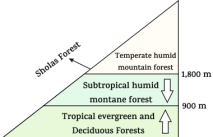
- The temperate moist mountain forests found on the Nilgiri, Annamalai and Palani hills are called ‘Sholas forests’. These forests are also found in the Satpura and Maikal ranges
- The trees found in these forests include Magnolia, Laurel, Cinchona, Wattle, Eucalyptus, Elm, etc.
B. Natural Vegetation of Himalayas
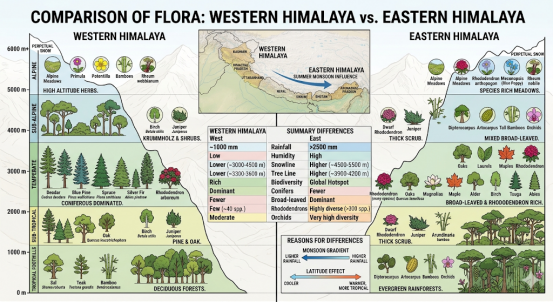
- In the mountainous regions of the Himalayas, up to a height of about 900 meters above sea level, the amount of rainfall rather than temperature determines the development of natural vegetation. Hence, up to a height of 900 meters, the amount of rainfall decreases as we move from Eastern Himalayas to Western Himalayas, due to which tropical vegetation has developed from evergreen forests to cattleya forests and savanna forests respectively.
- Between the heights of 1,000 and 2,000 meters, tall and dense forests of humid temperate type are found. These are mainly found in the form of strips of forests that create a conical shaped deep green landscape. Evergreen oak and chestnut trees are mainly found here.
- Pine forests are found in a well-developed form at an altitude of 1,500 to 1,750 meters and are economically important. • Dry temperate forests are found at an altitude of 2,000 meters to 3,000 meters. The main trees in these forests are deodar, birch, pine, silver fir, spruce etc.
- ‘Liquorice’ is obtained from pine tree, from which ‘turpentine oil’ is made. It is used in making soap, paint and in paper industry.
- Transition of alpine forests and pasture lands is found at an altitude of more than 3,000 meters. Trees like silver fir, juniper, pine, birch and rhododendron are found at an altitude of 3,000 to 4,000 meters. Seasonal migratory communities, such as Gujjar, Bakarwal, Gaddi and Bhutia make full use of these pastures.
- Due to the low latitude geographical location of the Eastern Himalayas as compared to the Western Himalayas and its proximity to the equator and the sea, not only the average temperature is higher but also the rainfall is more. This is the reason that the density of natural vegetation, biomass and biodiversity is higher in the Eastern Himalayas as compared to the Western Himalayas.
- Due to the higher average temperature of the Eastern Himalayas as compared to the Western Himalayas, all types of natural vegetation have expanded to higher heights. For example, in the Western Himalayas, coniferous and tundra vegetation is found at lower heights and in the mountainous regions above 4,000 meters, tundra vegetation cannot develop due to extremely low temperatures, whereas in the mountainous regions of the Eastern Himalayas, tundra vegetation has developed at an altitude of more than 4,000 meters.
Grassland Vegetation
- The grasslands of India (Savannah vegetation) are different from the ‘Savannah vegetation’ of the world, because here the small trees or grass that grow after the trees of the thorny vegetation region are cut are called ‘Savannah vegetation’ or ‘Grassland vegetation region’.
- The grasslands of India are also found in the form of rural pastures, in the low pastures spread in the western dry areas of the country and in the Himalayan ranges (Alpine region), which are known as ‘Marg’ in Jammu and Kashmir and ‘Bugyal’ in the Garhwal region of Uttarakhand.
- Apart from this, grasslands are also found in the evergreen forests of Tamil Nadu and Nilgiri Mountains of South India.
Wetland
- Wetlands are those land areas which have the characteristics of both moist and dry environments. The land in these areas is covered by a shallow water surface.
- Wetlands are a complex ecosystem which includes a wide range of inland, coastal and marine habitats.
- According to the Ramsar Convention, wetland areas include marshy marshy areas which can be artificial or natural, permanent or temporary and in which water can be stagnant or flowing. It also includes such marine areas whose depth is not more than 6 meters (at low tide).
- Thus, on the basis of the definition given in the Ramsar Convention, mangroves, coral reefs, estuaries, creeks, bays, ponds, swamps and lakes etc. are included.