
- Soil is a valuable natural resource. The word soil is derived from the Latin word solum, which means floor. Soil is made up of many types of minerals, remains of plants and animals. The thin layer of unorganized granular particles covering the upper layer of the earth’s surface is called soil. Naturally available soil is influenced by many factors, such as parent material, surface condition, natural vegetation, climate, time etc.
- Vegetation determines the amount of humus (organic matter) in the soil. Humus maintains the fertility of the soil. The process of soil formation is called pedogenesis. Soilogenesis is a complex and continuous process.
Soil Profile
- The collective arrangement of vertical layers (cuts) of different layers of the soil is called soil profile.
- The soil profile is made up of several soil layers and each layer differs from the other in its physical and chemical composition, organic matter and soil structure :-
| Level-O | Abundance of humus, organic material at ground level. |
| Level-A | Top soil. Usually black in colour and rich in organic matter. This layer is also called the leaching zone. Minerals and organic matter are found together. Most of the roots of plants are found in this. |
| Level-B | Underground soil, clay and silt.This layer is also called the water storage area and this layer collects all the leached minerals from the layer above it.This layer is made up of soluble minerals, such as calcilite.Thus, iron, aluminum and other organic compounds are collected in it. |
| Level-C | Weathered poor rocks.These rocks lie beneath the soil profile. |
Soil in India
- Soil is a mixture of rock debris and organic material that forms on the earth’s surface. Pedogenesis- is the natural process of soil formation which includes various processes like weathering, leaching, calcification etc.
- Components of soil are- mineral particles, humus, water and air.
Factors affecting soil formation
- Topography, parent material, climate, vegetation and other life forms, time, human activities
- The actual amount of each of these depends on the type of soil.
Classification of Soils in India
- In ancient times, soils used to be classified into two main groups – Urvara and Usara, which were fertile and sterile respectively.
- Based on texture, main soil types were identified as sandy, clayey, silty and loamy, etc.
- On the basis of colour, they were red, yellow, black, etc.
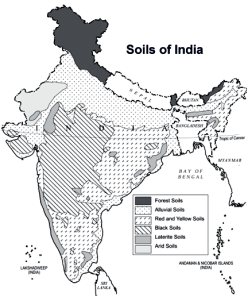
- On the basis of genesis, colour, composition and location, the soils of India have been classified into:
| Alluvial Soil | Properties:Alluvial soil is found in vast areas of northern plains and river valleys.Covers about 40% of the total area of the country.Alluvial soil is different in nature from sandy and loamy.In the upper and middle Ganga plain, two different types of alluvial soils viz. Khadar and Bhangar have developed.In the lower and middle Ganga plain and Brahmaputra valley, these soils are more loamy and clayey.The amount of sand in them decreases from west to east.The colour of alluvial soils ranges from light grey to ash grey.Intensive agriculture is done on alluvial soils Minerals :- These contain high amount of potash and low amount of phosphorus. Area :- Widespread in the northern plains and river valleys, in the peninsular region, in the east coast deltas and in small parts of Rajasthan and Gujarat. |
| Black Soil | Properties:Black soil is very dark, also known as Regur soil or black soil.Generally clayey, deep and impermeable.They swell and become sticky when wet and shrink when dry.Soil colour ranges from dark black to grey. Minerals :- Rich in lime, iron, magnesia, alumina and potash but poor in phosphorus, nitrogen and organic matter. Area :- Most of the Deccan Plateau which includes Maharashtra, Madhya Pradesh, Gujarat, Andhra Pradesh and parts of Tamil Nadu |
| Red and Yellow Clay soil | Properties:It develops a red colour due to the widespread presence of iron in crystalline and metamorphic rocks and appears yellow when it is in hydrated form.Fine grained red soils are generally fertile, while coarse grained soils found in dry upland areas have low fertility. Minerals :- They generally have very low amounts of nitrogen, phosphorus and humus. Area :- Areas with low rainfall in the eastern and southern parts of the Deccan Plateau, Western Ghats, Odisha and Chhattisgarh and southern parts of the middle Ganga plain |
| Laterite Soil | Properties:Develops in areas with high temperature and high rainfall and is the result of intense leaching due to tropical rainfall.Humus content of the soil is rapidly removed by bacteria that thrive well in high temperatures.Suitable for tree crops like cashews. Minerals :- Rich in iron oxide and aluminium compounds and deficient in organic matter, nitrogen, phosphate and calcium. Area :- Laterite soil is commonly found in Karnataka, Kerala, Tamil Nadu, Madhya Pradesh and hilly areas of Odisha and Assam. |
| Dry Soil(Arid soil) | Properties:The colour of dry soils ranges from red to brown.They are generally sandy in structure and saline in nature.The amount of salt in the soil of some areas is so high that salt is obtained by evaporating their water.In the lower strata, layers of pebbles are found due to the increase in the amount of lime. Due to the formation of layers of stones and pebbles at the bottom of the soil, the infiltration of water is limited. Therefore, when irrigation is done, moisture is not available in these soils for the growth of plants. Humus and organic matter are found in less quantity in these soils. Minerals :- These soils have low fertility and low humus and organic matter content. Nitrogen is inadequate and phosphate is normal. Area :- Especially developed in western Rajasthan, making the topography dry. |
| Saline Soil | Properties:These are also called barren soils.These are infertile and no vegetation of any kind grows in them.Their structure ranges from sandy to loamy. Minerals :- Saline soils contain a high proportion of sodium, potassium and magnesium but are deficient in nitrogen and calcium. Region :- More widespread in western Gujarat, deltas of the east coast and the Sundarbans areas of West Bengal, Rann of Kutch. |
| Peaty Soils | Properties:Found in the areas of heavy rainfall and high humidity, where there is a good growth of vegetation.Organic matter in these soils may go even up to 40-50 per cent.These soils are normally heavy and black in colour. At many places, they are alkaline also. Minerals :- Large quantities of dead organic matter accumulates in these areas, and this gives a rich humus and organic content to the soil. Areas :- It occurs widely in the northern part of Bihar, southern part of Uttaranchal and the coastal areas of West Bengal, Orissa and Tamil Nadu. |
| Forest Soils | properties:Formed in the forest areas where sufficient rainfall is available.Vary in structure and texture depending on the mountain environment where they are formed.They are loamy and silty on valley sides and coarse-grained in the upper slopes.In the snow-bound areas of the Himalayas, they experience denudation, and are acidic with low humus content.They are especially suitable for plantations of tea, coffee, spices and tropical fruits. Minerals :- Rich in humus but are deficient in potash, phosphorus and lime. Areas :- Himalayan region, Western and Eastern Ghats as well as in some parts of the Peninsular plateau. |
| Soil nutrients and their functions in plants | |
| Element | Work |
| Phosphorus (P) | Root development, energy storage, early fruit ripening |
| Nitrogen (N) | Growth and protein production |
| Potassium (K) | Increasing disease resistance, proper water absorption |
| Calcium (Ca) | Cell structure and division |
| Sulphur (S) | Helpful in protein and oil formation |
| Magnesium (Mg) | Helps in iron absorption in the plant, main element of chlorophyll |
| Iron (Fe) | Respiration and chlorophyll production |
| Molybdenum(Mo) | Nitrogen fixation in pulses |
| Cobalt (Co) | Nitrogen fixation, formation of vitamin B12 |
| Sodium (Na) | Increases drought resistance, helps in opening of stomata |
| Zinc (Zn) | Enzyme activity and protein synthesis |
Stages of Soil Erosion
- The removal of topsoil cover by exogenic agents like running water, winds etc. is referred to as soil erosion.
- Wind and water are powerful agents of soil erosion because of their ability to remove soil and transport it. Wind erosion is significant in arid and semi-arid regions.
- In regions with heavy rainfall and steep slopes, erosion by running water is more significant.
- Human activities too are responsible for soil erosion to a great extent.
- Types of Erosion :-
| Splash Erosion | First stage of erosion process. Occurs when raindrops hit bare soil. |
| Sheet Erosion | Uniform movement of a thin layer of soil across an expanse of land devoid of vegetative cover. |
| Rill Erosion | When sheet flows begin to concentrate on the land surface. Rill erosion leaves visible scouring on the landscape. |
| Gully Erosion | Rill erosion evolves into gully erosion. Gullies resemble large ditches or small valleys, but are metres to tens of metres in depth and width. |
Soil Conservation
- Soil conservation is a methodology to maintain soil fertility, prevent soil erosion and exhaustion, and improve the degraded condition of the soil.
- Over-grazing and shifting cultivation must be checked by educating villagers about the consequences.
- Contour bunding Contour terracing, regulated forestry, controlled grazing, cover cropping, mixed farming and crop rotation are some of the remedial measures which are often adopted to reduce soil erosion.
- In arid and semi-arid areas, efforts should be made to protect cultivable lands from encroachment by sand dunes through developing shelterbelts of trees and agroforestry.